
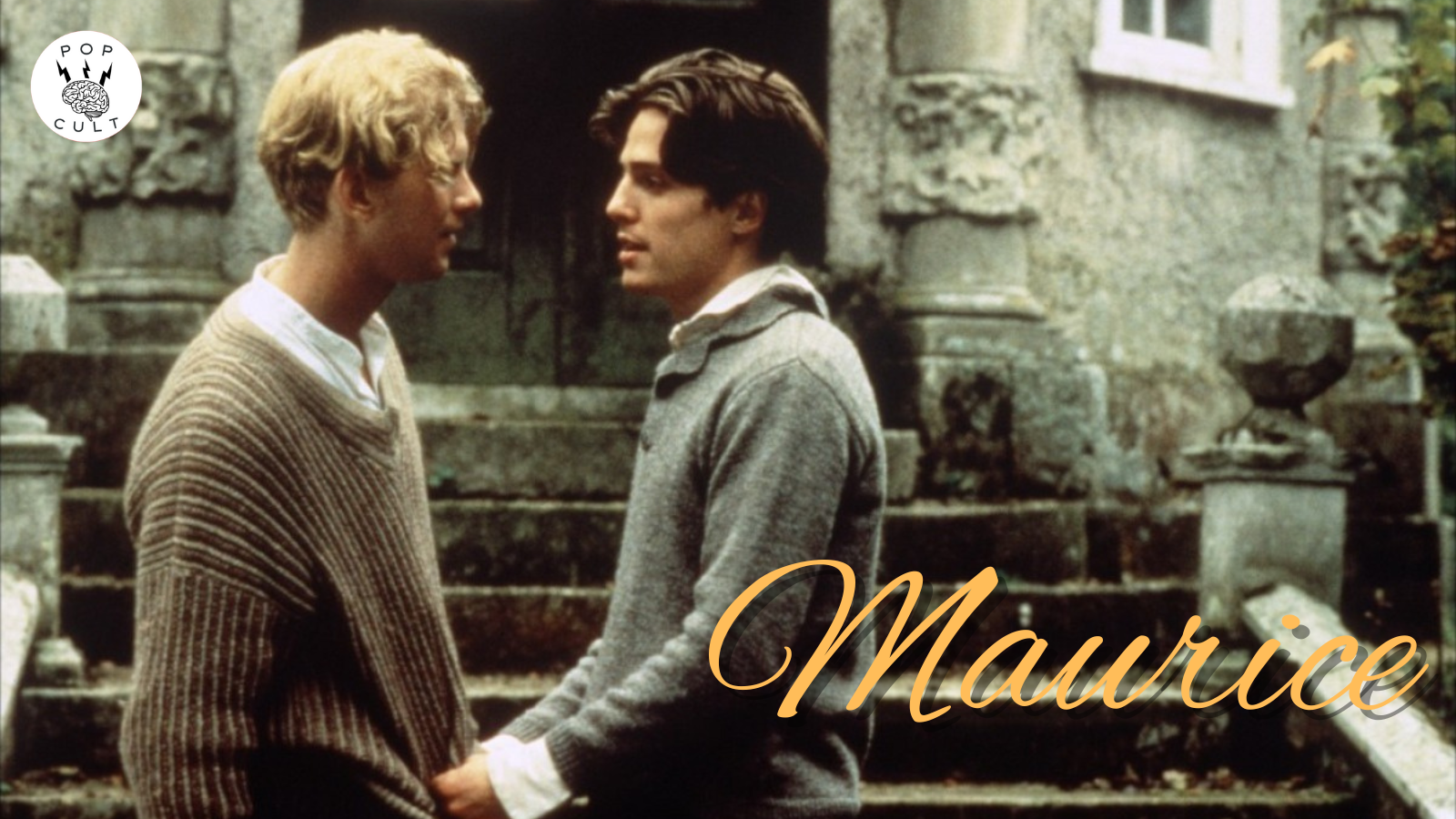
Maurice (1987)
Written by Kit Hesketh-Harvey and James Ivory
Directed by James Ivory
The English boys’ boarding school culture has long been an environment where homosexuality has been experimented with. It makes sense adolescent young men feel a surge of hormones and spend lots of time building intense friendships with each other. While not as prominent in the United States, we can look at the arena of high school sports as a similar venue. I’m never surprised when I learn a player on a football team develops feelings for a teammate. However, as much as these conditions are fertile for young men to come out as homosexual, they are more often than not met with toxic masculine brutality if they do. It’s one of the frustrating contradictions at the heart of male bonding in the West. Male camaraderie is supposed to be one of the most important things, yet it must never be romantic.
Set during the Edwardian period, this Merchant/Ivory film follows Maurice (James Wilby) as he attends Cambridge and becomes close friends with Viscount Risley (Mark Tandy) and Clive Durham (Hugh Grant). When they have a private moment, Clive confesses he’s in love with Maurice, who is surprised but doesn’t push against it. They have a passionate love affair, hiding it from the other young men they attend school with. Clive is upper-class, while Maurice is a working-class orphan, which creates friction between them. Clive insists they keep their relationship discreet and doesn’t allow them to have sex. He’s very concerned with his future opportunities and knows being openly gay would end all of them. Their mutual friend Risley gets arrested for soliciting sex from a soldier, which leads Clive to break things off with Maurice.
Maurice is heartbroken and seeks help from medical professionals to “cure” his homosexuality. He reunites with Clive but finds his former lover is now married to a woman and won’t acknowledge their romantic past together. During these visits, Maurice befriends Alec (Rupert Graves), the gamekeeper on Clive’s estate, and they are immediately attracted to each other. The two men begin taking greater chances to get together, drawing the attention of Clive’s butler, an extreme homophobe. As one new romance blooms, not without its fair share of challenges, Clive begins to reminisce about his past and sadly realizes he will never feel safe being open about who he really is.
Maurice is my least favorite of the queer films I’ve watched so far in this series. It’s not poorly written or directed; it’s just an extremely cold movie. I suppose that makes sense due to the period the story takes place, with homosexuality being something a person had to tread carefully about. It’s also a formalism present in many Merchant-Ivory films, very staid with the passion always brimming over rather than being explicit. This isn’t a story where the leads get a happy ending. Maurice certainly finds peace with himself and someone to love, while Clive isn’t suicidal but extremely melancholy that he will never have the love he did when he was in Cambridge.
As for the acting, I didn’t find James Trilby to be anything incredible. He’s a good actor but doesn’t have the charisma I would have liked especially being in the central role. Your attention will be brought back when Hugh Grant shows up. Early in his career, you can already feel the magnetism he brings to the screen. His boyish looks are perfect for Clive, and you quickly understand why Maurice would be attracted to him. Grant can also play the conflict in Clive when he’s married & established with a lot of believability. But more is needed to make the film compelling.
Some familiar British players are in crucial supporting roles, Denholm Elliott (The Indiana Jones films) and Simon Callow (Four Weddings and a Funeral). They do a good job, and Callow, in particular, provides much-needed humor to the film. Yet, once again, the story’s pacing is so clunky and plodding that it’s hard to feel emotionally invested in the picture.
I did enjoy how the natural world was used in the film. Maurice’s two loves are linked to being in nature, which makes the statement that his love is genuine. He and Clive find a quiet field in the countryside where they can be alone. Alec is responsible for the wildlife on Clive’s estate, making him an avatar of nature thematically. Despite my personal feelings that Maurice is too long and slow of a movie, I still think it does an excellent job of unashamedly presenting queer love on screen. It’s not near as good as the James Ivory-penned Call Me By Your Name, but that may have more to do with Luca Guadagnino being in the director’s chair and his passion for his projects.

 PopCult Reviews
I like the film better than you. Maurice isn’t an “orphan.” We see a lot of family scenes throughout the film. At one point, Clive seems drawn to Ada, Maurice’s sister, because she reminds him of Maurice. Maurice’s family is wealthy tradespeople but they have no title.