
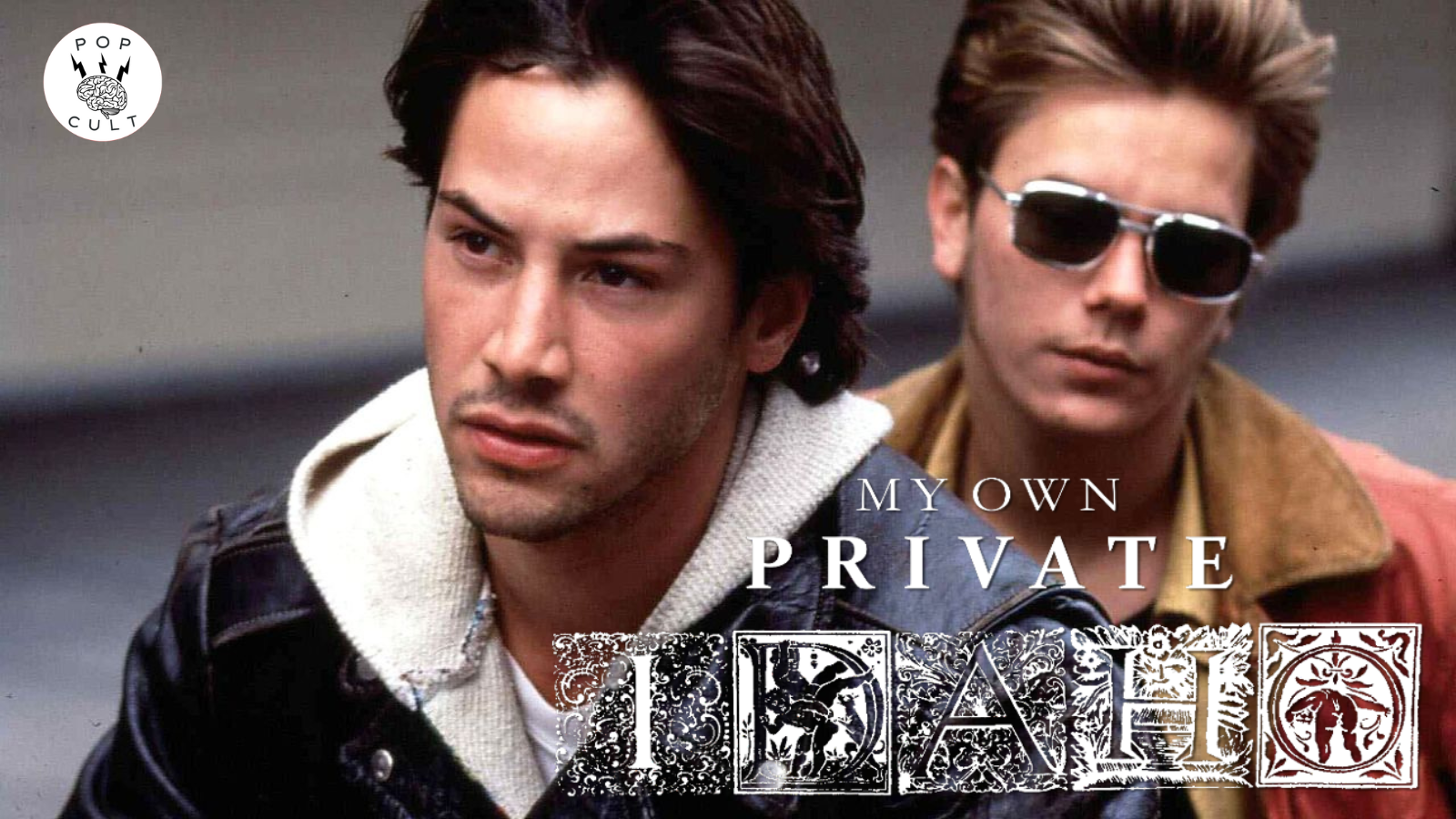
My Own Private Idaho (1991)
Written & Directed by Gus Van Sant
A person’s inner life can be such a vast, complex landscape. The way we process experiences & emotions may have some universality, but ultimately, the way you feel inside going through these things is something no one else can ever truly know. For the character of Mikey in My Own Private Idaho, almost his whole life is made up of this intimate inner world due to his chronic narcolepsy. He can never quite get anywhere or finish a conversation before passing out. Gus Van Sant tells his story from this character’s perspective, which means the audience sees the narrative in fragments. We’re in one place, then another, only to return to where we started. Did we really go anywhere at all? Or was this just the lovely dream of a lonely person with a very uncertain future ahead of them? Maybe it’s all these things. Perhaps the dream world is just as real as the tangible one for someone like Mikey.
Mikey (River Phoenix) is a street hustler on a stretch of deserted highway in Idaho. Mikey remarks that the road looks like “someone’s face, like a fucked-up face.” He experiences one of his narcoleptic episodes and passes out. Images of his mother comforting him flash in his mind and other fragments of his childhood flicker past. When he wakes up, Mikey is in Seattle. Is this the future or the past? Even Mikey doesn’t seem to know or care; this is how he experiences life. He’s picked up by a wealthy older woman (Grace Zabriskie) and brought to her mansion, where he finds his best friend, Scott Favor (Keanu Reeves), is one of three male sex workers she’s picked up for the evening. He has another bout of narcolepsy, and when he wakes up, Mikey is in Portland with Scott.
We’re introduced to Bob Pigeon (William Richert), a middle-aged mentor figure to a group of street hustlers who squat in an abandoned tenement. Scott admires Bob and remarks that he feels he’s more of a father to him than his own father. Scott also reveals he’s the son of the mayor of Portland, and when he turns 21 on his next birthday, he will inherit his father’s fortune and leave the sex work profession. Mikey can’t stop thinking about his own estranged mother. He has no idea where she is, but he keeps having these visions of her holding him as he sleeps, assuring him that everything will be alright. Scott decides to help Mikey find her, and they set off on a journey across the world.
The pair end up in Idaho, where Mikey grew up. By the light of a campfire on the roadside one night, Mikey carefully declares his love for Scott and how this man has his heart entirely. Scott reminds his friend that he only has sex with men for money and doesn’t believe he could truly love another man. However, he does sleep spooned with Mikey to comfort his friend. They find Mikey’s older brother Richard (James Russo), and the two siblings have a heart-to-heart where some very traumatic things about their childhood come out. There’s a lot of pain shared between these two men in that living room, which needs to be said. Richard says he thinks their mother is in Italy; at least, that’s the last he heard.
After prostituting to a wealthy old man (Udo Kier), the men head to Italy. They eventually come to a farmhouse in the country where Mikey’s mom reportedly lived and taught English to the children. Scott meets Carmela, a young woman who lives there who says Mikey’s mother left for the States months ago. Carmela and Scott fall in love with Mikey, forced to be the third wheel, smoking his way through the heartbreak and giving looks of scorn to the couple over the dinner table. The new couple returns to the U.S., leaving Mikey to make his own return trip.
Back in Portland, Scott’s father dies. Scott becomes unrecognizable, abandoning the street life, getting around town in limousines, wearing nice suits, and being protected by bodyguards. He even marries Carmela. Bob Pigeon and the other street hustlers, including Mikey, confront Scott at a fancy restaurant. They are shocked at how aggressively Scott rejects them, and Bob dies from a heart attack that night. The funerals for both Bob and Scott’s father are held on the same day in the same cemetery. They are wildly different from each other. Mikey stares down Scott during the rituals, giving an ambiguous look, both a challenge and an invitation. Scott keeps a neutral face and watches from a distance.
Then we’re back on the stretch of road from the start. Another narcoleptic attack. While Mikey is lying on the ground in a contorted position, two strangers pull off the road and steal his backpack & shoes; they drive away. The camera floats up and away from Mikey, suspended in the air contemplating him from a distance as a version of the National Anthem plays. A moment later, another car pulls up. We’re too far away to see who it is. They lift up Mikey and put him in the backseat of their car. They drive away. The end.
We’re left with many questions and many things that will always be up to the viewer to interpret. Who picked up Mikey in the end? Were the bookends on the empty road Mikey’s present? Were the events of the film Mikey’s memories or dreams he was having in his narcoleptic sleep? Was Mikey’s mother even still alive? Why couldn’t Scott love Mikey as much as he loved Scott?
Director Gus Van Sant leaves all of this to us, but a somber reading of the film will be the most accurate from my perspective. Mikey continually has visions of salmon swimming against the stream when he has his episodes, and this image explains a lot about his character. Salmon do this to return to their spawning grounds, where they were born, to lay & fertilize eggs. Mikey isn’t interested in procreation but fixates on finding his mother. He dreams of her comforting him, protecting him as he struggles through life. Every change of scenery is about getting closer to her, yet he never even glimpses the woman outside his sleep.
Then we have Scott, the object of Mikey’s love, who clarifies early on that he will abandon the street life one day and become a rich asshole. Despite knowing this, Mikey still loves him because Scott acts for the most part in Mikey’s interests. He wants his friend to find his mom; he wants his friend to discover the peace that might soothe his heart. Yet, Scott creates dissonance in Mikey both in the pending and actualization of his leaving. But is Scott real? Or is he just another part of Mikey’s dream? Maybe life is so bad for Mikey that even in his dreams, he cannot find someone to love him forever. It hits hard to think about, but I genuinely believe Van Sant is pointing in that direction. This is a character study of a man whose life is a series of heartbreaks, for whom sex is a transaction focused on fulfilling other people’s desires. His hopes and dreams never seem to come together.
Mikey’s comment about the road before him looking like a “fucked up face” is a comment on himself. He’s pockmarked with acne, and his sideburns are unkempt. People who live like our protagonist don’t have the resources or time to make themselves “pretty.” Mikey is still a beautiful man; he just wears the pain of his life on that face. In interviews, Van Sant said Mikey was a very asexual character in his conception, and I think he remains that way on the screen. His attraction to Scott is not because Mikey wants sex with Scott, though I’m sure that’s part of it; he truly loves Scott in the way that we want to share our lives with certain people we meet. Mikey wants to see Scott every day and just be in his presence, that would be enough, and he can’t even have that in the end.
Van Sant even films the sex scenes like fragments in Mikey’s head. Posed freeze frames of bodies in various positions, of faces frozen in ecstasy. They feel erotic in only the most baseline way. He also plays with structure in ways that hint that most of what we see are Mikey’s dreams. There’s a brilliant sequence in a sex shop where the covers of gay pornographic magazines come to life, their models engaging in arguments & conversations with each other. This can’t be from anyone’s objective perspective, so it hints that the film is a fantasy, an escape that pulls Mikey back to Earth by the final scene. The rawest we ever see Mikey is during Bob Pigeon’s funeral when he finally lets loose, becoming a hooting reveler celebrating his dead friend’s life. I recalled Where the Wild Things Are when that scene played, another dream that feels so real about growing as a person.
That final scene, performed over “America the Beautiful,” has much going on. The use of that song and the film’s ongoing theme of the separation of the classes speak to myriad tensions that had bubbled to the surface in the 1980s. The wealth gap was more prominent than it had ever been. AIDS had created a schism in the open acceptance of homosexuality that had seemed promising in the 1970s. The aftermath of the Reagan era had left America’s soul hollowed out and was the soil from which our present troubles have grown. Does the person who picks him up intend to help Mikey or do him harm? We cannot know this, but I fear it’s the latter. People like Mikey don’t live in old age. The society they exist in makes sure of that.
River Phoenix’s childhood was similar to the rough street life of his character Mikey. The only difference was that River had a far larger family around him, with five siblings. Raised by hippies, River never attended a formal school or received a diploma. He had been taught to read and write and was interested in learning from those who knew him. To make money, he and his sister would play guitar and sing on the street and used their earnings to support the family. River was discovered by a talent agent while he and his siblings sang on a street corner in Westwood, California. After a few years of doing commercials, he booked a crucial role in the Joe Dante science fiction/adventure Explorers, but his breakout was Rob Reiner’s Stand By Me.
Two years after Stand By Me, River had purchased his family a ranch outside of Gainesville, giving the clan their first permanent home in over a decade. River had moved over forty times before he turned 18. In 1988, River won the Best Supporting Actor Academy Award for his work in Sidney Lumet’s Running on Empty. He would be in this film three years later, and his life would end two years after My Own Private Idaho’s release. The span from his breakout to his death was only seven years. Reportedly, River was binging on cocaine and heroin in the days leading up to his fatal overdose on a speedball at The Viper Room. He was only 23 years old.
My Own Private isn’t simply a showcase for River Phoenix’s magnetic acting talent or Gus Van Sant as a filmmaker; it is also Keanu Reeves’s best performance to date. You can keep The Matrix and John Wick; give me this Keanu any day of the week. He feels so comfortable with River (they were real-life friends), and the scenes between them reflect that. The sense of ease and love and friendship flows off the screen. You are entirely with Mikey in wanting Scott to love him back, and that wouldn’t work if you didn’t have these specific actors in the roles. They brought their love for each other to the screen and used it to create stunning performances.
I think My Own Private Idaho is one of the best pieces of art I have ever seen. I was emotionally moved in a way that never felt maudlin. The characters speak so naturally, but Van Sant has also infused the script with lofty bits inspired by Shakespeare. The film is a partial adaptation of Henry IV, and Henry V. Van Sant manages to fold in so many elements that, on paper, sound like they would create a muddled mess, yet everything works. At every turn, we are in the hands of artists who know when a moment should be grounded when it should be surreal, when it should be hilariously funny, and when it should be tender & heartfelt.
If anything, this is an emotional masterpiece, a character study of its time, yet it never feels dated in our modern context. After watching this film, I finally got people’s love for River Phoenix; we lost someone of immense depth in their craft. Gus Van Sant gave his all in this movie, and the work that came after has never quite matched this. They are not bad films, but he was spent after this one. If you have had this on your watch list for a while, please watch it as soon as possible. It is a reminder of how great movies can be when they are made with tenderness and love.

 PopCult Reviews
This is a beautifully written analysis of My Own Private Idaho. The author’s deep understanding of the film and its characters is clear, and their emotional investment in the story is palpable. Anyone with an interest in film, or simply human relationships, will find much to appreciate here.
founder of balance thy life https://balancethylife.com