
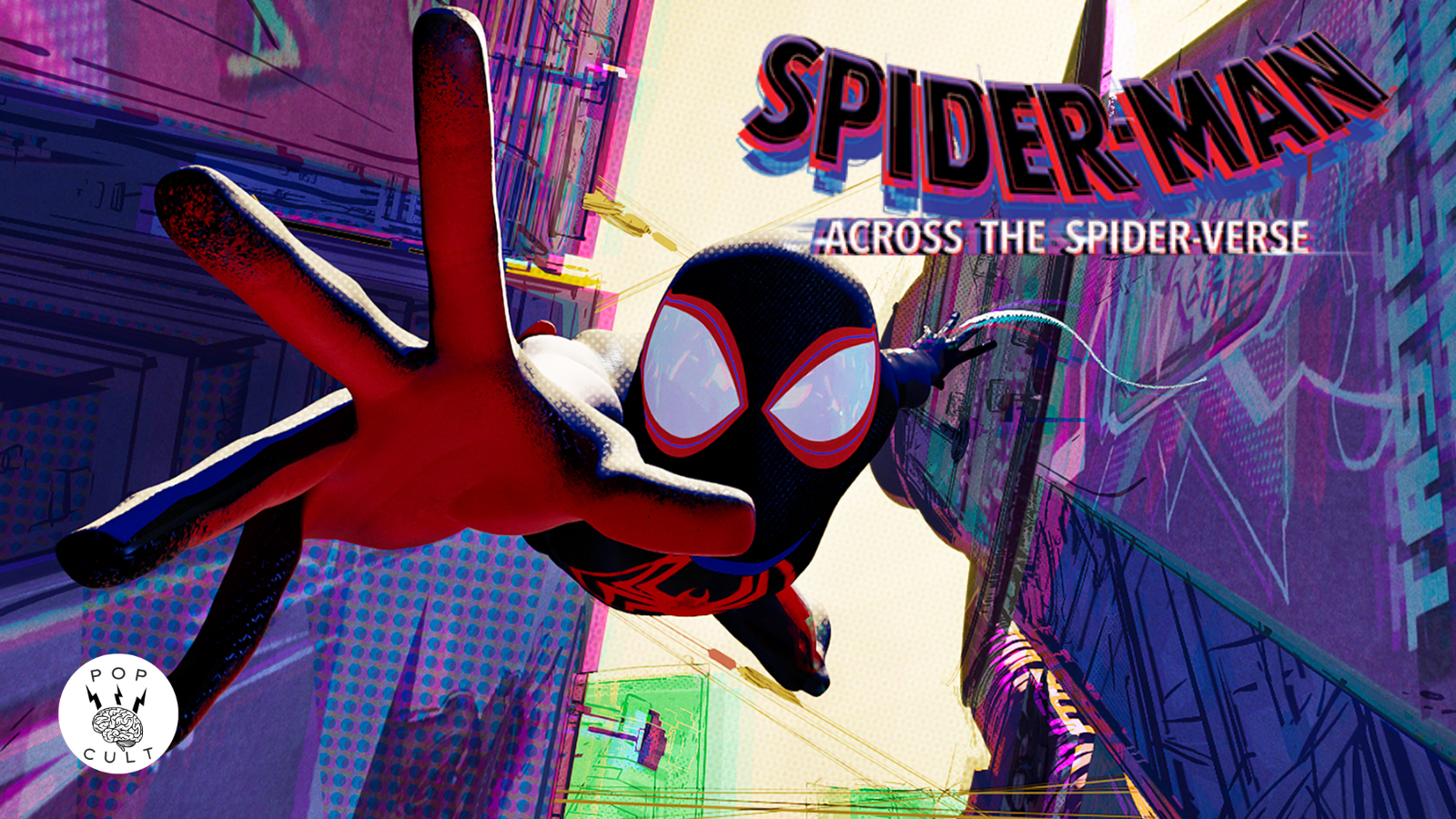
Spider-Man: Across the Spider-Verse (2023)
Written by Phil Lord, Christopher Miller, and Dave Callaham
Directed by Joaquim Dos Santos, Kemp Powers, and Justin K. Thompson
In January 2019, I was sitting at home on a weekday due to an unexpected week of snow. By the end of the week, the snow was melting, but there was still ice on the rural backroads, so we were still closed out of precaution. Buses wouldn’t handle these conditions well. I got a text from one of my sisters asking if I wanted to see this new animated Spider-Man movie with her and my nephew. I’d been aware of it but wasn’t chomping at the bit to go see it. However, getting to spend time with her and my nephew was something I always loved to do.
I liked the film, particularly how close it touched on the same tones that endeared movies like Sam Raimi’s Spider-Man or Richard Donner’s Superman to me. These are all movies that genuinely understand the core of the superhero in them. The style was also an extraordinary evolution of computer animation, giving personality to a form that produced a lot of lifeless-looking content. I can’t say I had the same feelings about this follow-up, Across the Spider-Verse.
This time, we begin with Gwen Stacy, the Spider-Woman of Earth-65. We get an overview of her origins and then find she’s clashing with a version of The Vulture from another reality. Miguel O’Hara, aka Spider-Man 2099, and Jessica Drew, aka Spider-Woman of another Earth, show up to help stop him. They reveal that the events of the first movie were only partially resolved. A hole was left open in the Multiverse, and people are getting scrambled between realities. Gwen is confronted by her father, Captain George Stacy, and reveals she’s Spider-Woman. She thinks he would be sympathetic but draws his gun on her trying to arrest her for crimes the authorities believe she’s committed. Gwen vanishes into the Multiverse, joining up with O’Hara and his Spider-Society.
Meanwhile, Miles Morales is trying to balance his personal life with his duties as Spider-Man. A new foe emerges in the form of The Spot, a scientist who was on the scene of the collider explosion in the last film. The Spot can create portals between spaces and discovers he can do the same with the Multiverse after clashing with Miles. Miles has failed to meet his parents’ expectations but doesn’t yet feel safe enough to reveal who he is to them. Gwen shows up to catch up with Miles, and they leave his reality to pursue The Spot. They meet many different Spider-people and eventually learn why O’Hara has such hostility towards Miles as one of them. Miles believes he can fix everything. However, the film ends on a shocking cliffhanger that puts our hero on the path of where his life could have led him if that spider hadn’t bitten him.
First off, this sequel is even more visually stunning. The group of artists responsible for Across the Spider-Verse does an incredible job representing so many different aesthetics, including a stop-motion Lego moment. I especially liked The Vulture, which was done in a Da Vinci sketch style. They managed to make Gwen’s reality have a different tone & texture than Miles’ without doing anything too wildly overboard. They used a robust style guide complete with color palettes to differentiate each universe from another. The Spot also has a unique aesthetic that makes him equally silly and creepy when the story needs him to be. This is a benchmark for future films in terms of animation technique and artistry.
However, I really did not enjoy the pacing of the plot. Going into this, I knew it would be part of a larger adventure, but wow, I expected some sort of resolution. I hoped the film would have a central plot that would be explored and resolved and that some subplot would blossom into a larger narrative to be addressed in the sequel. Nope. The movie ends without resolution for anyone, really. Gwen has a heart-to-heart with her dad, but that’s about it. Every plot thread is left dangling; we don’t see any growth. That doesn’t mean I see this as a failure, but they chose the wrong format to present this story.
When we finished, I looked at my wife and said, “That was a decent first half of a streaming series season,” she agreed. It felt like we had 4-5 episodes of a Disney+ series, a really high production value show, patched together to make a two-hour-plus runtime. It’s as if they took half of Loki or Star Wars: Andor and showed it on the big screen. It is technically not bad, but it does not deliver the experience of what a film should be. Even during the Golden Age of cinema, they knew serialized stories like this were fine; you just broke them into many smaller parts. I guess children have been conditioned to sit and stare at a screen this long by parents who don’t know how to interact with them and just hand them a tablet, but they shouldn’t be. Again, there is so much good stuff in this movie that I felt bad it was ruined by trying to do so much to the point that the film has no ending.
I could understand something like Dune, as it is based on a dense novel. Even then, I didn’t feel warm toward that movie because I was dissatisfied with the conclusion. I knew it would be continued, but everything felt like a set-up for something else that had yet to be made. With Across the Spider-Verse, they aren’t directly adapting any one story, so they had far more freedom to structure the movie. They chose to do lots of world-building and exposition but left us hanging in a manner that didn’t feel satisfying. Back to the Future Part II is an excellent example of a cliffhanger that excites you for the next film while still featuring a fully resolved plot. Even The Empire Strikes Back delivers a clearly communicated whole arc in Luke’s story while leaving the audience with questions.
This is not a film structure I am genuinely interested in engaging with. If you listen to the podcast, I regularly talk about 90 minutes being the default length of any movie. It must earn that with an exemplary plot if it wants to be longer. It used to be that movies had deleted scenes because they understood. There is an economy to storytelling that considers attention span, structures, archetypes, pacing, etc. You can play with aesthetics and deliver wild, experimental films but, especially with populist cinema, I don’t really like long, loud spectacles for the sake of it. I will get more into this later in the month when I write up my reviews of the Indiana Jones movies, but Kingdom of the Crystal Skull is a perfect example of a film that completely fumbles its storytelling economics. Across the Spider-Verse is nowhere close to that bad, but it feels irregular in shape, which doesn’t quite fit the medium it was presented in.
The Flash film is dropping in theaters this weekend, and I have zero interest in watching it for various reasons, including the fact it is over two and a half hours long. There used to be this adage of “leave them wanting more,” we’re now in an era of cineplex entertainment that has me asking if studios could please stop already. Even Beau is Afraid, made by a director I highly respect, was pushing my limits. I liked it because, even if it was incredibly long, at least it was something I’d never seen before. With superhero movies, I don’t need gargantuan runtimes; tell your story and stop. These are children’s movies, and having been a primary school teacher, I am very aware of attention spans. Thus, Across the Spider-Verse would have made an outstanding streaming series.
There’s a lot to enjoy about Across the Spider-Verse. As I said, you aren’t going to get a more visually bountiful animated film this year. Yet, I would have loved there to have been more cuts, really pare the picture down to a solid 90-100 minute piece that delivered a mix of character and action. Maximalist filmmaking dominates the American sphere of the film industry, and I believe that such hyper-stimulating fare is better in smaller doses than in mind-numbing all-day affairs.

 PopCult Reviews
One thought on “Movie Review – Spider-Man: Across the Spider-Verse”