
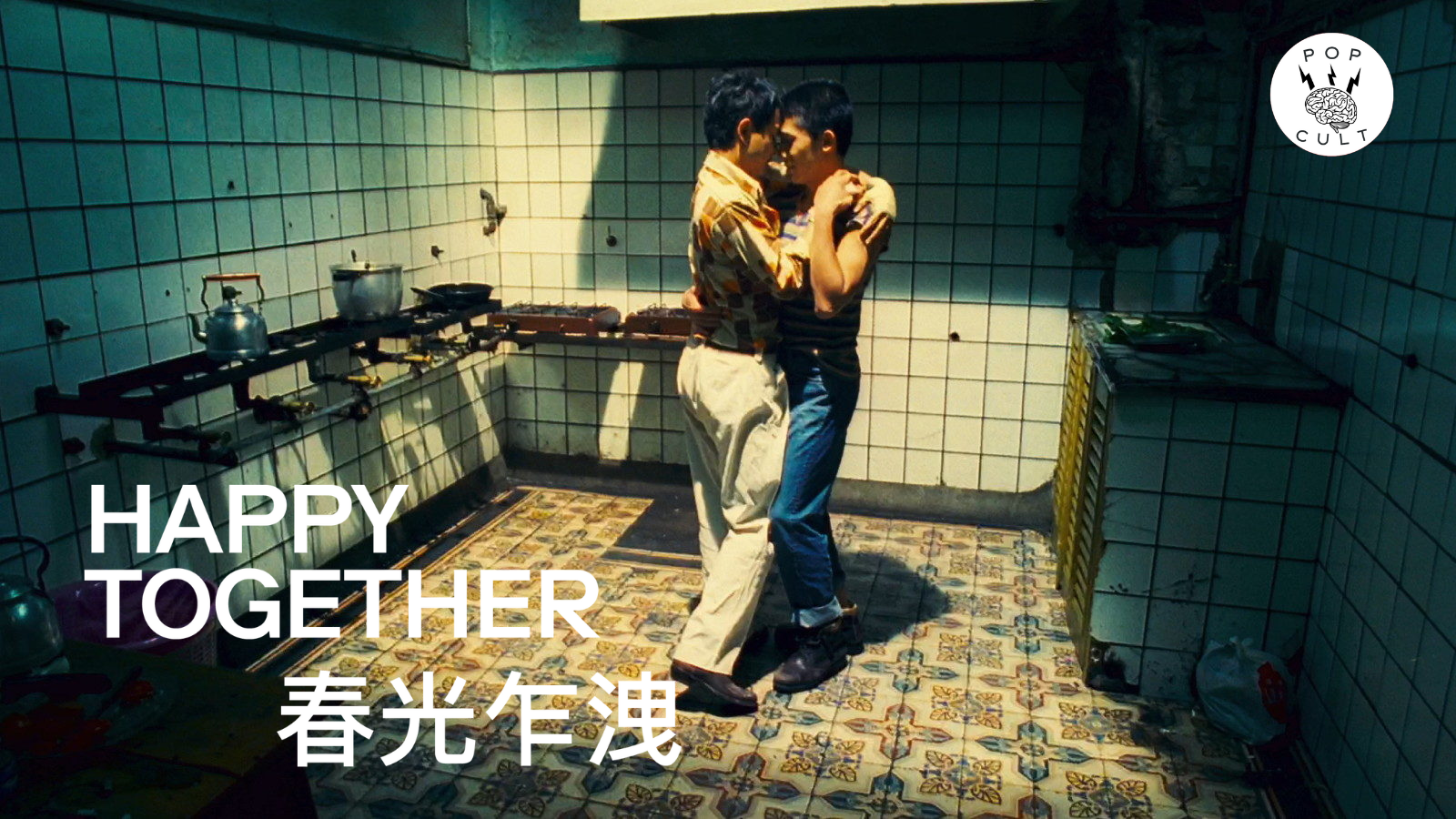
Happy Together (1997)
Written & Directed by Wong Kar-wai
Wong Kar-Wai has been named by Barry Jenkins (Moonlight, If Beale Street Could Talk) as one of his primary filmmaking influences. Both directors are less interested in intricately plotted narratives than powerfully atmospheric mood pieces. They like to focus their cameras on characters without any pressure for that character to grow or learn any lessons. It’s merely observing a person as they struggle with the challenges of their lives. Wong’s core theme in his work is longing, particularly how people long for each other or, in many cases, the idea of another person. Because this is ultimately a desire that cannot be satisfied, his characters often end up in some form of misery, haunted by what didn’t happen.
Ho Po-wing (Leslie Cheung) and Lai Yiu-Fai (Tony Leung) are a gay couple from Hong Kong whose relationship is dotted with tumultuous break-ups, followed by partial reconciliation & reunion. They find themselves in Argentina, another destination that could cure their dissatisfaction with life. While looking to visit the Iguazu Falls, they argue, break up, and go their separate ways for now. Fai works as a doorman at a tango bar in Buenos Aires, hoping to save enough money to return home and forget about this whole mess. Po-wing begins hooking up with a different man every night, living off them and acting aimlessly. It doesn’t help that Po frequents the bar where Fai works. One night, Po attempts to steal from one of these friendly gentlemen and is beaten bloody. Fai opens his claustrophobic apartment to his wounded friend but insists they are not getting back together.
Fai can’t help but want to protect Po, and when his assailant comes into the bar one night, Fai unleashes hell on the man resulting in his firing as a doorman. He gets a job in the kitchen of a Chinese restaurant, where he meets Chang (Chen Chang), a Chinese Taipei immigrant. Meanwhile, tension boils over between Fai and Po, with the latter accusing the former of stealing his passport. Their attempts to reconcile again have been marred by suspicion, and yes, Fai did steal the passport. Po leaves, angrily declaring it is over between the two of them. The lives of these three men begin to splinter. Chang has earned enough money to keep traveling the world and says goodbye to Fai, who seems to have had feelings for the man but never confessed to them. Fai has enough to return to Hong Kong but visits the Iguazu Falls one last time, the destination he and Po never reached all those months ago. Po arrives at the apartment, finding it empty, realizing his chance with Fai has passed.
Queer romance in the media is a highly complex thing. I’ve listened to and watched a lot of conversations where queer people have spoken about the common theme of punishment in the media about their relationships. Same-sex couples often suffer at the hands of homophobic societies, which makes life miserable. While these stories aren’t disconnected from the reality of being queer, they can compound into something depressing. The constant portrayal of endless strife makes the community appear as something it is not or that same-sex couples are more dysfunctional than straight ones. This is simply not the truth. Queer couples experience all the same things as straight couples in roughly the same ratios because they are HUMAN BEINGS. If it appears that queer people live more chaotic lives from your straight perspective, have you ever given the thought that it may be due more in part to the society that hates them than entirely on the back of the individual’s choices?
Happy Together is an excellent counterpoint to Andrew Haigh’s queer British romance, Weekend. Where that film shows the budding of a new romance, this one is about a relationship that has overstayed its welcome for far too long. Fai and Po feel like a couple that should have transitioned to just friends a long time ago, but they are so addicted to the habit of each other. Their relationship problems are not because they are gay but because Po is incredibly flaky, and Fai is too meek in standing up for himself. These are relationship problems experienced by many straight couples as well.
There is a rich intimacy between these two, especially when Po is recovering from his injuries. It gives Fai purpose to care for his partner, but as Po becomes healthier, speaking out more and doing things that rub Fai the wrong way, the problems reemerge. There is no harmony between these men, made even worse and more evident by being in a strange land. If they were somewhere with a language they understood better or had a larger community to rely on, maybe their problems wouldn’t be so bad. However, in Buenos Aires, they are all each other has, and it just isn’t going to work.
There’s a refrain from Fai that once upon a time, their relationship was good. He wants to recapture that feeling in the present. Yet, the more we get to know them both, the more this feels like an imagined memory by Fai. Perhaps he was content during a more amenable honeymoon phase, overlooking glaring problems that would glow like a neon sign years later. We all have been guilty of that, and one of two things happens: You break things off and move on, or you seek to work through the problem to preserve the relationship. Fai and Po do neither, so they end up running around in circles expecting something to change while not making any effort.
Wai’s camera captures all of these beautifully, especially the cramped nature of Fai’s apartment. There are moments of great beauty, most famously the two men dancing the tango in their tiny kitchen during a brief moment of shared bliss. Like a drug addiction, their relationship was once like this all the time in the early stages. Pure joy and love. But also like an addiction, something soured along the way, and they keep returning to get a hit only to find it makes them feel awful. Their sex scenes resemble a type of combat, attempting to achieve orgasm while fighting with the other.
If these two could achieve a fresh start, Fai imagines they could find happiness with each other. Being unable to escape Argentina doesn’t help and further compounds the sense of imprisonment they see in their relationship. Fai makes it worse by swiping Po’s passport, which makes the latter man reasonably enraged. No one wants to be held hostage, especially by the person who purports to love them. What makes matters worse is that I suspect both men know this about their relationship. You can see it on their faces, their disgust at what they have done to each other while simultaneously feigning that the love is still there.
They are terrified to end this because what lies before them is so unknown and frightening. I often peek in at what young single people are up to today, and I pity them. Starting and developing a healthy relationship in the West feels like navigating a field of landmines from my perspective. The ways relationships have become extensions of the ravenous hunger of capitalism doesn’t help, interactions between partners taking on the shape of transactions. I often see experiments with things like polyamory, a practice that isn’t bad but one that I believe exists at the “expert level” of relationships, going south and torpedoing a relationship that may have been something good.
What it reveals is a misunderstanding of the true nature of love. Love is not the constant hunt for self-pleasure, though love can feel that good. Love of any kind is an act of sacrifice. It is the acknowledgment that you see something in another that is worth sacrificing a part of yourself to build a union with them. It is not a feat for everyone and has a high chance of not going well. To love healthily involves a mindset that can balance the Self and the External. In Happy Together, we watch these two continually fail to find that balance. Gay or straight, it’s something we all wrestle with as we are all naturally inclined to seek an emotional union with other people. The world around us has begun to feel more alien to our natures, demanding things of us that our minds & bodies find friction with. We are dehumanized daily, so is it any wonder finding genuine love has become so complicated?
The Iguazu Falls becomes an ongoing motif in the picture, mainly through a kitschy lamp Fai keeps in his apartment depicting the body of water. Footage of the falls, stylized and desaturated, swallows up the screen at the beginning and end of the movie, a massive roaring void that simply never ceases. Po comments about how much he hates the lamp, and by the end of the film, when he returns to Fai’s empty apartment and discovers the light was left behind, he slumps down on the bed, staring into it, looking for something he will never find. The Falls was a place they once were desperately trying to get to, and in that journey, things went off the rails. Now, sitting in the devastation of what is left, Po still thinks of that distant place and imagines they will somehow make it there, despite the impossibility of it all. As the lyrics of the title song play, “I can’t see me lovin’ nobody but you for all my life.”

 PopCult Reviews
One thought on “Movie Review – Happy Together”