
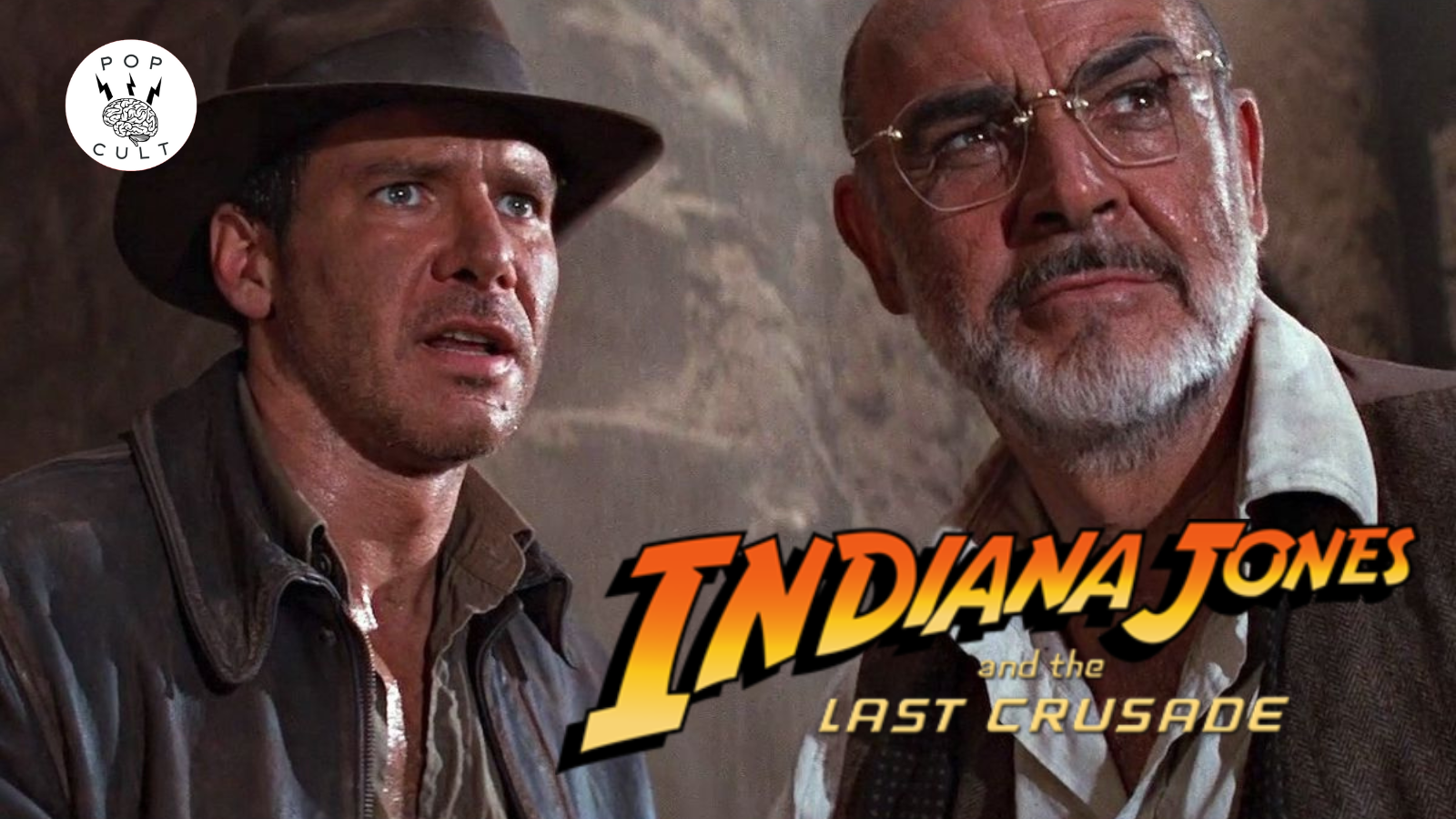
Indiana Jones and The Last Crusade (1989)
Written by Jeffrey Boam, George Lucas, and Menno Meyjes
Directed by Steven Spielberg
The idea had been to make three movies from the start. After Temple of Doom was less successful than Raiders of the Lost Ark critically, there was some hesitancy about continuing. Steven Spielberg hadn’t felt as committed as he would have liked on Temple, the subject matter didn’t interest him, and the material was far darker than he would have liked. However, the director believed they could correct the course and make something better. Eschewing directorial gigs on Big and Rain Man, Spielberg focused on developing the third Indy film into something special.
George Lucas initially threw out a “haunted house” premise, and a script was written, but Spielberg found it too similar to Poltergeist. The Holy Grail was brought up but sidelined in favor of Indiana Jones and the Monkey King, which was a strange-sounding film that would have gone from Scotland to Mozambique, where Indy would battle the mythical monkey king as well as a Japanese pirate with a bionic arm. This was rejected because, with hindsight from Temple, they realized how racist the African natives were being depicted. Also, the script was bonkers. Innerspace screenwriter Jeffrey Boam was brought in and reworked all the material thus far to make a script that resembled something close to the final product. More drafts would follow, and what started in 1985 finally wrapped up in 1988 with the movie we know as The Last Crusade.
In 1912, a young Indiana Jones (River Phoenix) encountered grave robbers that set him on a path to become the archaeologist he would be as an adult. We also see his complicated relationship with his father, Dr. Henry Jones, Sr. (Sean Connery), who is obsessed with the Holy Grail’s lore. Jump to 1938, where Indy learns his father has gone missing while working for Walter Donovan (Julian Glover) in searching for the Grail. With his colleague Marcus Brody (Denholm Elliott), Indy journeys to Venice, where Henry Sr was last seen. They are aided by Elsa Schneider (Alison Doody), the elder Jones’s Austrian assistant. Indy follows the notes in his father’s journal and discovers a map pointing to the resting place of the Grail. However, the Nazis are involved, and Henry Jones Sr. has been their prisoner this whole time. Father & son must team up, overcome their long-standing conflict, and save this artifact from the hands of those who would do evil with it.
The Last Crusade is my favorite Indiana Jones film, and I would argue it is the best in that the premise is at its most fully realized. These movies are comedies, after all, with action set pieces. The things I remember the most about the pictures are Indy failing and the humor that comes from those scenarios. We know he will ultimately win, but seeing that he makes mistakes or is the victim of circumstance ensures the films are entertaining. There will never be an Indy film where he walks away without scars, even when he stops the bad guys. Where Raiders was a very tightly written adventure film and Temple was a zany action comedy, The Last Crusade took the best of both movies resulting in a film that zooms by despite being over two hours long. The script never strands us in a location for too long, and we are always moving onto a new place and absorbing set pieces.
The chemistry between Ford and Connery deserves much praise as the glue that brings the movie together. While Connery remains off-screen for the first half or so of the picture, it is still an entertaining Indiana Jones movie. However, when they finally unite, the film becomes something more. I love the decision to immediately put them in a perilous situation the minute they are reunited. In this way, the writers can tell us much about their relationship through how the characters handle this obstacle. Henry Jones, Sr. is an academic and not used to the sort of life his son lives. When the father is expected to engage in the escape, he fumbles and makes mistakes that all of us would do under those circumstances.
Through the opening prologue, we understand where Indy gets his idea of an adventuring archaeologist from, and it is not his dad. Yet, Indy’s deep knowledge of history and myth is informed by his father’s dutiful studies. So this makes The Last Crusade a great final Indiana Jones film in that Indy’s arc is coming to understand what type of archaeologist he wishes to be. Spielberg is a master with the camera and lighting, so every film scene evokes the heightened pulp world these films were inspired by. The movie doesn’t lean on that and dives headfirst into character development in a way that the source material rarely did. The prologue resembles Norman Rockwell’s painting at specific points; how young Indy and his fellow scout are lit and framed feels like it was lifted out of Boys’ Life magazine. However, no one is painted in broad strokes other than maybe the Nazis, but fuck them. The Indy films have a formula, but it is one in which there is a lot of room for variation.
Look at the love interests: Marion Ravenwood is who you might expect, a Princess Leia type that can jump into the trenches with Indy. Willie Scott seems like a typical damsel in distress but has a lot more personality than that; your mileage may vary, though. Elsa is a femme fatale, entirely unlike the others. She’s Austrian, which slightly distances her from the Nazis but keeps her aligned. Elsa is in conflict, attempting to balance her allegiance to the Third Reich with her reverence for these artifacts. She’s the only Indy love interest who dies, which makes sense based on the character’s parameters. I also like that her role as Nazi complicates things for Indy in a way previous Nazi enemies had, not including the ones in this film.
For Indy’s arc, he experiences something profound that shapes him going forward. In Raiders, it is witnessing the Ark of the Covenant wiping out his Nazi captors. In Temple, it is choosing to help people instead of simply seeking riches. In The Last Crusade, Indy’s arc is about reckoning with his rejection of his father and understanding that his true inspiration for what he does is Henry, Sr., not some romanticized grave robber from his youth. Some critics at the time said they didn’t like the more mature storytelling here and felt it harmed the pulp adventure that made the first two films so beloved. I would disagree because I always favor film franchises trying to make each installment better than the next rather than simply “wash, rinse, repeat.”
Because of the arc Indiana Jones experiences in The Last Crusade, it was a perfect stopping point. Yet, anytime something is successful, Hollywood cannot help but spam the button like a lab chimp who has learned how to get treats. They showed some restraint, it would be nineteen years between installments, but scripts were being feverishly scratched out as the next movie was pondered. If you stopped watching these films with The Last Crusade, that would be a perfect endpoint. There’s no more story to tell. But they made another…and soon another that they promise is the finale. In our following review, we will look at Kingdom of the Crystal Skull and work to understand why this one doesn’t work as remotely well as the previous three.

 PopCult Reviews
One thought on “Movie Review – Indiana Jones and The Last Crusade”