
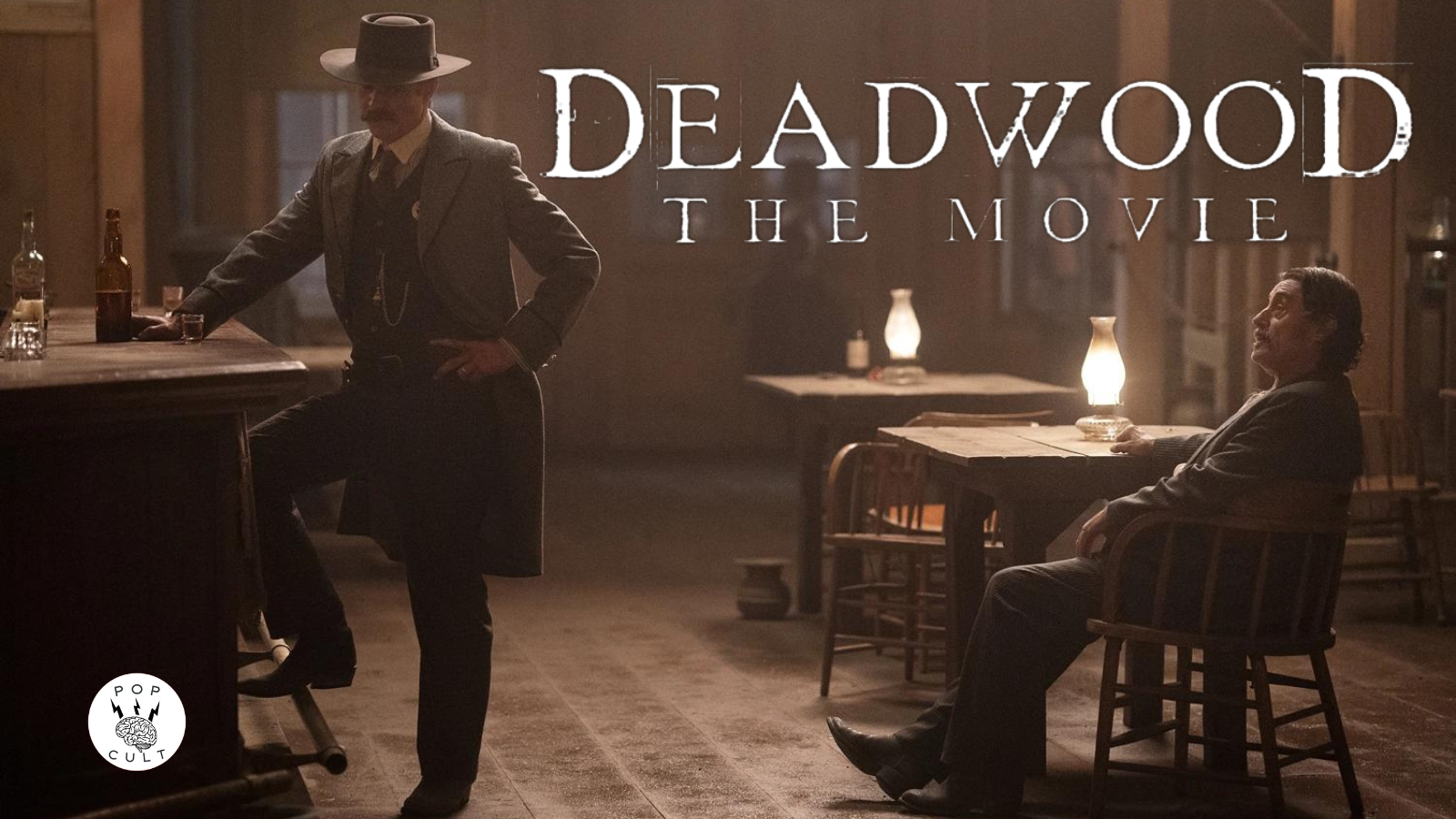
Deadwood: The Movie (2019)
Written by David Milch
Directed by Daniel Minahan
It wasn’t the ending we would have liked, but we never believed there would be an ending. That’s how I feel about Deadwood: The Movie. The original idea was to do a series of made-for-HBO films that brought a satisfying conclusion to the series. Money and life saw to that not happening. The film was made just in the nick of time, I suppose. Shortly before he began work on the movie’s script, series creator & showrunner David Milch was diagnosed with Alzheimer’s. He currently resides in an assisted-living facility as the disease has no cure and weakens a person’s ability to function daily. Milch’s gift to us as he undergoes this tragic transformation is a final glimpse at Deadwood and the characters we grew to love over three seasons. It’s a spotty, often messily structured film, but it is a way to say goodbye.
It has been a decade since Deadwood was folded into South Dakota. Celebrations are being had over this anniversary, and with them come some familiar faces who left years ago. Mrs. Ellsworth (Molly Parker) has taken the train with her ward Sofia. Calamity Jane (Robin Weigert), presumed dead from drunkenness by her old friends, has rode back into town to make amends with her former love Joanie Stubbs (Kim Dickens). Even the bastard George Hearst (Gerald McRaney), now a U.S. senator from California, has returned to lord over his earlier conquests. He is also intent on possessing Charlie Utter’s (Dayton Callie) land as it stands in the way of installing phone lines which Hearst has invested in.
Trixie (Paula Malcolmson) is married to Sol Star (John Hawkes) and is pregnant with their first child. She sees Hearst passing during his visit and comes out on the balcony, publicly decrying him as a murderer and scoundrel. The senator recognizes her as the woman who shot him after Ellsworth was assassinated and decides to use this as leverage. Hearst demands a meeting with the ailing Al Swearengen (Ian McShane). He wants Utter’s land, or he goes after imprisoning Trixie. Al cannot abide this and so reluctantly agrees to try and broker a deal.
Meanwhile, Al is no longer the spry bastard he once was, the pains he inflicted on his body over the years have finally caught up, and he is beginning to make amends with his pending death. Eventually, now U.S. marshall Seth Bullock (Timothy Olyphant) becomes involved in the Utter affair, eager to exact vengeance on Hearst for the past. His hot-headedness and Al’s calculation must find a balance again as they weather this last trial together.
I love how this film embraces the flow of time. Once, these characters stood tall and bold, and now, having aged, especially in an environment that wears you down hard, they are slouched, move a little slower, and have plenty of gray hair and wrinkles to show for it. The visuals are more cinematic than ever, with HBO clearly giving the production team a healthy budget.
The city of Deadwood is larger than we’ve ever seen it, with the train stopping here at a brand new station and Bullock & Star running an inn to compete with the now Hearst-owned Grand Central Hotel. The hotel is still managed by E.B. Farnum (Wiliam Sanderson), and he is still the mayor though all of it is surface-level and ceremonial. Farnum seems to have given into this fact of his life, that despite the titles he’s bestowed, he will always be a lackey. We get a short but wonderful Farnum monologue, his lamentations over the state of his life, and jealousy over those he believes do better than him. No Richardson, though, as that actor passed away four years prior.
David Milch knows a thing or two about an unexpected tragedy in life, how tragic things befall us no matter how hard we often try. Besides his medical condition, Milch ended up $17 million in debt to the IRS. His wife, Rita, was engaged in a series of lawsuits with his money managers, who kept the severity of his debts with loan sharks secret from her. Milch’s follow-up to Deadwood, 2006’s John from Cincinnati was a disastrous flop for the network. His third series, Luck, about horse racing, was canceled mid-season after so many horses became injured and had to be put down on the set. Despite the many setbacks in Milch’s life, the cast of Deadwood would eagerly proclaim when asked in interviews that they would love to revisit those characters and that world at least one more time.
Milch gave us a story about old people in their twilight. They aren’t elderly and infirm but can’t move at the speed they once did. Life is heavier now, and they bear its weight on their shoulders, shoulders that are not quite as strong as they once were. What he makes very clear is that these characters did not exit this world and that life was lived in the audience’s absence. Children have been and will be born. There are more streets than ever, and more visitors coming and going. The movie’s plot feels like a handful of episodes from a new season that won’t entirely be completed. That means while we get a scene of firm finality, while around the edges, things are left frayed. We won’t ever really know what life will be like for Trixie & Sol, Johnny, Dan, Wu, or any of them after this. The assumption will be that they keep on living until a moment when we hope & pray they pass peacefully, remembered by their families as people who worked hard and lived by a code, however flawed it may have been.
The final lesson we learn from Deadwood is that some things, no matter how hard we fight, are inevitable. The world changes, and often bad people grow in power. It doesn’t mean we should submit to that or stop fighting when we know what is happening is wrong. Al always taught Bullock that you have to pick your battles. The marshall is hot-headed to a fault, and even now, the father of three children wearing a gray mustache is a firebrand. Al has slowed down, each breath more precious than the one before, and he implores Bullock to do what is best for his family. Men like Hearst are trying to outrun death; one way or another, it will come to them regardless of what you or I do about it.
Milch’s intent from the start was to examine how people form structured societies out of what appears to be the chaos of life. Here in the final chapter of the story, Deadwood has become an ordered society. Yet death remains in all its forms. The telephone is coming, and with it, all sorts of headaches. But what can you do? Technology is not the problem; in the end, it is us. We don’t know how to have restraint; we pursue base pleasure rather than work towards something greater; it is the apes in us. But that could and likely will change one day with time and toil. The future will always be born, whether elegant or graceless, it will emerge, and we will learn to deal with it. Along the way, we respect & protect each other, and then we die, the world spinning on and taking no notice. But we were here. We lived.

 PopCult Reviews
3 thoughts on “TV Review – Deadwood: The Movie”