
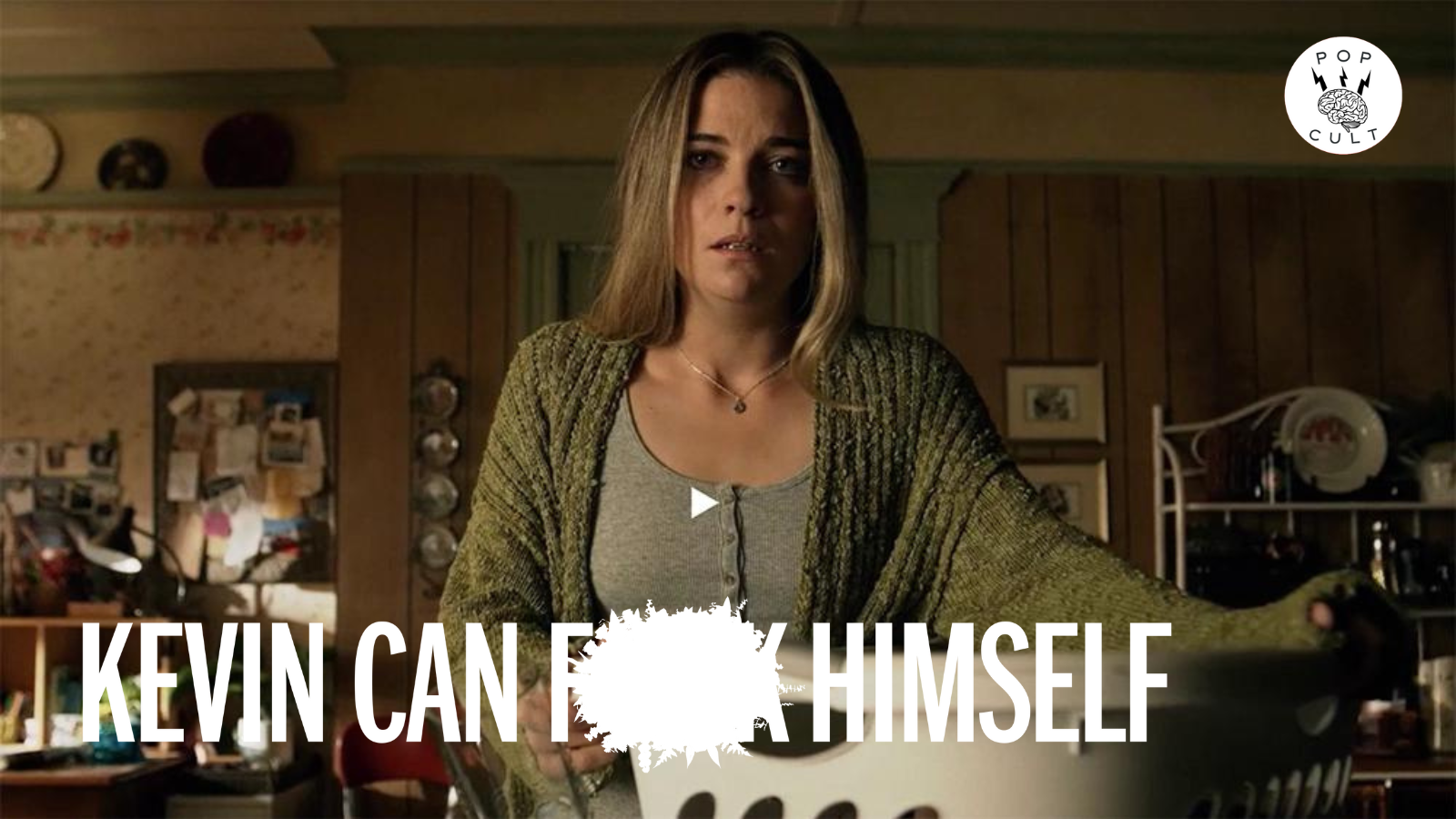
Kevin Can F**k Himself Season One (AMC)
Written by Valerie Armstrong, Dana Ledoux Miller, Kevin Etten, Craig DiGregorio, Noelle Valdivia, Mel Shimkovitz, Tom Scharpling, Sean Clements, Kate Loveless
Directed by Oz Rodriguez and Anna Dokoza
The television landscape has changed wildly in the last few years. When I was growing up, my television screen was filled with cheery families in sitcoms and silly high-concept procedural dramas, ala The A-Team and Knight Rider. Something shifted in the late 1990s with the arrival of The Sopranos, the idea that television could feature highly dysfunctional people in everyday settings doing terrible things. From there, this would grow into something like Breaking Bad, Weeds, Better Call Saul, and more. Yet sitcoms remained. Everybody Loves Raymond and King of Queens featured the trope of the schlubby idiot husband whose wife tolerates his mediocrity.
In 2016, CBS had a sitcom in its lineup titled Kevin Can Wait, an attempt to bolster the career of Kevin James, who’d already had success on King of Queens, which lasted for nine seasons. Kevin Can Wait was not much of a change, with James playing essentially the same character. At the end of season one, it was decided that Erinn Hayes, who played Kevin’s wife, would be written out of the show by having her die offscreen between seasons. This way, they could bring in Leah Remini, the actress who played Kevin’s wife on King of Queens, and provide some of the most base fan service a sitcom could.
Kevin Can F**k Himself is not meant as a direct parody but an attempt to explore gender roles in traditional American sitcoms. The structure of the series is one of the most unique I’ve ever seen, with multi-camera sitcom sequences when Kevin (Eric Petersen) is present but switching to a far more muted single-camera “cinematic” style framing when his put-upon wife Allison (Annie Murphy) leaves where he is at. Allison used to think Kevin’s buffoonish antics were charming, but fifteen years into their marriage, she has grown exhausted at his inability to take responsibility for his destructive actions and, even worse, that the world seems to reward his stupidity.
Kevin’s insensitivity towards Allison’s needs in their life is played for laughs in the “sitcom world,” outside of that, we can see she is becoming jaded and hateful towards him. Her marriage has left her unhappy, and the knife seems to dig in even deeper when Allison crosses paths with Sam (Raymond Lee), an old friend from high school. When Allison learns from their neighbor Patty (Mary Hollis Inboden) that Kevin has spent everything from their special savings and that her dreams of moving to a nicer neighborhood are gone, she decides she wants to kill her husband. But how? It has to be a way she won’t get suspected or caught.
I have to say the whole premise of this show is one of the most brilliant I think we’ve brought to television in years and is so ready to be dug into and explored. However, the final product leaves so much lacking, and I was pretty disappointed when we reached the end of the first season. The show moves back and forth between its two formats but never in a way that I found to be satisfying. I can see them taking their time to start playing and getting wild with it, but by the end of season one, barely anything about the two distinct visual styles and tones has been unpacked to an exciting degree. I will continue this one simply because there’s only one more season to watch. If the show was still going on or had further seasons, I probably would have dropped it with season one.
The show started out promising, really hammering in how suffocating it would be for someone like Allison to be trapped inside a world that is essentially Kevin’s playground. There is no scheme too stupid, no fuck-up too big that he can’t come back from without a single scratch on him. Consequences don’t exist for a schlub like Kevin. The cinematography is boldly stark, with slightly oversaturated and overlit sitcom sound stages complete with a canned laugh track. Then Allison steps outside, where the bleak, cloudy Massachusetts winter is a window into her soul. Life has become a dreary march toward oblivion. As I said, this is a fantastic story device that has the potential to tell incredible stories.
Yet early in season one, I sensed a lack of confidence in embracing the dual format. Every episode has a Kevin plot and an Allison plot, which always intersect unsatisfyingly. Kevin’s stories don’t have the devastating impact I think they should have on Allison’s world. What she is doing in plotting his murder never seems to have any sticking power until the season finale, and even then, it lands with a thud. The split is about 25% Kevin, 75% Allison and his stories feel like genuine sitcom episodes. I think a sense of creeping existential horror from how he just brushes off everything would have helped bring Allison’s growing hopelessness home. But even her story arc feels stifled with the edges shaved off.
Her grand scheme settles on spiking his food with opioids, and then the season derails as it goes deeper with the ideas surrounding opioid abuse. For a series whose concept promised to explore gender in American media, this was a hugely unsatisfying divergence. It might have worked if the minutiae of Allison trying to acquire the pills was engaging, but it feels tedious. Then when the big moment comes, it all deflates like a balloon, no payoff, and we’re back to square one. What should be a playfulness back and forth between television formats ends up emphasizing how badly they clash with one another.
There’s a shift around the halfway point of the season to spotlight Patty more and more. She is the little sister of Kevin’s best friend, Neil. We watch her go from the wisecracking side character to someone with a complex and challenging personal life. Patty goes through multiple relationship arcs, and this ends up making Allison’s plot to kill Kevin feel like spinning plates to kill time. In fact, I would argue actress Mary Hollis Inboden would be the one deserving of a Best Actress nom at the Emmys if the show were to ever get any. I don’t think Annie Murphy does a lousy job as Allison; it’s the writing that ultimately fails her and ends up giving Patty a far more interesting role. The most fleshed-out plot points and character beats happen to Patty, not the purported main character of the series.
Over and over again, the show reminds us how hard it is for Allison to break away from Kevin. I got the point four episodes in and wondered when the show would start playing with its format more. There comes a point where Allison and Patty are involved in such destructive actions that are entirely separate from Kevin’s antics that the show feels it has lost the plot. Kevin needs to be the show’s central villain, and it never once feels like he is. Allison ends up feeling like a variation on Kevin by the end, someone who keeps hurting other people without seeing any real consequences in her own life. That doesn’t feel like too great of a commentary on gender in television. Remove Kevin from the scenario; I feel like these characters would still be living bleak, unfulfilling lives. But that would mean making Kevin a true monster, and the show is too scared to go there.
There’s a brief moment in the season finale where Kevin may go through an arc that changes him. The actor is given material that clashes with the sitcom format and then…nothing. The episode ends on a cliffhanger fully intended to keep the existing audience hooked, and like I said, because there are only a handful of more episodes, I’ll stick with it to the end. I don’t know if I could recommend this show because I don’t feel the promise of the gimmick pays off in the execution. The promos could lead you to believe this is a wildly experimental show, and it really isn’t. I’m genuinely hoping that the second season sees loose ends resolved and we finally get a worthy clash of the formats in a way that illuminates the characters and ripples through the way we view sitcoms.

 PopCult Reviews
2 thoughts on “TV Review – Kevin Can F**k Himself”