

Mork Borg: Solitary Defilement (10d+5)
Written & Designed by…? (no specific names on the document)
You can get this set of solo rules here.
This playthrough also uses the Mork Borg Core Rules and the Feretory supplement.
OSR stands for the Old School Renaissance, which is a revival of a style of “classical” tabletop RPGs. This type of game is marked by four core ideas: 1) the GM is a referee of sorts and makes rulings and has the final say on the events in the game; 2) players have to be explicit in what they want their characters to do to avoid traps & hazards set up in advance by the GM, 3) characters are heroic but not invincible as death comes often, and 4) the events are not balanced, and players can wander into areas they are not prepared for. There is, of course, more unpacking of these ideas and additional concepts that come into play, but these are the base foundation of OSR. From my limited knowledge, OSR was a response to a period of more experimental story-centered games like Powered by the Apocalypse or changes made to stalwarts like Dungeons & Dragons that fans didn’t care for.
Mork Borg is put into the category of OSR, but even then, there is still much debate about how good of a game it is. Inspired by heavy metal music, Swedish designers Pelle Nilsson and Johan Nohr created what translates into English as “Dark Castle.” The mechanics are relatively simple, with players mostly rolling against Difficulty Ratings (DR) with the applicable ability in Tests. The character creation always results in underpowered characters, so the chance of becoming a smear on a dungeon wall is very high. That’s not anything really new to OSR games, but what Mork Borg did bring is an incredibly evocative graphic design aesthetic. I will share some images below so you get the gist.

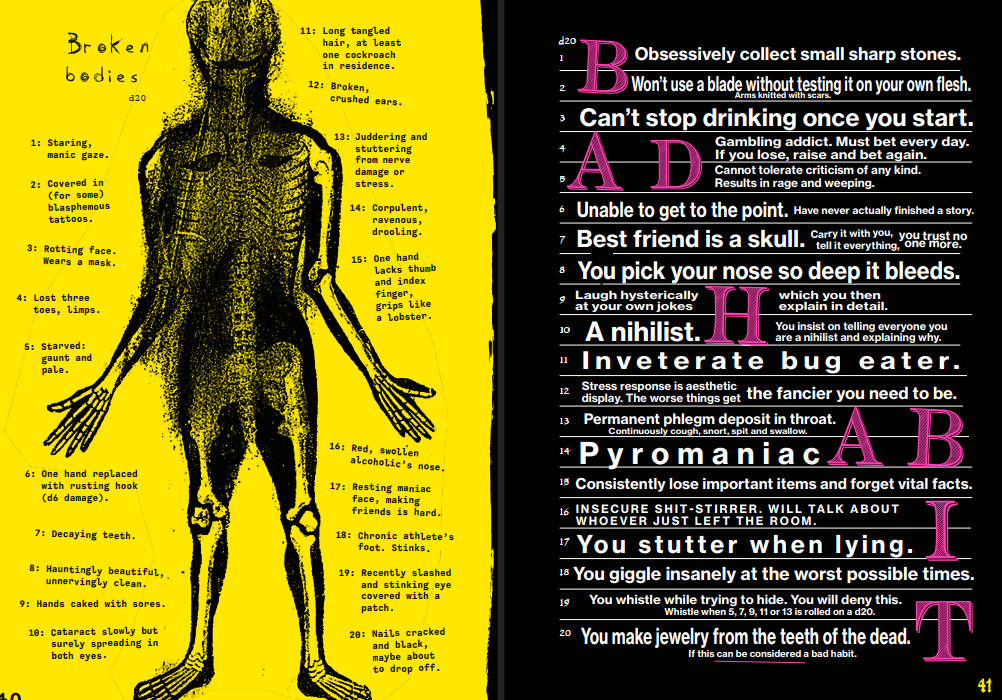
The tone of the book and subsequent supplements is one of a world sunk into bleakness and evil. The setting in the core book is called The Dying Lands, but the details are for you to figure out at the table beyond some elaborately illustrated and vaguely worded accompanying text. Each day in the world of The Dying Lands requires a roll on the Calendar of Nechrubel; a result of a 1 means the world is one step closer to complete destruction. The resulting apocalyptic event is determined by rolling on a random table resembling a page of scripture from an in-universe religious text. After seven times rolling a 1, the world ends, no matter if your character is still alive and breathing. That is, if your character can survive for that long.
There are some additional rules, like Omens, a sort of Luck stat that can be used to alter several things in play but get expended until the next morning when you reroll how many you will have for the next day (always either 1 or 2). NPCs and Monsters are not automatically out to kill you; a Reaction roll determines what they do when your paths cross. For the lucky few, they have access to Scrolls, spells that grant the bearer a special power. A roll with your Presence stat determines how many daily uses you get of each Scroll you might find, anywhere from 1 to 4 times. There really aren’t experience points like in other games, which fits into the general cruelty of the game’s feel. You might ‘Get Better’ if you can survive; the GM might allow you to roll 6d10. If the result is higher than your current HP (very likely), you can increase your overall HP with the result of a six-sided die roll. A similar mechanic allows slight tweaking of your stats. This is not a game where you will create a super-powered epic hero, and that’s what makes it fun.
Solitary Defilement is a solo supplement that incorporates many of the ideas developed by Sean Tompkin in his Ironsworn system, and he even gets a shout-out in the book’s opening. This supplement uses a 20-sided die rather than a six-sided but retains the Strong Hit, Weak Hit, Miss concept. You roll against a DR, and both die must exceed the DR individually, not adding them up. When you begin an adventure, you determine if it is Straightforward (1 milestone) to Sucidal (12 milestones). Like Ironsworn, this allows a solo player to track their own progress rather than a GM knowing how close the players are to the end. Everything aside from combat is handled with Moves using 2d20. Mork Borg’s standard combat system works fine, meaning you will probably die, and running away may be your best option.
Dungeon Crawling uses some randomizing mechanics and templates, but thankfully, that has been automated with DNGNGEN. This will create 4 special rooms. You’ll roll through your Dungeon Crawling move to see what room comes up next. A Strong Hit will be one of your 4 special rooms, a Weak Hit is a generic room (rolled up through Oracles included with Solitary Defilement), and a Miss means a trap or hazard is sprung on the player. There are also Micro-crawls which are a series of four spaces the player must move through to get past an obstacle. For example, you may need to sneak into an army camp while they sleep and steal a magic item. That can be a Micro-crawl.
I used the random character creation tool Esoteric Hermit for my first sit-down to play Mork Borg with Solitary Defilement. The result was Wemut, whose class was Gutterborn Scum. Don’t expect your standard Fighter, Rogue, Ranger, or Wizard classes. You don’t need a class if you just want to roll up a character, but they add some flavor elements that help with your world-building. This was the character description I was given:
As a child, your mother was hanged from a tree outside Of Galgenbeck, and you fell from the corpse.
An ill star smiled upon your birth. Poverty, crime, and bad parenting didn’t help either. In your community, an honest day’s work was never an option. Not that you ever tried; what are you, some kind of mug? A razor blade and a moonless night are worth a week of chump—work.
Deceitful and cruel. Hauntingly beautiful, unnervingly clean. Can’t stop drinking once you start.
Wemut wasn’t a great combatant with a -3 in Strength, Agility & Toughness weren’t spectacular either with a 0 in each, while Presence was my highest stat with a whole +1. Wemut is Stealthy, so all Presence and Agility tests were reduced by 2. Wemut is a great backstabber, with Coward’s Jab allowing him to sneak up on an enemy and deal regular damage plus an extra 3 points. He did come with a Scroll, Roskoe’s Consuming Glare which allowed him to inflict d8 points of damage on d4 creatures. As you will see, I only used some of the mechanics to their optimal level as I was learning, but it was still a lot of fun.
I imagined Wemut, while Gutterborn Scum, was unnaturally beautiful compared to those around him. One would associate high cheekbones and wavy blond locks with the royals, and so placed on the face of the lowest of the low, Wemut would unnerve people. This constant feeling of being gawked at has deleteriously affected his mental health. Though he sees himself as touched by the Devil, blessed and above the rest of these groveling insects, he is cursed to live amongst.
His mother was hanged to death by three other scumbags who had left Galgenbeck to set up shop in Graven-Tosk. There are Krugl the Iniquitous, Daeru Scornblood, and Gotven Grub. After they left Wemut’s mother to die, stringing her up with the same rope he carries in my pack, the Devil clawed up from Hell to midwife the child. In addition to the hanging rope, Wemut has his mother’s left femur as a weapon. At least he thinks it is her’s. He dug up the plot where he was told she was buried and took the bone. If not, he’s disturbed the grave of some other poor soul. Wemut’s goal is to make this trek to Graven-Tosk, locate the three killers, dispatch each of them, and bring their hearts back to his mother’s grave.
The journey from Galgenbeck to Graven-Tosk will take 10 days, so Wemut sets out. Our Calendar roll shows we’re safe; the weather is a gravelike cold, so Wemut wraps his tattered cloak tightly around himself. The road was once well-maintained, but the controlling families of Galgenbeck no longer take care of the infrastructure; they are devoting the coffers to protecting them in the face of global annihilation. Wemut’s first encounter on the road is with the Devoted of the Slumbering Behemoth, a cult that lugs the massive stone coffin of a sleeping giant across the land, convinced that this world is his dream and the world ends when he wakes up. It’s a crowd of around 90 people, and a small group becomes hostile to Wemut. They start shouting curses and slurs as he gets closer. Asking the Oracle, I learn they will attack me, but if I can recite some of their holy verses, Wemut will be allowed to pass.
I rolled the General Adventure Move (GAM) with a 14DR against my Presence and Failed real bad. After trading blows back and forth, Wemut kills two of the six but then runs for it. He distances himself from the Order before camping for the night.
Day Two begins with hammering rain, but the road improves. It’s still a section that is well-paved. Rations are low, and Wemut spends the day unsuccessfully foraging off the side of the road. Camping doesn’t go well as that hammering rain makes the ground soft & marshy, soaking our hero and keeping him from good rest.
Day Three proves more eventful. While thunder roars across the landscape, Wemut comes across the ruins of an old tower. He reasons there could be something to eat and decides to venture inside. One side of the building has been blasted apart, making a hole so he slips in. A figure inside is disturbed, revealing itself as a man-sized crow creature that immediately attacks. Wemut takes a couple of blows and gives some back before fleeing through a door with a spear embedded in it.
On the other side are shelves of books. Wemut doesn’t know how to read, but reasons have something to do with the occult due to the pentagrams on many leather covers. The ceiling has bowed and cracked with black feathers and birdshit seeping through. Wemut tries to search for something valuable in this room, but a large part of the ceiling is disturbed, and some crows swarm down, slashing at him. Wemut swings the femur at them and kills his attackers before journeying further. He finds a torture chamber complete with a rack and an iron maiden. Sitting in a wooden chair in the corner is an old blind man whose feet have fused to the stone floor like roots. They merge with woody plantlike material that goes further into the tower.
He is a blind alchemist; Wemut learns who can hear his visitor and pleads for help. Wemut lies, promising to help the man while swiping two suspicious-looking, fetid morsels of food on a nearby plate. The next room appears to have been scorched by a horrible fire. The bones of a previous explorer litter the black stone floor. Movement, plants, and vines are reaching out and searching through the room. Wemut avoids their touch by slipping through a trapdoor in the floor and finds himself in a musty, dank cellar where the roots merge with the walls, which pulse and secrete sticky fluid.
Wemut can tell this must have been the blind alchemist’s lab as it is full of the vials, tubes, and other equipment you would expect to find, though in immense disarray. There appear to be the ruins of a golem, its runes smudged from its chest. Wemut notices a hole in the belly of the golem and takes a chance, reaching in and bringing out a Black Kergus knife, a weapon used mainly by the roving orc armies in the Wasteland. It’s a better weapon than the femur, so he pockets it. There are no doors, but he does find the wall to the north is weak and slams into it a few times, tumbling into the next room.
Here is a crypt, skeletons laid to rest around the edges of the wedge-shaped room. There’s a stone in the center of the ground with a circle of crows standing around it, concentrating intensely. They don’t attack, and Wemut finds he can speak to them by thinking….or he’s going insane, you choose. They tell him that above them is the crow creature, and he regularly eats their kind. They plead with Wemut to kill the beast. They have little to offer, but he can keep whatever meat he can harvest from the monster and camp in the tower for the night without the crows disturbing him. Wemut takes the deal and climbs a ladder back up to the room he started in. He ambushes the Crow Monster, and they battle; eventually, the foe collapses, but before Wemut can search, he crumbles into ashes.
A quick check upstairs reveals an active golem on patrol who goes for Wemut. Wemut climbs back down to the ground floor, deciding to just camp and move on in the morning.
Day four starts with a piercing wind and a well-traveled trade road. Wemut is ambushed by Adnah the Troll. A single swing of the troll’s club kills Wemut in an instant. Thus his story ends.
More stories from Mork Borg will be coming all month long, and they all end in some pretty hilarious deaths with a lot of fun along the way.

 PopCult Reviews
9 thoughts on “Solo Tabletop RPG Review & Actual Play – Mork Borg: Solitary Defilement Part One”