
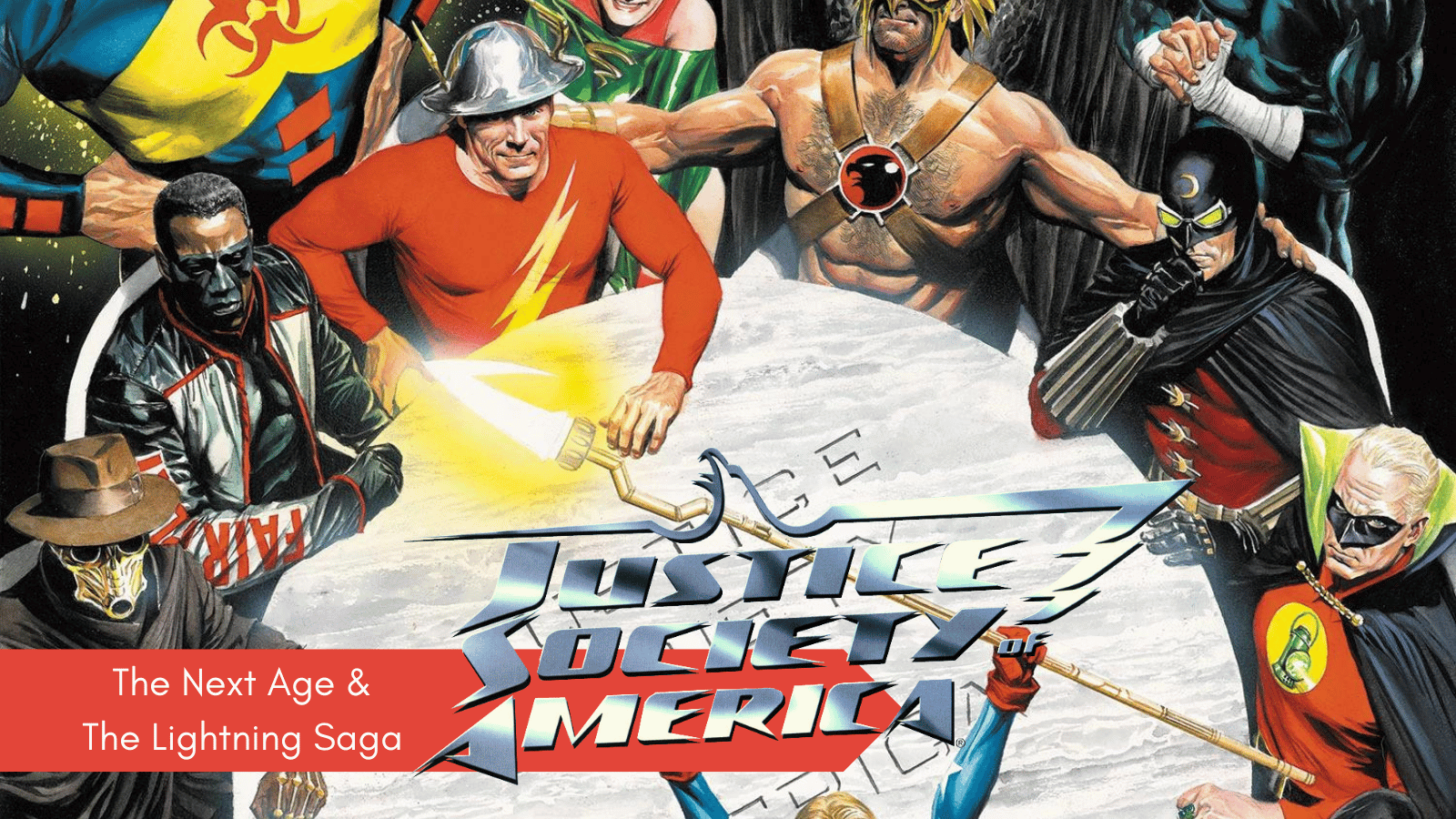
Justice Society of America: The Next Age (2007)
Reprints Justice Society of America #1-4
Written by Geoff Johns
Art by Dale Eaglesham
Justice League of America: The Lightning Saga (2008)
Reprints Justice League of America #0, 8-12 and Justice Society of America #5-6
Written by Brad Meltzer & Geoff Johns
Art by Shane Davis, Ed Benes, Fernando Pasarin, and Dale Eaglesham
In 2007, Geoff Johns was pretty much the top dog among writers at DC Comics. He’d just finished up one of the Flash runs of all time, authored the company’s most recent crossover event Infinite Crisis, co-authored the follow-up weekly mini-series 52, was in the middle of a Green Lantern run that reinvented the character and was also writing Teen Titans, Booster Gold, and Action Comics. This was all prelude to him getting the job as Chief Creative Officer for DC’s film ventures in the 2010s. I argue that was the moment Johns began to decline. While this Justice Society of America run is good, it is not as strong as the previous JSA series.
Green Lantern (Alan Scott), The Flash (Jay Garrick), and Wildcat are the original Justice Society’s only living members. In the wake of the Infinite Crisis and World War III, the team is fragmented & possibly about to permanently disband. The Justice League implores their older stalwarts to reform the team with the mission of helping the next generation of legacy heroes aspire to great heights. They recruit some old friends: Mr. Terrific, Power Girl, Dr. Mid-Nite, Stargirl, Hourman, and Liberty Belle (formerly Jesse Quick). Meanwhile, an ex-FBI agent and relative of the original Mr. America has donned the superhero guise in Virginia. He investigates the murder of his family, which is tied to a series of murders of the descendants of Golden Age superheroes and their families.
These attacks bring many characters into the JSA family. Damage, the son of the original Atom, literally crashes through the walls of the team’s New York brownstone headquarters, pursued by one of the killers. Maxine Hunkel, the granddaughter of the team’s caretaker, Ma Hunkle, displays extraordinary wind manipulation powers and joins as Cyclone. It turns out Wildcat has a son he never knew about, and his son has a strange ability that makes him more than just a namesake to his old dad. And then there’s Starman, a mentally ill man living in a sanitarium in Opal City, who leaves during the day to play hero before returning “home” in the evenings. He mutters strange things that don’t make sense at first but become more evident as time passes.
It’s a decent start to the new run. The enemy behind the murders has deep ties to the Justice Society, and they make sense as the big bad, even if the story feels a bit simple overall. I think the most effective sequence is the introduction of Nathan Heywood into the book. He’s a relative of the metal-skinned heroes Commander Steel and Steel, so it’s no surprise that as events play out, Nathan gets coated in organic metal as well. He was an aspiring football player left disabled from a career-ending injury. Gaining superpowers does help him to one degree, but a side effect (his skin is entirely numb) means he can’t feel the hugs from his surviving family members after they are attacked at a reunion.
One of my problems with this reboot is we get a lot of new characters in rapid succession, to the point that the book feels overcrowded. Throughout this introductory story arc, Hawkman and Sandman also return. The recruitment drive continues into the next volume so that by the end of Johns’ run, we have about a half dozen new legacy characters that only get a little development. It feels like the writer was rushing to get out about three to four story arc ideas he had before officially quitting the book. Some of these stories are way too decompressed (we’ll get to Thy Kingdom Come next week) while you have these new, exciting characters spoiling on the vine and never getting their backstories developed.
The second part of this review encompasses only a portion of the Justice League of America volume. The Lightning Saga was a crossover set up in both books and serves as a nostalgic trip back to when the JLA and JSA had annual crossovers. In the pages of JL of A, the team discovered one of the henchmen for a recent villain was an amnesiac Karate Kid. No, not Ralph Macchio, but the member of the future group The Legion of Superheroes. It also becomes evident in JS of A that their Starman is Thom Kallor, who operated as Star Boy on that same future team. How did these Legionnaires become trapped in the present day? I don’t think it’s ever very clearly laid out.
The League and Society split into mixed groups and go globe-trotting to rescue other lost members of the Legion. Dream Girl gets picked up at Arkham Asylum, Wildfire ends up being found in Superman’s Fortress of Solitude, Timber Wolf has been hanging out in Gorilla City, the winged Dawnstar is discovered on Hawkman’s homeworld of Thanagar, and Triplicate Girl is found in the ruins of the Legion of Doom’s HQ sunk in Slaughter Swamp. Once reunited, they suddenly remember their mission is to bring “him” back, and longtime DC fans are meant to associate this with a story from the Legion books in the 1960s where Lightning Lad was brought back from the dead. It’s not him this time but a present-day hero that gets reintroduced.
Hey, so what did that scene with Despero, Ultra-Humanite, and Per Degaton mean? These three villains pop up for a brief moment together, hinting at some future conflict. Welp, that goes nowhere. It doesn’t get resolved in the pages of either the Justice League or Society. That trio may have shown up in Booster Gold, but that was clearly Johns trying to salvage a storyline that sputtered out. Yeah, and why are the Legion in the present day because they clearly indicate more is going on in the final panels? Your guess is as good as mine. There’s a brief mention of “The Legion of Three Worlds,” which ended up being a tie-in to the Final Crisis story a year later, but I didn’t get the feeling that when Johns wrote that into the story, he knew exactly what it would be.
What was beginning to happen was that DC Comics was getting into the same cycle Marvel was experiencing around this time, event churn. As soon as one event ended, it was expected that the hype for the next would begin. The problem is that if every six months or so, you interrupt an ongoing title to tie it into an event, it makes these big happenings feel less important. They become nuisances that hinder character development and worldbuilding for hype and shock value. Between a bloated but interesting cast and a fervor to tease too many stories, Johns lost the way a bit when compared to the initial run of JSA. That doesn’t make this terrible but a bit lackluster in comparison. He had big plans, which we will get into next week.

 PopCult Reviews
2 thoughts on “Comic Book Review – Justice Society of America: The Next Age & The Lightning Saga”