
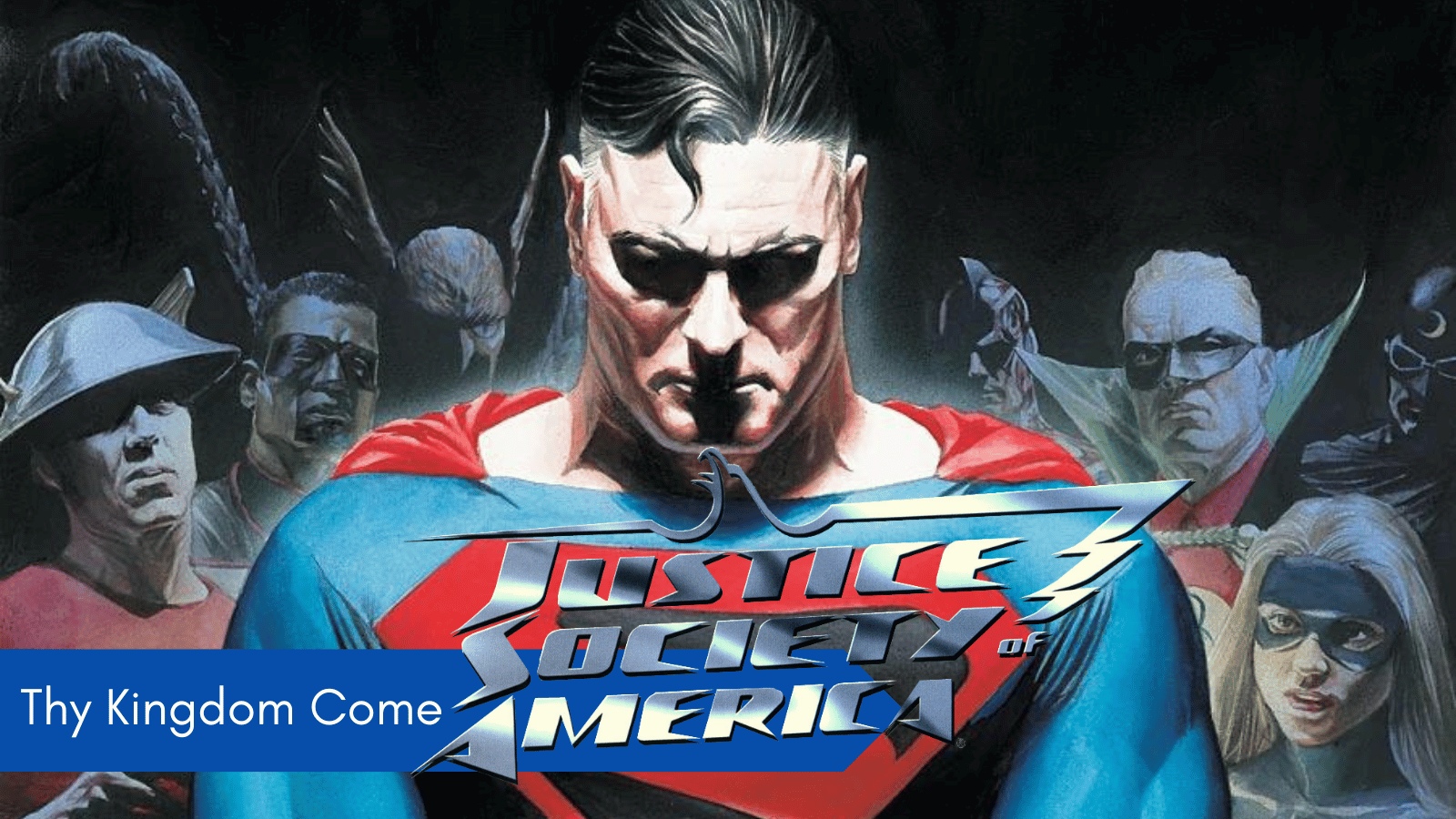
Justice Society of America: Thy Kingdom Come Part One (2008)
Reprints Justice Society of America #7-12
Written by Geoff Johns & Alex Ross
Art by Dale Eaglesham, Fernando Pasarin, and Alex Ross
Justice Society of America: Thy Kingdom Come Part Two (2008)
Reprints Justice Society of America #13-18, Annual #1
Written by Geoff Johns & Alex Ross
Art by Dale Eaglesham, Fernando Pasarin, and Jerry Ordway
Justice Society of America: Thy Kingdom Come Part Three (2009)
Reprints Justice Society of America #19-22, Justice Society of America Kingdom Come Special: Superman, Justice Society of America Kingdom Come Special: Magog, Justice Society of America Kingdom Come Special: The Kingdom
Written by Geoff Johns, Alex Ross, and Peter Tomasi
Art by Dale Eaglesham, Nathan Massengill, Jerry Ordway, Bob Wiacek, Alex Ross, Fernando Pasarin, and Mick Gray
Geoff Johns has always reached deep into continuity for his work at DC Comics. It’s why he was such an excellent fit for the JSA, able to draw on decades of stories & characters and build upon them. When the Justice Society had a revival post-Infinite Crisis, I was among many people hyped to see the writer continue with these characters. However, the longer this new book went on, the more it felt like Johns was stretching out a small number of storylines for two years. The most egregious example of this is Thy Kingdom Come. It’s one of a few sequels written to the prestige 1996 mini-series Kingdom Come.
In Kingdom Come, co-written by Mark Waid & Alex Ross with painted art by Ross, we jump a couple decades into the future where the status quo has been dramatically transformed. Superman comes out of retirement to try and reign in the hyper-violent younger generation but just compounds problems until reaching an apocalyptic finale. A couple years later, DC attempted to keep the success of that four-issue mini-series going with The Kingdom, written by Mark Waid, with Ross refusing to participate. It became clear that Waid and Ross had dramatically differing ideas about the Kingdom Come reality, its origins, and where it should go in the future. With Infinite Crisis, the DC multiverse was restored, and Earth-22 was designated as the reality where Kingdom Come took place. Johns got Ross onboard, and together they wrote this sequel, spanning fifteen monthly issues, a double-sized annual, and three special tie-ins.
The first book opens with some stories that don’t directly tie in but allow for some development of characters who will be necessary when the story starts. Citizen Steel is grappling with his inability to comfort his loved ones after the massacre at the family reunion. Superman reaches out to the troubled Starman. This is followed by a one-off spotlighting Liberty Belle & Hourman’s mentorship of Damage. We also get some interesting back story for Belle, aka Libby Chambers, the daughter of Golden Age heroes Johnny Quick and the original Liberty Belle. These types of stories are where Johns shines the brightest, so it’s a shame that in recent years he’s leaned into more bombastic decompressed storytelling.
Then we finally get to the Kingdom Come Prologue, where Power Girl is spotlighted. She’s still mourning over the discovery she came from the now-extinct Earth-2, and her last remaining family (Superman & Lois Lane of Earth-2) are dead. She’s truly alone in the universe from the perspective of her “homeworld.” There’s about to be a boxing match between Wildcat and his son Tom, but it’s interrupted by a five-alarm factory fire across town. The JSA jumps into action and finds the obscure Titans villain Goth dead in the middle of the blaze. Starman uses his cosmic powers and creates a miniature black hole to swallow the flames. A figure tumbles out of this portal and emerges carrying the depleted Starman. It’s an older version of Superman.
The JSA immediately believes this is some sort of trick and tries to suss out who this man is. It turns out he’s the Superman of Earth-22. While the characters don’t grasp the significance, a regular DC reader would have known the story of this hero’s Earth. I was very excited about this storyline at the time of publication because I love Kingdom Come. And it starts off well. This aged Superman has been pulled from his reality just before the climatic events of Kingdom Come, so he’s at his most despondent. Now he can save this world from befalling the same fate.
After confirming that this Superman is legit, the JSA starts recruiting more. The roster is already very full, but Johns adds more to it. This is one of my problems with this run; we keep adding but not doing much development. Jakeem Thunder & Thunderbolt return to the team. A new Judomaster is recruited. We’re introduced to one of the grandsons of Amazing-Man, one of the few Black Golden Age superheroes, who has taken up his grandfather’s mantle. Lightning, the daughter of Black Lightning, is asked to join. The strangest recruit is Lance Corporal David Reid, who has no relative who was a JSA member. Instead, he’s meant to be one of President Franklin D. Roosevelt’s descendants and is stationed in Afghanistan. His unit stumbled upon a strange tomb earlier, and now a bizarre piece of weaponry has grafted itself onto David.
While all this is happening, Mister America is investigating deaths tied to Goths, and a pattern emerges of metahumans who fashion themselves as gods being brutally offed. The killer appears to be a man named Magog. In Kingdom Come, Magog is responsible for Superman’s retirement, a metahuman willing to kill the villains. When Superman saw the public favored Magog’s methods, he stepped away out of shame. Now it appears he has a chance to stave off the same fate happening to this Earth. Magog learns he’s being hunted by the heroes and shows up in their own base to try to take out as many of them as possible. The fight eventually sees them teleported to Central Africa. The heroes learn Magog is the disciple of a Promethean Giant partially buried in the Earth named Gog (The names are a Biblical reference to two obscure figures labeled as “giants” in the Bible.)
Gog kills Magog and then emerges from the Earth, claiming that he comes in peace. The following parts of the story become a “be careful what you wish for” scenario. Power Girl gets sent to Earth-2, but this is from the new multiverse, and they already have their own Power Girl. Citizen Steel hopes to get his powers nullified to some degree. Damage gets the scarring on his face healed but with a cost. The story drags on and on. I like stories of this kind that were often rushed in the Silver Age, getting to breathe and expand. However, Johns doesn’t use that space to go in surprising directions. The story happens as you might expect, taking place over a long time.
The ending cancels out much of what happened, especially with the Superman of Earth-22. He’s sent back to the very moment he left. The most significant consequence is that one of the new recruits ends up as the new Magog, a character initially conceived as a pastiche of Leifeld-esque guns & pouches types. The best part of it all is the Alex Ross painted sequences in the final issue detailing the rest of the life of the visiting Superman back on his homeworld. It’s cool to see him as a little old man a thousand years in the future, looking on with pride as the Legion of Super-Heroes flies across the sky. Did we need over a year of issues to get to that moment? I don’t think so.
Johns would get a hunger for revisiting beloved DC out-of-continuity stories because he would eventually write the Watchmen sequel, Doomsday Clock, and the quasi-Killing Joke follow-up, The Three Jokers. He’s not writing bad stories; they just don’t have these previous books’ emotional or historical weight. Watchmen and Kingdom Come resonated so strongly with readers because of how unexpected they were and how they were telling stories in a way that readers had never seen before. When you make sequels to these stories in standard comics, you are immediately removing the thing that drew people to them in the first place. If you develop the world of Kingdom Come, explaining more of the history and detailing background characters, you are undercutting the fun of reading the comic and making inferences about what is happening between panels or the gap between the present and this dark future.
I never felt I needed to know where Magog came from; I got the concept and how he fits into the story’s themes. It also doesn’t help that Johns has built up this diverse cast of characters I’d love to see spotlighted, but instead, they are lost in the shuffle of Thy Kingdom Come. Amazing-Man, for instance, is introduced during this story, plays a supporting role, and upon its conclusion, has left the team and returned to New Orleans. This version of the character, a civil rights activist helping in the ongoing recovery from Hurricane Katrina, never shows up again, save for a background appearance at a funeral about a year later. Wasted potential.
There’s one more review to go before this Geoff Johns’ Justice Society era wraps up. That will involve the writer revisiting a character to whom he gave a brand new life: Black Adam.

 PopCult Reviews
2 thoughts on “Comic Book Review – Justice Society of America: Thy Kingdom Come”