
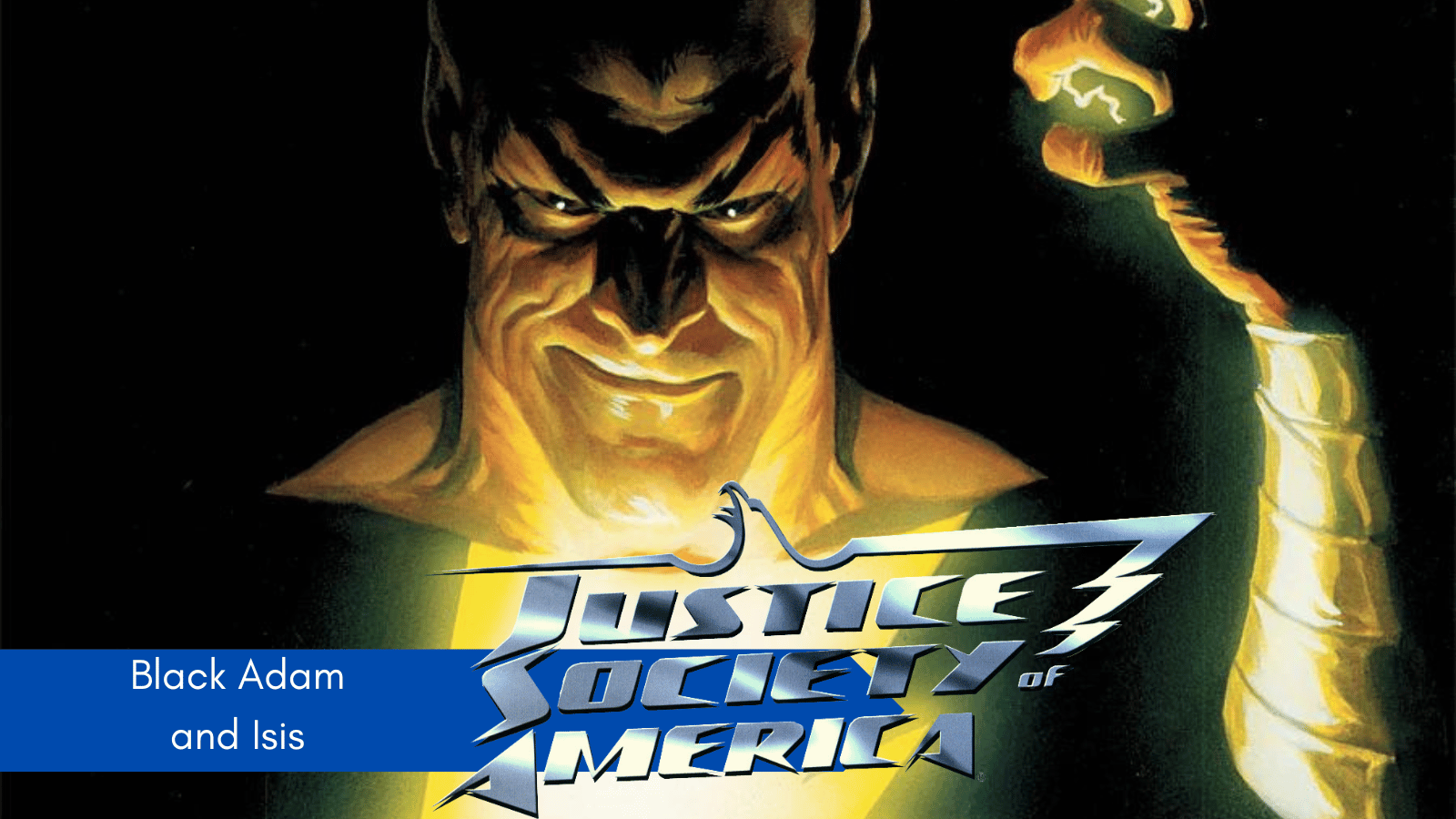
Black Adam: The Dark Age (2008)
Black Adam: The Dark Age #1-6
Written by Peter J. Tomasi
Art by Doug Mahnke
Justice Society of America: Black Adam and Isis (2009)
Reprints Justice Society of America #23-28
Written by Geoff Johns, Jerry Ordway, and Matthew Sturges
Art by Jerry Ordway, Dale Eagelsham, and Fernando Pasarin
Before Dwayne “The Rock” Johnson desperately tried to carve out a niche in the superhero franchise landscape, Black Adam was just one of the villains in Captain Marvel, aka Shazam’s rogues gallery. Like many villains, he served as the shadow to the hero, a dark version of that main character. When the Shazam franchise was revived in 1995 via Jerry Ordway’s one-shot graphic novel The Power of Shazam (followed by an ongoing series), Black Adam was brought back with more nuance than you would expect with modern comics. He would eventually become a member and then enemy of the Justice Society during Geoff Johns’ first round with the book, a character arc that has permanently redefined how readers view Black Adam. In Johns’s final (at the time) arc on JSA, he brings some closure to Adam and the corner of the world he occupies in the DC Universe.
Before that, though, writer Peter J. Tomasi dealt with the fallout of 52, the weekly series that followed Infinite Crisis. In the pages of 52, Adam retook the throne of his homeland, Khandaq, and even fashioned his version of the Marvel Family with Isis as his bride and her brother Osiris to finish the trinity. Things went wrong when genetically engineered “horsemen” of Apokolips were sent to kill Adam and took out this makeshift family he’d created. Adam lost his mind in the face of these deaths, and Captain Marvel used his powers to erase the word “Shazam” from his enemy’s mind so that Adam could no longer transform into his super-powered version. This is where Tomasi’s The Dark Age picks up.
Adam has a group of devoted followers surrounding him and engages in daily exercises to try and recall the word, including having them physically strike him, thinking intense pain might break the block. The JSA consisting of Mr. Terrific, Wildcat, Dr. Midnight, and Atom-Smasher are following the leads of Adam-sightings to try and bring him in to stand trial for his many crimes. Adam has another obsession: recovering his beloved Isis’s remains and finding a way to magically resurrect her. Using Ra’s Al Ghul’s Lazarus Pit only works temporarily, so Adam finds himself before the Tower of Fate in Salem. Instead of finding Dr. Fate within, Adam discovers the imprisoned villain Felix Faust, who offers a deal to restore Adam’s power and bring Isis back in exchange for helping Faust escape. An agreement is struck, but it pits Adam against old allies turned enemies.
I couldn’t imagine someone unfamiliar with what had been going on with Black Adam picking up The Dark Age of the shelves and have any idea what the hell was going on. It’s a complicated story to provide all the history for within these six issues and keep the character moving forward. I think Tomasi does a decent enough recap, though. His characterization of Adam is consistent with the groundwork laid by Johns during his JSA run and in 52, so this feels like the natural next part in the villain’s story. A lot of things happen in these six issues, and a lot of characters pop in from time to time. It’s a complete story, but several things feel like sidenotes or moments the writer really wanted that didn’t necessarily keep the story flowing.
In Johns’ “Black Adam and Isis,” we begin with the fallout from “Thy Kingdom Come.” Hawkman is being asked to resign as he sided with Gog during that event, which makes him very mad. Johns then quickly undoes where Tomasi left things in The Dark Age by having Faust’s trick suddenly known by Adam. This moment made me think there was no agreed-upon plan for one story to move into the next. Maybe Johns had planned on doing a lengthier Adam arc within the pages of JSA but then realized how overloaded his schedule was and cut his tenure on the book shorter than initially planned? So Adam and his queen are back together, not even halfway through the first chapter of this collection. The JSA also reveals that many new members have left the team: Amazing-Man, Mister America, Citizen Steel, Magog, and Starman. That annoyed me because so much of Johns’ run on this round of JSA was about filling out these ranks, introducing new legacy heroes, and then tossing them aside with no actual development. Steel and Starman probably got the fairest shake in that regard.
Adam & Isis attack the Rock of Eternity and strip Billy of his powers; he was now operating as the Wizard. Jerry Ordway is on the art, so he recaps his Power of Shazam graphic novel as the JSA tries to figure out precisely who Adam is. Meanwhile, Mary Marvel had been turned “evil” as part of one of the worst DC weekly series ever, Countdown. Adam & Isis bring her to the Rock to act as one of their own, and this is all as convoluted and annoying as it sounds. What’s genuinely obnoxious is that Ordway’s design for this evil Mary doesn’t even match what she looked like in the pages of Countdown. This was during the waning years of the pre-New 52 DC Universe, and you could clearly see how Editor-in-chief Dan Didio did no actual planning & coordinating with his creators. Vague initiatives would roll out, but right away, it would be clear that no one had the details ironed out for them, and the lines of communication between creative teams were poor.
By the end of the story, Adam & Isis are frozen in place by the resurrected Wizard, while Billy & Mary have been stripped of their powers “for good.” I think they remained powerless until Johns rebooted Shazam in the new 52 timeline. The story wraps up with some of the members who had quit the JSA showing up again as there was a spin-off about to launch, JSA All-Stars, in which many were spotlighted. If you had been a fan of Ordway’s Power of Shazam ongoing, this story arc was a way to wrap up some loose ends and revisit Fawcett City. Otherwise, it feels awkward and needs a clear direction.
It also ends in one of the worst ways for a comic to end: a mysterious shadowy figure appears from the sky like lightning, makes vague statements about the imprisoned Adam & Isis, and we’re teased into thinking this is going anywhere. I double-checked on the fan-run DC wiki and found there was no follow-up to this scene. The implication is that this figure is the owner of the Rock of Finality, parallel to the Rock of Eternity, yet neither Johns nor anyone else decided to pursue this tease further. It undercuts the story’s impact because it was used to not wrap things up, failing to deliver a complete narrative. There’s more to the story than they tell us, except there isn’t.
What works far better is the next issue, Johns’ final one in this series. Courtney Whitmore, aka Stargirl, has her 16th birthday party with her teammates from the JSA present for the celebration. These slice-of-life “family” issues were the ones Johns did so well with. He definitely has the characterizations of these heroes down, and his writing feels so effortless & natural. The focus is clearly on Stargirl and her friendship with each team member, with flashbacks to moments where she got featured during Johns’ run. As she was based on his younger sister, who died tragically in a plane crash as a teen, it is fitting that he closed his run out with a simple story about this character growing up. While his own sister would forever be frozen at the age she was when she passed, Johns could keep her alive through Stargirl.
The rest of the collection includes a two-parter written by Jerry Ordway featuring the current Spectre of that era and a tease for how the JSA would tie into the Blackest Night event. Neither of these is all that interesting.
When I think about how I felt when Johns wrapped up his first run on the JSA versus this second batch, it is like night and day. That first round was so well done, and he made the most of each character on the team, giving everyone rich, complete arcs that helped them become heroes that grew. They were not the same at the end of those 80-something issues, and those changes have remained for many of them. This second bout just feels poorly planned and not well thought out. I loved the idea of these new characters but could never see anything come to fruition. It felt more like Johns had a general concept or a costume design but only planned a little beyond that. The writer was stretched too thin at this point; Didio essentially put the weight of the DC Universe on his back. They were definitely chasing the trend Marvel had started by positioning Brian Michael Bendis as the “architect” of the company’s direction. Johns was clearly being asked to creatively steer the ship for the most part.
As of this writing, Johns is nearly half a dozen issues deep in a chronically delayed JSA 12-issue mini-series. As of late, his career has been plagued with delays, which means what should have taken a year to tell will likely take 18 months to two years to finally get printed. It may be time to find someone else to take on the JSA mantle. Many talented writers are out there, and I believe Johns has his heyday with this team, but that magic is long gone. I still highly encourage readers to seek out collections of his incredible first series; it remains some of the best superhero team comics I have ever read. This won’t be the end of our revisiting of Johns’ work as we have his Superman run and much more to explore sometime down the road.

 PopCult Reviews
2 thoughts on “Comic Book Review – Justice Society of America: Black Adam and Isis”