
This special reward is available to Patreon patrons who pledge at the $10 or $20 monthly levels. Each month, those patrons will pick a film for me to review. If they choose, they also get to include some of their thoughts about the movie. This Pick comes from Bekah Lindstrom.
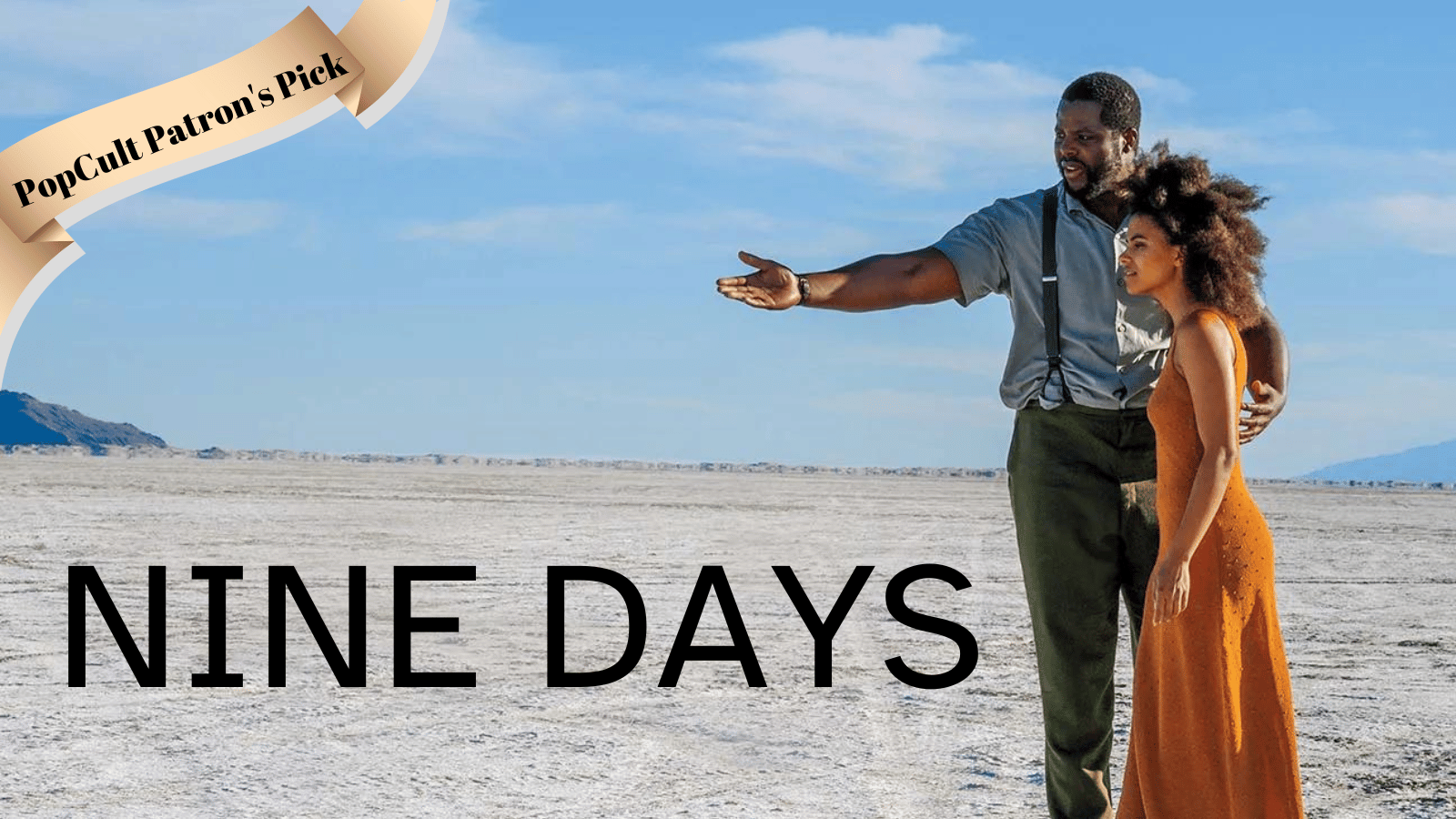
Nine Days (2020)
Written & Directed by Edison Oda
I did not like this movie. From what I see online, it has proven to be a very polarizing film, with few people settling in the middle. I know exactly why I didn’t like it, which concerns some creative choices by the writer/director Edison Oda. I think the film is way too long for what it is trying to say and how it is trying to say it, and I argue the message could have been more poignant if a good half hour was shaved off the runtime. By the time we get to the third act, Oda is just saying a lot of the same things over and over but not building upon them in a manner that excites or interests me. It is thematically similar to another divisive film that came out recently, Alfonso Cuaron’s Bardo. I enjoyed Bardo because I felt the director kept things visually inventive, so I never got bored with the images on the screen. Nine Days is never able to move past the sedate, bland tone it sets at the start.
Will (Winston Duke) is an arbiter in a blasted desert landscape of an afterlife. He judges souls in this realm to determine if they are ready to inhabit a newborn body on Earth. Those who are not chosen are given a unique human experience before they fade away, their existence erased. Unlike most beings around him, Will has lived in multiple bodies on Earth and has a perspective that makes these spirits interested in speaking with him. He becomes particularly obsessed with Amanda, a young violinist whose life ended suddenly in a car accident. The seeming randomness of this juxtaposed with the person’s immense talent doesn’t make sense to Will; this feels like a great injustice. Over nine days, he works through a new batch of souls. One of these souls, Emma (Zazie Beetz), doesn’t do what Will expects and proves to be the entity that pushes him to confront his complicated feelings about existence.
I don’t think Oda is untalented. The film has a strong, consistent look, and I have no doubts he spent a lot of time thinking about how he wanted this world to look. He cites Spike Jonze’s Her as an influence in exploring human vulnerability and Scarlett Johanssen’s performance in that film. Jonze also serves as an executive producer for Nine Days. I can see the connections, but I think Jonze was able to craft a more interesting story that was more grounded in human experience than Nine Days. For me, anytime a film presents its characters in such a metaphorical manner, I feel an almost immediate emotional disconnect.
This film would have worked much better as a stage play than a film because of that aspect. The theater is the place, for me, where you can play with large philosophical ideas in such a naked manner, and it works. I just don’t have those same associations with cinema, I need characters living some sort of life when I watch a movie. There’s a lot of talk about how great life is, but we see so little of it being lived in Nine Days, so a movie with such a vast conceit felt unnecessarily constrained. Compare it to something like Baraka, the experimental documentary. That film explores the same themes of Nine Days but understands they exist in a plane of abstraction, making the characters a little tricky to work with if you want to approach it from a more cosmic perspective. Thus, that film disconnects us from the conceits of narrative cinema and, in my opinion, is a more emotionally rewarding experience than what I got from Nine Days.
One of my big problems with contemporary American cinema (and, upon reflection, going back through the decades) is how direct it is to the point of becoming reductive. American films tend to oversimplify the complexity of ideas. Abstraction is better when you deal with lofty ideas. Take Terence Malick’s Tree of Life, for example. Some characters embody archetypes, but Malick eschews heaps of interpersonal conversation (while using slightly abstracted dialogue), which allows the images and their juxtaposition to “do the talking.” I find significant meaning in that film because it respects my intelligence enough to not state its thesis explicitly through dialogue but use the strengths of the medium of film. Film is not a medium of speech. Instead, image is the most important, followed by sound (not necessarily dialogue).
None of this means Nine Days looks terrible or is poorly performed. DP Wyatt Garfield pulled from great inspiration, citing There Will Be Blood and Seven as visual touchpoints. I found the interior lighting to resemble a lot of David Fincher’s work, with yellows, greens, and browns given prominence over other colors. Every actor commits to their roles and never feels awkward in their delivery. Winston Duke continues to impress me, and Zazie Beetz is not far behind. Even the supporting roles are very endearing. My problem is that I expect to be challenged or surprised when you make a film about these ideas. There should be an exploration beyond surface-level pop philosophy, and in this, the movie failed for me. I never felt surprised, challenged, or emotionally moved. Aesthetic and narrative choices that were made actually made me feel emotionally cold towards what happened. Your mileage may vary, but Nine Days was simply not for me.

 PopCult Reviews
One thought on “Patron Pick – Nine Days”