
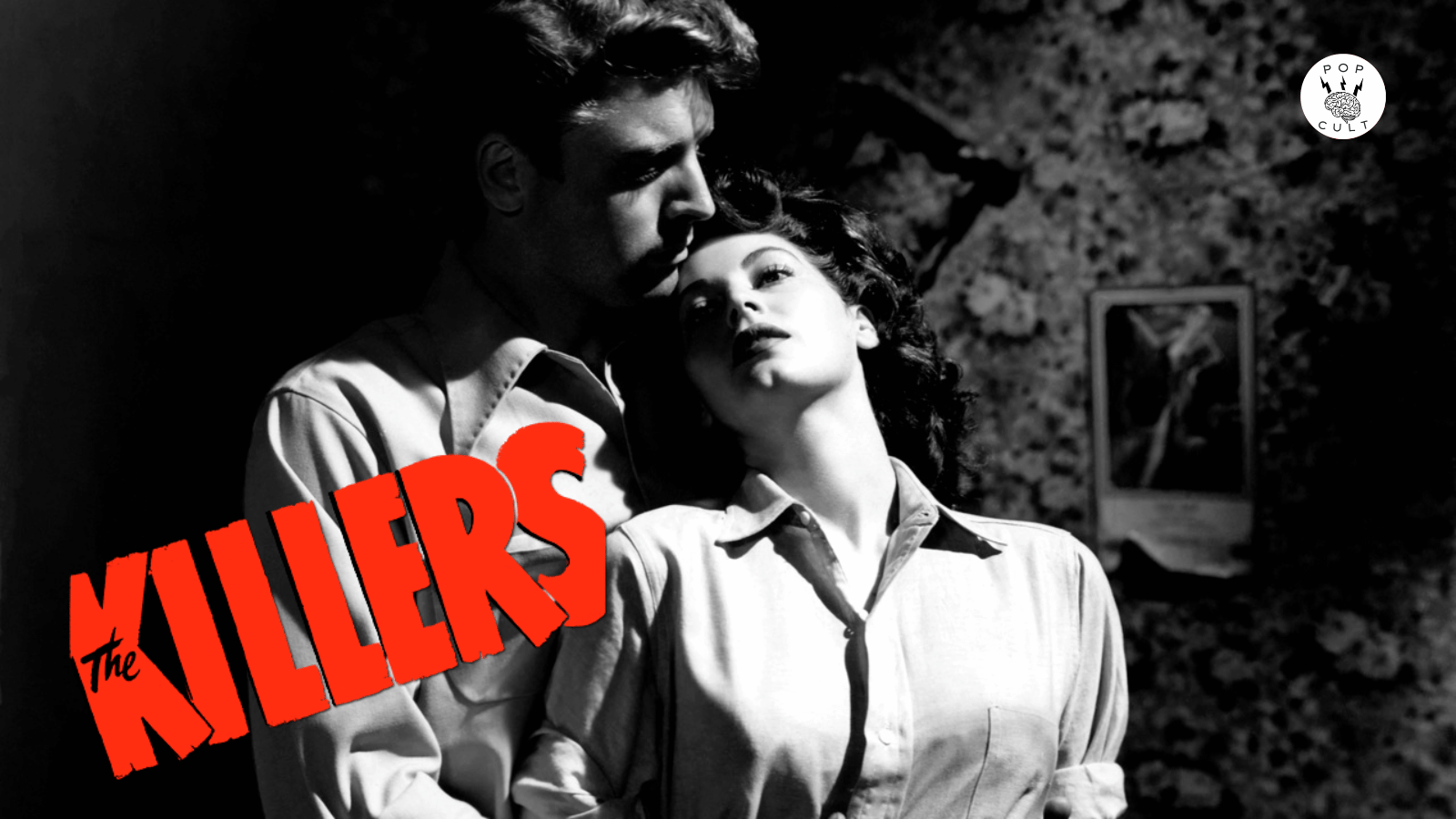
The Killers (1946)
Written by Anthony Veiller, John Huston, and Richard Brooks
Directed by Robert Sidomak
Ernest Hemingway is not a name we often associate with noir & crime literature. The short story this film is based on isn’t necessarily a piece of noir fiction, either. That piece makes up only the opening sequence of this film, which expands significantly on the central character through extensive flashbacks. Up to this point, Hemingway had been vocal about how much he disliked Hollywood’s adaptations of his work. However, The Killers stood out as one that garnered his praise. Many people liked it, leading to four Oscar nominations, including Best Director and Best Film Editing. The film’s director was a German man who fled Hitler’s Nazi regime after propaganda minister Joseph Goebbels leveled an attack on one of the filmmaker’s pictures. The Killers is a film that is a tragic examination of masculinity, all coming from men who suffered extensively under the social expectations of what sort of men they could be.
The film opens in the sleepy town of Brentwood, New Jersey. Two unscrupulous types set up in a diner, asking around for Pete Lund (Burt Lancaster). They say to close the joint unless Pete shows up, then let him in. One of the customers gets spooked and sneaks out the back to warn Pete. These men have come to kill him. Strangely, the potential target doesn’t appear phased; he tells his friend there isn’t much he can do. The men show up at Lund’s room and shoot him to death, the man having made no move to defend himself. But why? Later, insurance investigator Jim Reardon (Edmond O’Brien) shows up in Brentwood. Pete’s friends learn he is Ole “The Swede” Anderson, a prizefighter in Philadelphia.
Through flashbacks, we learn about Ole’s career going down the tube after a hand injury. He gets caught up with crime boss “Big Jim” Coffax. Ole’s longtime friend, police lieutenant Sam Lubinksy, watches as his friend drops his longtime girlfriend for the more glamorous & connected Kitty Collins (Ava Gardner). Lubinksy also notices that Kitty is wearing stolen jewelry, and Ole confesses that he gave them to her, gaining him a three-year stint in prison. Upon release, he fails to straighten up and gets even more indebted to the mob, having to commit more robberies. He also reconnects with Kitty, and things get worse and worse. Eventually, it becomes clear how he ends up the resigned criminal on the run, awaiting his executioners.
One of the first things I thought of once the film’s plot kicked in was how remarkably like Citizen Kane this film is. Its entire structure is people talking about a guy who dies in the opening. The way the audience learns who this man is through the stories his friends & enemies tell about him. Citizen Kane is adjacent, with the same moody, atmospheric elements paired with a story where the protagonist is doomed to fail. No wonder other filmmakers used its skeleton to make crime-centric films in the following years. From a narrative point of view, it’s also a lot of fun to start with a broad outline of the character and then spend the film deconstructing that figure, especially with conflicting viewpoints. We end up with a protagonist who embodies much of the complexity people possess in real life.
Part of what makes The Killers work are the contributions by John Huston to the script. Huston had written & directed The Maltese Falcon five years prior, one of the films that helped define the entire genre in the public’s eyes with the archetype of the private eye in Sam Spade (Humphrey Bogart) and Sidney Greenstreet & Peter Lorre’s distinctive villains who would inspire countless bad guys in noir pictures to come. The Maltese Falcon is a detective story, while The Killers is less concerned with the investigator than the tragic victim of the opening. Like Sam Spade, Reardon isn’t the character who goes through an arc in the story. From his first appearance, Reardon is pretty much the same as the man in the final scene. The dead man has the arc, just like in Citizen Kane. While that sounds so strange on paper, both films make it work.
Beyond the structure, it feels obvious how much the camerawork of Citizen Kane had on the films that followed and among Orson Welles’ admirers. Director Robert Sidomark employs some clever framing but nothing ostentatious. It’s subtle, but if you are paying attention, you’ll notice little camera movements or cuts to a different angle that suddenly ass rich context to what is happening between the characters.
One of the visual highlights of the picture is the big heist where the factory payroll gets stolen. I was reminded of Huston’s The Asphalt Jungle, which lets its story and dialogue halt to observe the intricate procedure of a similar heist. Here, Sidomark and cinematographer Woody Bredell use a crane shot, following the robbers from the outside and allowing the audience to view the robbery through the windows of the building. A camera dolly is used when the guards chase after the burglars flee. It’s an incredibly well-constructed sequence that pushes cinema beyond what you see in most pictures of this era. Once again, they clearly were inspired by Welles’ experimentation.
Sidomark also makes use of mirrors in one memorable scene. When Reardon first meets Kitty at a dive bar, reflections create a sense of unease in the story. There’s someone following them, which makes the cameras and mirrors feel like the prying gaze of the assailant. In this film and others of its time, we see the language of noir being constructed before us. Today, we recognize the tropes & the meaning behind camera positions & blocking. We have to remember that audiences were being exposed to these things for the first time and learning the language as it was invented.
It can’t be overlooked that this film was the feature debut of Burt Lancaster. If you are a fan of old movies, you’ve likely run across Lancaster many times. My favorites from his filmography are Sweet Smell of Success, Elmer Gantry, and The Swimmer. There are many more I need to watch at some point. It’s fascinating to see how Lancaster is already proving to be a new type of actor; his character is wrestling with his masculinity, feeling pressured to do things to prove his manhood. He’s brilliantly paired with Ava Gardner, the perfect noir femme fatale hiding her dark side under a completely believable innocent facade. That traitorous turn is one of the great dramatic points of the picture.
The Killers feels like a step forward for film noir, a move from being a quickly churned-out genre to something where artists say we should expect more technique. Sidomark and his crew are showing how these aren’t just dime-store pulp stories but rich explorations of the dark side of humanity. We see this through the time and care given to constructing the picture. It’s also a perfect adaptation in that the short story is presented almost verbatim, and the rest of the film never undercuts that. The story of a poor soul stumbling down the wrong path is given the respect it deserves.

 PopCult Reviews
One thought on “Movie Review – The Killers”