
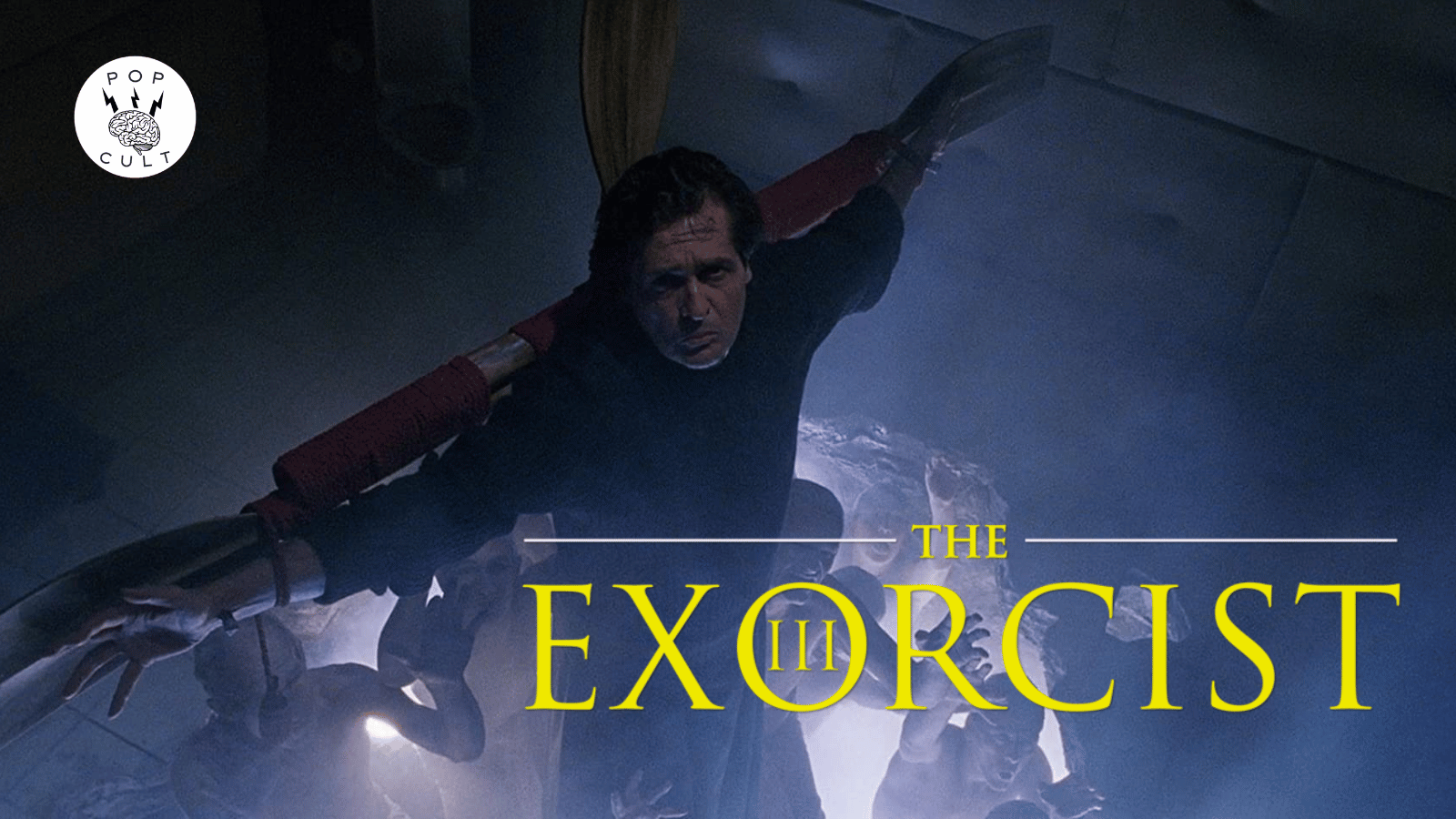
The Exorcist III (1990)
Written and directed by William Peter Blatty
Exorcist II: The Heretic was a disastrous flop for Warner Bros. During the premiere, the original novel’s author recalled laughing out loud moments into the film starting. It seemed he would have his response in the form of a third film only years after the comical sequel. Even the first film’s director, William Friedkin, was on board with Blatty’s concept and how it would continue the story. Then creative disagreements broke out and came to the point where Friedkin left the picture.
While that leaves us wondering what Friedkin’s The Exorcist III would have been like, Blatty was given the chance to direct. It wasn’t the first time, though. He’d helmed another film, 1980’s The Ninth Configuration. To say that film is complicated & challenging to penetrate would be an understatement. Blatty didn’t soften his style for the movies; he wrote in a literary way. For a film expected to appeal to a broad audience, it seemed like The Exorcist III may, in fact, be more of a cult hit.
This story isn’t about Regan MacNeil because The Exorcist was never really about her. Instead, the focus shifts to Lieutenant William F. Kinderman (George C. Scott, played by Lee J. Cobb in the original). Kinderman was good friends with the late Father Damien Karras (Jason Miller), and the circumstances surrounding his death haunted the investigators for the following years. Something evil awakens one night in Georgetown, coinciding with the murder & mutilation of a young Black boy, Thomas. This murder and the following ones seem to align with The Gemini Killer, but he was executed fifteen years ago, the same night Karras took the demon from Reagan.
Kinderman learns that a local psychiatric ward holds a patient (Brad Dourif) who was found stumbling, mute in the darkness the same night Karras took the demon. For the last fifteen years, he hasn’t spoken, and now he has awakened, claiming to be the Gemini Killer reborn and that he can commit these murders while straight-jacketed and locked in a basement room. Kinderman must now stare into the void, face primal evil, and see if his soul can withstand it.
The Exorcist III drips with atmosphere. From the opening sequence, the audience is immediately brought to a specific place and time. It doesn’t feel precisely like Friedkin’s film; it has a texture & life of its own, but you can feel the threads that connect the two. The world feels like it is in extreme decay, that we are in a world where the barrier between the souls of humans and the fires of Hell has been weakened. Things happen that are incredibly surreal. The opening sequence features a demonic presence entering a church with such force the large crucifix hanging over the altar opens its eyes. This is a world where it doesn’t matter where you are; evil can reach you with minimal effort. It’s not the possession of a single child but the demonic possession of the entire world.
The first half is stronger than the second, not that the second is terrible. When the explanations start, the movie loses some of that atmosphere. That’s the thing about horror: the more you explain to me what is happening, the less mystery there is, and with less mystery, the horror is diminished. The nature of the murders is described but not explicitly seen, and I think that distance makes their gruesome nature more palpable. There’s an obscenity to the crimes, an evil glee that goes into not just killing these people but making a performance of their death. Blatty creates a template that Andrew Kevin Walker built upon years later in Seven. This is a world on the edge of Hell, and a few people are trying to push back against the steely, precise evil swimming beneath its surface like a hungry shark.
There are sequences here that work beautifully and others that need some polish. On the masterful end of things, you have the infamous hospital hallway sequence. Having recently watched my way through the Insidious series for future reviews, I noted how much of that film’s scares relied on the wail of strings in the score to properly scare the audience. The Exorcist III’s hallway sequence lacks a soundtrack except for a strategically placed cue. This piece of music is not the scare; it is something we see on screen for a brief and chilling moment. The music serves as an underlining of this. You could remove that sting, and the horror would still shake the viewer. I had seen this film before and knew exactly what was coming at the end of this scene. Yet, I felt the jolt and terror as if watching it for the first time, a testament to Blatty’s craft in building dread through film.
The reveal in the film’s latter half about the Gemini Killer isn’t bad; I just think it’s way more direct than I wanted from the film. The performances from Dourif and Miller are incredible; they are intense, and the way Blatty cuts really makes you feel like you are in the presence of an entity composed of multiple voices & identities. The filmmaker always took the Catholic side of this story far more seriously than I know I did, and so it can sometimes veer off into territory that feels very specific to the point of alienating.
I found George C. Scott’s performance to be so layered and fascinating. He’s playing a gruff, veteran detective, the whiskey audible in his voice. Yet, he speaks like a poet in some moments when he’s inspired. He gets angry to the point of crying. You resonate with his anger. He’s a cog in an institution that is clearly falling apart. The hospital represents the failure of modern medicine to provide genuine care. The best they can do with a mute stranger is lock him away to be forgotten. I wholly understand the thrashing of Kinderman against these failing structures in a world that feels more & more doomed with each passing day.
Kinderman’s bursts of foaming rage are counterpointed by the calm, measured tone of the Gemini Killer, detailing with pleasure how he will tear the cop’s life apart. Folding in the lost & tortured soul of Damian Karras adds another sadistic layer to the demon’s torture. Is it Damien, or like in The Exorcist, a monster approximating another’s memory of a loved one? The intent is to dig a corkscrew into the soul, coring out what remains of Kinderman’s humanity.
There are strange turns that don’t make complete sense: Patrick Ewing & Fabio appear as “blink and you will miss them” angels. The nurse’s visit to Kinderman’s house has always felt too rough, not as refined as other horror sequences. It is, without a doubt, a far better follow-up to the original than whatever the hell John Boorman was doing in the 1977 sequel. This brings us back to the mysterious horror of that initial possession, an act of pure evil that has expanded, darkness consuming the horizon. Kinderman is a man toiling in Hell.

 PopCult Reviews
One thought on “Movie Review – The Exorcist III”