
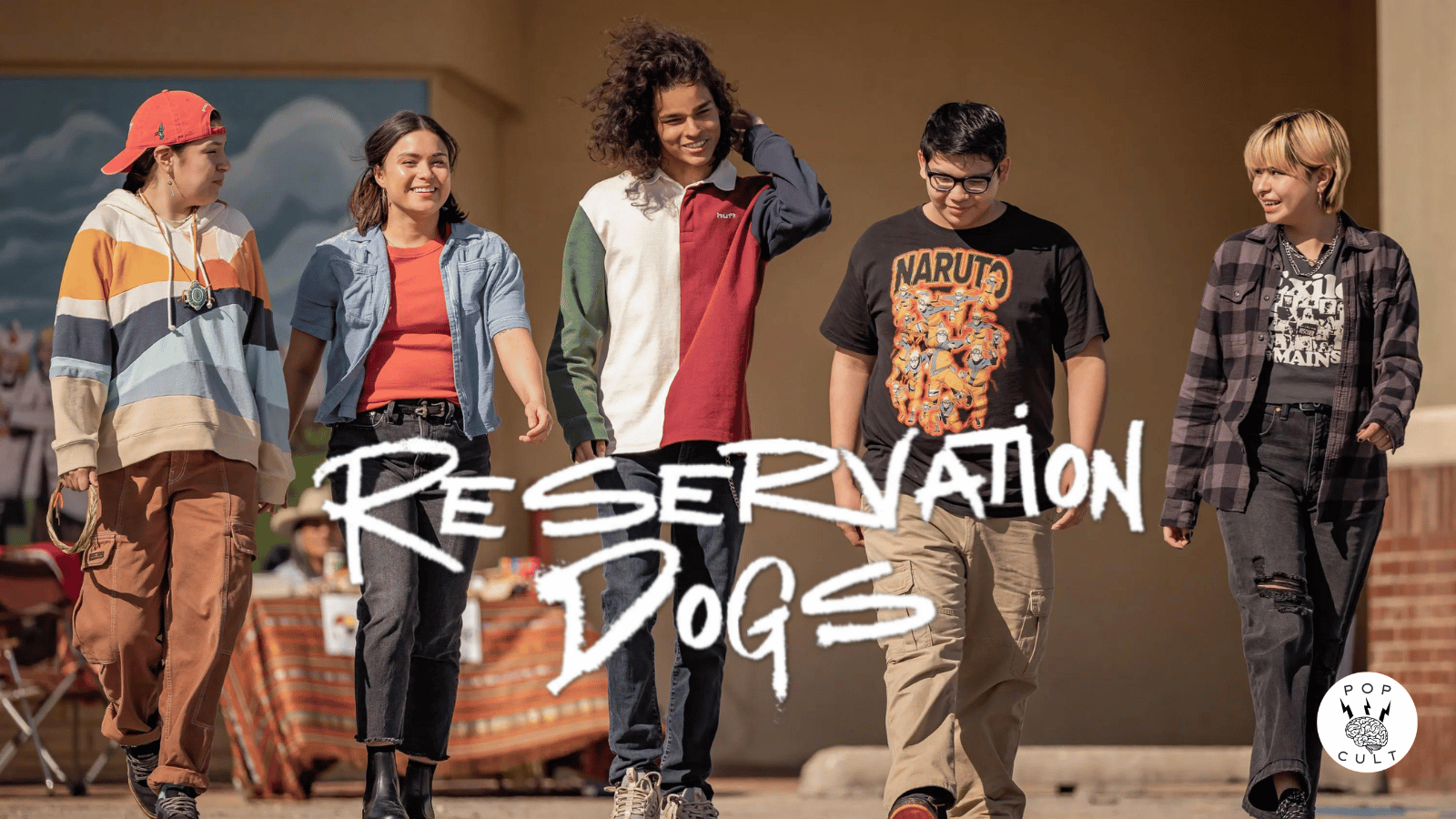
Reservation Dogs Season Three (FX)
Written by Sterlin Harjo, Dallas Goldtooth, Tazbah Chavez, Erica Tremblay, Tommy Pico, Bobby Wilson, Migizi Pensoneau, Ryan RedCorn, Kawennáhere Devery Jacobs, and Chad Charlie
Directed by Danis Goulet, Tazbah Chavez, Blackhorse Lowe, Kawennáhere Devery Jacobs, and Erica Tremblay
Reservation Dogs was one of those rare shows that presented the life of poor people without pitying them. It didn’t dull the edges of poverty or how it feels to come from a marginalized group, but it never wallowed in misery. American Indigenous communities are composed of survivors, those who have endured horrific abuse over generations. This final season of the series centered on the effects of white-run boarding schools on generations removed from them but never made the white perspective anything more than an afterthought. That is the correct way to tell these stories because the Indigenous people carry the trauma of that treatment with them. I can tell that series creator and showrunner Sterlin Harjo wanted to connect two seemingly distant generations to show how history resonates through to the present.
When last we saw the core quartet of the show, they had eloped to Los Angeles to put their late friend Daniel to rest. They end up stranded with no car and seek out Bear’s (D’Pharaoh Woon-A-Tai) estranged dad but find another woman and three half-siblings. Bear leaves a note but goes along with his friends who are getting home via Greyhound bus with the help of an auntie. The spirit of William Knifeman (Dallas Goldtooth) appears, distracting Bear from this journey, and the young man ends up stranded in the middle of nowhere.
But this journey has a purpose as it leads him to cross paths with Maximus (Graham Greene), an elderly Native man fixated on aliens he believes are communicating with him. Bear begins to see some of himself in this tragic figure, isolated from the friends he loves and disconnected from the material reality around him. Eventually, Bear makes his way home, but the show keeps revisiting Maximus and his story. There’s a stand-alone episode where Bear encounters Deer Woman, a mythic figure from Native folklore. In this episode, we get flashbacks to memories she holds from a child she saved from one of the brutal boarding schools. Scenes depicting the physical abuse of Native children haunt Deer Woman as she makes her way to the home of one of the people responsible for the death of a friend she had in those days.
The boarding school appears again midway in “House Made of Bongs,” where we flashback to 1976 and Maximus as a youth. His friends include people we’ve met in the present, but here, we see them around the same ages as our central characters. The message is clear: while they are old & gray now, they are the same as today’s young people. They liked to smoke weed, hang out, crack jokes, and, most importantly, try to share & continue their people’s traditions. Young Maximus is holding a grudge against his cousin Fixico, his undiagnosed mental illness not helping in that regard. Fixico has just begun training as his community’s medicine man, which is reflected in the present with Willie Jack (Paulina Alexis) being trained by the elderly Fixico.
There’s a constant tension between staying where you are and being pulled away from the outside world. Bear’s mother, Rita (Sarah Podemski), gets offered a promotion at IHS, which would see her moving to Oklahoma City. Bear graduated from high school and is becoming a man, so it’s the first time in her adult life that she can do something for herself, but she’s scared. Rita uses Bear and other people as excuses to not take the job when, in reality, she’s reasonably afraid to leave a community where her entire life has been rooted. A visit from the spirit of her late friend Cookie, Elora’s mom, helps Rita work through those fears of leaving.
Elora (K. Devery Jacobs) also finds herself moving on. This begins when she discovers her estranged father is a white man, causing some brief disorientation about her identity. College applications ask for the income of all her living parents, and that serves as the catalyst for Elora to seek out her father. Rick (Ethan Hawke) lives a few towns away and is a single father raising three children from a later relationship. Elora comes into town just wanting him to fill out paperwork. However, she finds a familial warmth that she misses with the passing of her grandmother. The prospect of meeting new siblings is both scary & wonderful. Jacobs plays this episode so well; her performance is not limited to dialogue but through body language & reactions. Hawke is excellent & very effortless, and he plays “the dad who stayed away because he thought that’s what was wanted” exceptionally well. The show clearly hints that Elora is at the start of joining a new family, not giving up the ones in her Native community but expanding the scope of her love.
Cheese (Lane Factor) gets some great moments and even a spotlight episode. Being younger than his friends, Cheese has realized they will go their own ways soon, and the hurt of that loss is too much. He holds himself up in his bedroom until his grandma seeks out three of the town’s elders: Brownie (Gary Farmer), Bucky (Wes Studi), and Big (Zahn McClarnon), who take the teenage boy out to fish and bond. It’s a great episode that emphasizes what positive masculinity can look like, a mix of good-natured ribbing but also being vulnerable about mistakes. Big’s arc this season is subtle, often running in the background, but his guilt around the death of Cookie gets resolved in a way that feels satisfying.
The heart of the show for me has always been Willie Jack. She has always been the one to work to keep the family together, but she is also not afraid to feel sad & express that sadness. Willie Jack is also one of the funniest characters in the show because her personality is so unique and warm. She ultimately keeps things together and shows she will help carry the torch into her generation, preserving the old ways while not being afraid of the inevitable changes. I knew that as the show closed, this Native community would be okay because Willie Jack was there.
While I don’t feel the emotional satisfaction I got from the conclusion of FX’s other great comedy-drama, Atlanta (one of the most outstanding American television series ever made), Reservation Dogs ends on the terms it set for itself. The first half of this season feels heavily weighted on Bear’s character. The series has always seemed unclear if he is our central figure or if this is an ensemble piece. I have preferred the show the more its scope expands and how characters like Big or Rita developed more. Doing that makes us understand the community that exists in this place better. The show wouldn’t be able to stay just a comedy about teenagers on a reservation. While season two lost some of the initial fanbase, I loved the emotional catharsis those episodes, and these provide. Here’s hoping the people involved in Reservation Dogs continue to get work and we see more great art from Native voices.

 PopCult Reviews
2 thoughts on “TV Review – Reservation Dogs Season Three”