
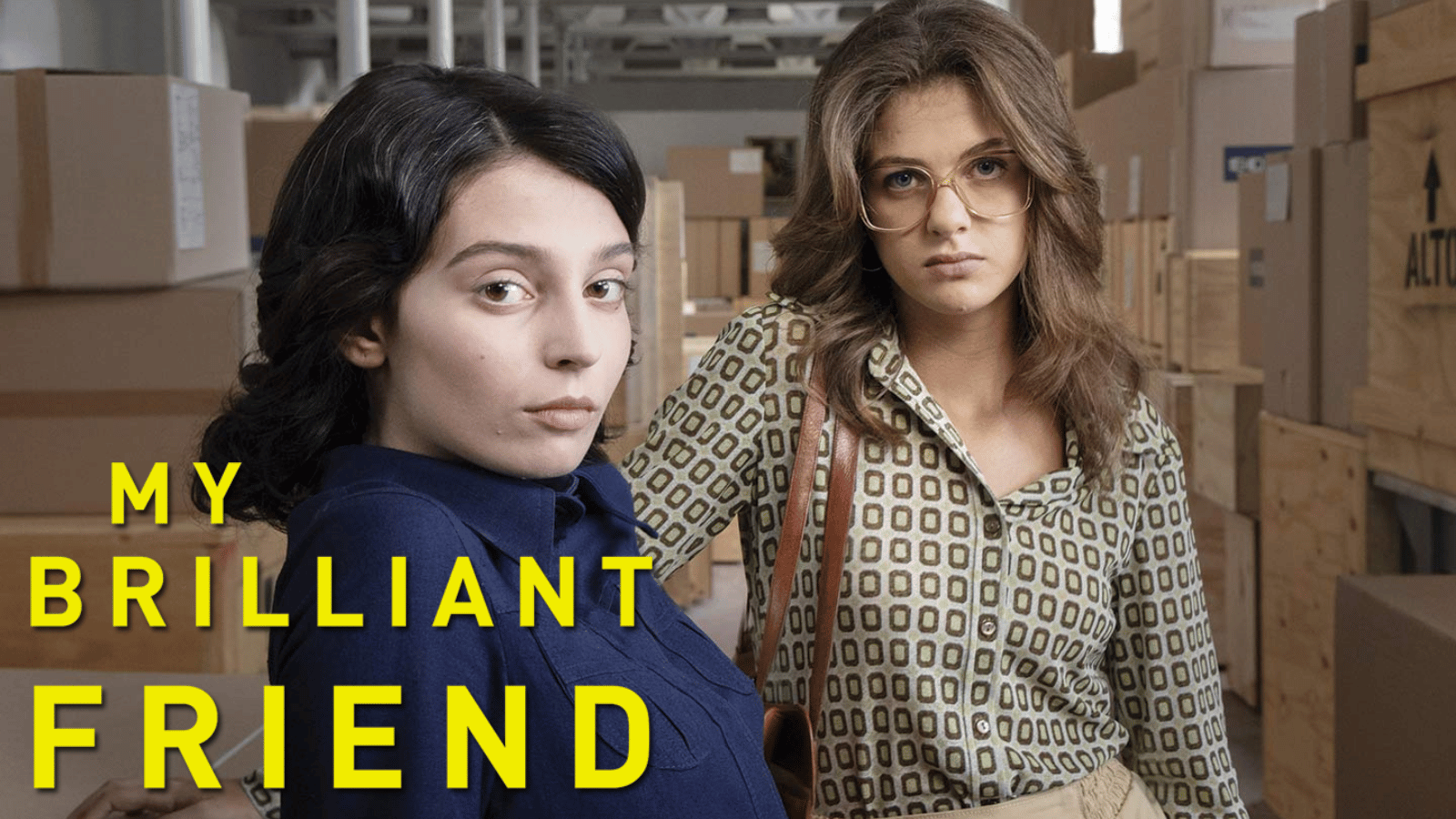
My Brilliant Friend Season Three (HBO)
Written by Elena Ferrante, Francesco Piccolo, Laura Paolucci and Saverio Costanzo
Directed by Daniele Luchetti
I have been very impressed with how this show has made very young actresses appear to age into their late 20s/early 30s. It’s done through the talents of make-up artists, hair stylists, and wardrobe, along with the actresses’ physical and emotional performance. There are moments where the youth of Lenu might slip by all that, but for the most part, this season completely sold our two lead actors as maturing women, worn down by a society that looks all too similar to the one their mothers grew up in. That was the overarching theme of the season: Lenu’s realization that she was living a life as unexamined and pre-planned as her own mother, just with nicer furniture.
The events of season three flow by so quickly, years peeling away as we watch Lenu (Margherita Mazzucco) go from engaged to a junior university professor to married and, by the end of the season, the mother of two little girls. This happens against the backdrop of the women’s liberation movement that reshaped Western society in the 1970s. Lenu has her friend Lila’s (Gaia Girace) thoughts in her head throughout these years, how Lila said marriage made her feel suffocated and how being a mother drained her. Lenu wants so desperately to prove this wrong, but five years into her marriage, it’s hard to deny the truths Lila spoke of. It’s not that being married is inherently oppressive; it’s the social structure that puts men’s interests above women’s that makes it that way. Despite her husband’s progressive leanings, Lenu comes to see him as holding the same misogynistic mindset as the men in her neighborhood she was trying to escape.
As mentioned above, I was very impressed with how the production team allows characters to age in fluid ways. I found Girace brought a lot to her performance as Lila this season. I should note she is not in much of the show this time, reflecting the distance that has grown between her and Lenu. Lila is back in the old neighborhood and has compromised so much of her life to work with people the two friends vowed to stand against. The book title that served as the basis for this season is “Those Who Leave and Those Who Stay,” and that is precisely what the season is.
Lenu’s return to her neighborhood in Naples is a reminder that she is someone who understands this place, but she is also repulsed by it. We see how Pietro, her husband, is out of his depth, while Lenu understands the aggression needed to make your way through this place. However, she’s a woman, and his manhood creates problems; the Solara brothers ignore Lenu’s wishes and cajole her husband into letting them lavish the family with hospitality. Lenu’s little sister lives with Marcello, and Lila works directly for Michele. The bad guys from their youth are now intertwined in their lives, and this disturbs Lenu.
The first half of the season features Lila more heavily, working at a sausage factory owned by Bruno. The working conditions are taking a toll on her body. Pasquale is more entrenched in the communist movement than ever and sees Lila as a powerful spokesperson for the cause. He doesn’t know how to handle the situation well and ends up putting Lila in quite a bit of harm. I feel mixed about the portrayal of communism in the series; I wish they would showcase slightly older and more mature people in the movement.
Instead, we only ever get young, brash men who are repeating the mistakes of their forebears by not taking women seriously. This is strange to me because the communist theory I’ve read thus far doesn’t show animosity towards women. What I’ve read regarding domestic labor is that it is seen as a legitimate form of labor just like any other and that society has a responsibility to economically compensate stay-at-home moms & dads because they are raising the next generation of workers. Their ability to provide quality care & a positive home for their children is crucial to making society function. I don’t doubt there were anti-feminist people in the Italian communist movement. We see that in the women that Lenu encounters, she’s never really too deep into things but has friends who are involved.
The scope of the world has expanded immensely. In season one, stories barely left the simple neighborhood in Naples. Now that the community has exploded with widened avenues to allow for car traffic, almost everyone there owns one. After getting married, Lenu’s visits are much less frequent, and by the end of the season, I wonder if we’ll see much more of the place in season four. When Lenu first comes back after publishing her novel, the people of the community view her with disgust; the book’s explicit sexual scenes are a scandal. When she returns married & a mother, they greet her with gifts, including a copy of that novel translated into German.
The continued theme here is that both women, Lenu & Lila, seem unable to escape the gravity well of their childhoods. Lila is living back there with Enzo, who is her partner, in lieu of legal divorce. Lenu seems forever seduced by her childhood love of the unreliable Nino. The show also uses its final scene this season to make the casting of these two actresses make sense from an impressionistic point of view. Lenu looks into a mirror where she sees the adult narrator of the series (Alba Rohrwacher). The implication for me was that for a long time, Lenu couldn’t see herself as anyone but the young girl growing up in Naples. Having made the first significant decision of her adult life, Lenu is transformed in the mirror from a girl to a woman. I appreciated that the show didn’t wholly support Lenu’s decision; there’s a bittersweet heartbreak to the moment. A family has been broken apart, and we are unsure how this will play out.
With one more season, the main actors have been recast with older performers. I’m still determining how I feel about this, and it will take some adjustment to see these new actors as these same people. I have loved every second we spent with Girace & Mazzucco; saying goodbye is hard. I expect we’ll see them again in a flashback or a fleeting memory in the final season. This is one of the best televisions I’ve ever seen, and I have zero doubt they will stick the landing when the time comes.

 PopCult Reviews
2 thoughts on “TV Review – My Brilliant Friend Season Three”