
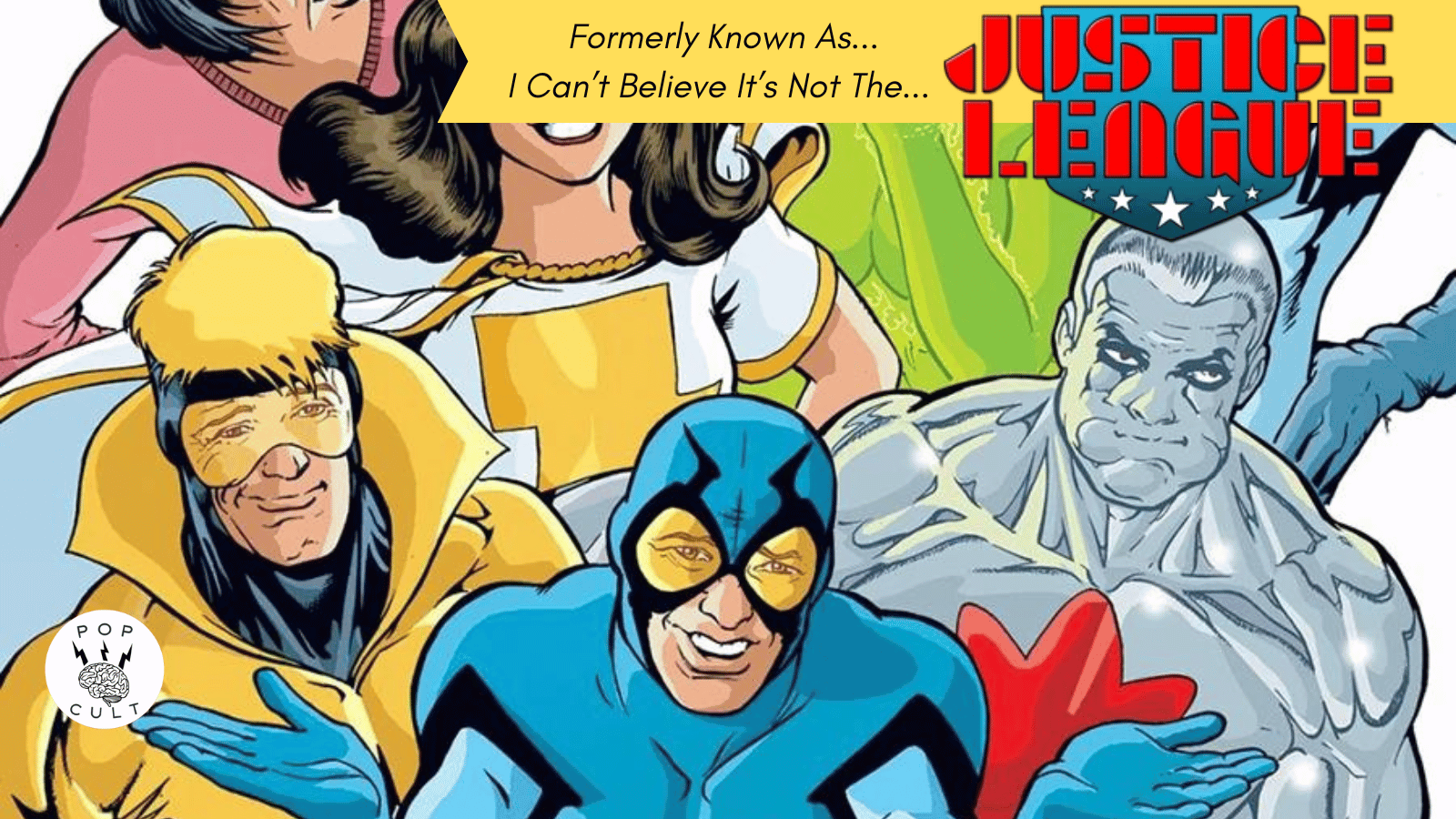
Formerly Known as the Justice League (2003)
Reprints Formerly Known as the Justice League #1-6
Written by Keith Giffen & J.M. DeMatteis
Art by Kevin Maguire
I Can’t Believe It’s Not the Justice League (2005)
Reprints JLA Classified #4-9
Written by Keith Giffen & J.M. DeMatteis
Art by Kevin Maguire
On October 9th, 2023, Keith Giffen passed away from complications following a stroke. I can’t say with complete certainty, but I believe my first Giffen comic was Justice League America #42, so I always think of this run with J.M. DeMatteis when I see the writer’s name. Since then, I’ve read more of his work. I enjoyed his time on the Five Years Later reboot of the Legion of the Superheroes, but nothing can eclipse his Justice League. I’ve re-read and reviewed all of that here on the blog, so it was time to look at the two sequels that came about in the 2000s.
By 2003, Grant Morrison’s cinematic JLA was most prominent in the minds of DC Comics’ readers. It made sense as it featured the classic line-up: Superman, Batman, Wonder Woman, The Flash, etc. However, weirdos like me still had a soft spot for the Giffen-era team. There must have been enough fans or strings pulled to get us, Formerly Known as the Justice League.
This six-issue mini-series finds Maxwell Lord, the wealthy businessman who founded the Justice League International, intent on getting the band back together. He recruits robot sidekick L-Ron, who is working the drive-thru of a fast foot joint. Lord’s plan is to create a hotline the average citizen can call when they need superhero help, which he regretfully wants to name “The Super Buddies.” The recruitment drive continues with familiar faces like Blue Beetle, Booster Gold, Fire, Captain Atom, Elongated Man, and his wife Sue joining up in varying degrees of reticence. Captain Marvel (Shazam) declines the invite, but his sister, Mary Marvel, sees it as an opportunity to do more good. Her naive, positive mindset is quite at odds with this dysfunctional team.
Kevin Maguire’s illustration style was the first thing that stuck out to me. It’s hyper-expressive in a way that most comic artists never attempt. Maguire studies the human face in-depth and can deliver many variations in his characters. They aren’t just happy – they are gleeful, giddy, overjoyed. They aren’t just angry – they are slightly annoyed, boiling mad, furious with rage. It’s the perfect art style for a comic book that tells a more grounded, working-class superhero story. They are heroes because they want to do good, but they are also humans who have bills to pay. Their personalities are also so wildly varied that, of course, they will clash.
Since readers last saw many of these characters, their lives have changed: Fire does modeling on the internet. Elongated Man & Sue have been in a state of semi-retirement. Booster Gold has married an elderly heiress because he’s a gold digger, and he & Beetle are at odds trying to prove which one of them has matured more since the old days. Neither does a convincing job. Captain Atom is the one character in this mix with whom the writers never know what to do. It makes sense then that Atom doesn’t appear in the sequel mini-series two years later.
Despite having so many of the familiar elements of the 1980s/90s run, the book was flat. There was some of the old magic lacking. The expectation of a particular type of story loomed so large from the first pages that Giffen & DeMatteis felt pressured to be more of everything. They try to be sillier than the original series. They have the characters argue more than they did in the old book. The male chauvinism that seemed balanced with barbed responses is not as well-written here and comes off as pretty gross. It’s not the most offensive thing I’ve read; they just read like lazy, dumb jokes. Instead of one core plot, the book goes off in several directions: the neighbors where the Super Buddies rent their offices want them out, the team gets abducted by Roulette to fight in her arena, and the battle with Manga Khan never feels as developed as they could have been. So much of the book centers on jumping into zany antics that we don’t get the time to have these characters do any reflecting. Throughout it all, I found Maguire’s art to be the linchpin holding it all together.
Two years later, in the pages of the anthology series JLA Classified, these creators returned for a second round with the Super Buddies. Captain Atom is swapped out for Power Girl, which is a better choice. We also see Guy Gardner come back into the fold, formerly a Green Lantern at the time of publication but still very much a supreme jackass. I found this mini-series to work a lot better than the first. The writers balance the tone evenly with a good mix of humor and pathos.
Power Girl is part of the Justice Society and has become a far more competent hero than she was in her JLI days, which makes her frustration with the Buddies relatable and hilarious. The contrast between the worldly Fire and the wide-eyed Mary Marvel is played up more, which makes for a fun counter dynamic to Beetle & Booster’s Abbott & Costello routine. There are great bits between Elongated Man and Sue, especially when he incorrectly assumes she’s with child.
One of the problems that remains is the writers’ tendency to run a joke into the ground. The original JLI books would have ongoing jokes and callbacks that worked because they weren’t focused on so closely. Now, readers expect that the stories will be chock full of this zany humor, and you can feel the writers scrambling to find material to hold onto. Sometimes, it hits perfectly; other times, the joke keeps coming up on every page, and you’re left wondering when the story will move on from it.
The story is broken into three parts – setting up Power Girl & Guy Gardner’s return, accidentally trapped in Hell, and fighting their way off Earth-3 against their evil counterparts. I was far more engaged in these stories than in the first volume. There’s a moment in the Hell arc where a deceased teammate returns and holds quite a bit of emotional impact. That’s followed by a variation on the story of Orpheus and Eurydice, which ends just as tragically. It leads to a surprising bonding moment between Guy and Fire, two characters who are more often than not at each other’s throats in anger.
The same year this story was published, DC editorial decided to suck all the humor out of these characters and make them punching bags in the Infinite Crisis storyline. Max Lord would turn evil and murder Blue Beetle, and the rest of the team would try to avenge his death in the pages of The OMAC Project. There have been attempts to nod to this bygone era of the Justice League and even a maxi-series by Judd Winick that showcased a seeming ignorance of their personalities entirely. We may read and review that here someday. While these two mini-series are not the best of the Giffen/DeMatteis League, they are a nice, brief return to a type of comic that just doesn’t exist anymore.

 PopCult Reviews
it was a very nice review!!!! Congrats!!!
Nice review. To say things would turn dark for these characters is a gross understatement. A mood whiplash would be more apropos. But this was post 9/11 and everything was darker and edgier – including Marvel, for that matter. So reading the series is a pleasant surprise considering the period it came out. It sure wasn’t perfect, but it was nice to see some humor being injected into the proceedings.