
Divine Intervention (2002)
Written and directed by Elia Suleiman
Santa Claus runs across a hill near Nazareth in a panic. He’s pursued by a gang of knife-wielding youths. He runs out of steam. They catch up with him. Everything moves so quickly. Santa looks down. The hilt of the knife extends from his chest. He stumbles back. Collapses. That is how Elia Suleiman begins Divine Intervention, another of his vignette comedies. Is this a heavy metaphor about Western culture being driven out by the Palestinian youth, a shocking, dark comedic scene to grab the audience’s attention, or both? My answer is yes.
As we work our way through these Palestinian films, you might find yourself thinking: “Wow, all these movies seem to center around the Israeli occupation in some way, even if the story in the foreground isn’t directly related to it. Why is that?” This is because the occupation and those who carry it out have put Palestinians in such a chokehold there is no other subject worth examining so closely. Where they live, how much food they have access to, how often they can see loved ones who live outside of the West Bank or Gaza, every single aspect of their movement and lives is controlled by the occupying power.
In the West, we have been afforded some freedoms that allow our focus to rarely focus on how we are controlled. Media in the West is also a tool of control through distraction. Cinema in Palestine is outside the confines of Western manipulation, so it can focus solely on what is most important in the culture.
In the Journal of Palestine Studies (Vol. 29. No.2, Winter 2000), Suleiman was interviewed and explained how he relates to his homeland: “The notion of space for me is mixed up with identity. It is true that I have always questioned the problem of identity, in all its aspects-identity and its negation, identity and its position, identity and otherness. But now, I have the feeling that the notion of identity-my identity as a Palestinian-has lost its meaning as a point of departure for my work, at least in political terms.“
And then this statement: “I don’t have a homeland. And since exile is the other side of having a homeland, I’m not in exile. On the other hand, at another level-a nonpolitical level-every place is both a homeland and an exile. What is important is to be able to position oneself in relation to the world, to give spatial support for your perception of the world. Exile is a privilege in the sense that it makes this possible. Exile is a kind of “place,” too. For me, Nazareth and New York are both simultaneously exiles and homelands.“
These two statements help us understand Suleiman’s aesthetic choices in his work, why he shoots everything from such a distance, and why his character in each film remains silent for almost the entire runtime. He feels detached from the places he inhabits and, as a result of this detachment, doesn’t feel a strong sense of identity. To have identity means to have a connection to a place.
Suleiman’s film persona is the human representation of exile, a person outside of location and thus an emotional blank. He is from Nazareth, not the West Bank, but also Palestinian, so he feels connected to his people within that space. He later states that the Israeli occupation has made Palestinian identity and the land even more closely tied together. As we will see in other pictures, this is represented with much more fire and passion. For someone like Suleiman, who lives in limbo, the experience is more alienating.
Divine Intervention exudes a strong sense of comedy mixed with tragedy. A moment can be quite funny or silly and then turn into something heartbreaking in a single second. That emotional whiplash can be a fact of life for many of the Palestinians living under occupation. Through the vignettes, the director attempts to discover the identity he struggles to find in himself. There’s a scene where a man driving through his neighborhood on his way to work waves and smiles at the people in his community while uttering insults towards them or bringing up bits of gossip he’s heard. They live in solidarity against the occupation, but that doesn’t mean they always get along. It’s an incredibly human and relatable moment.
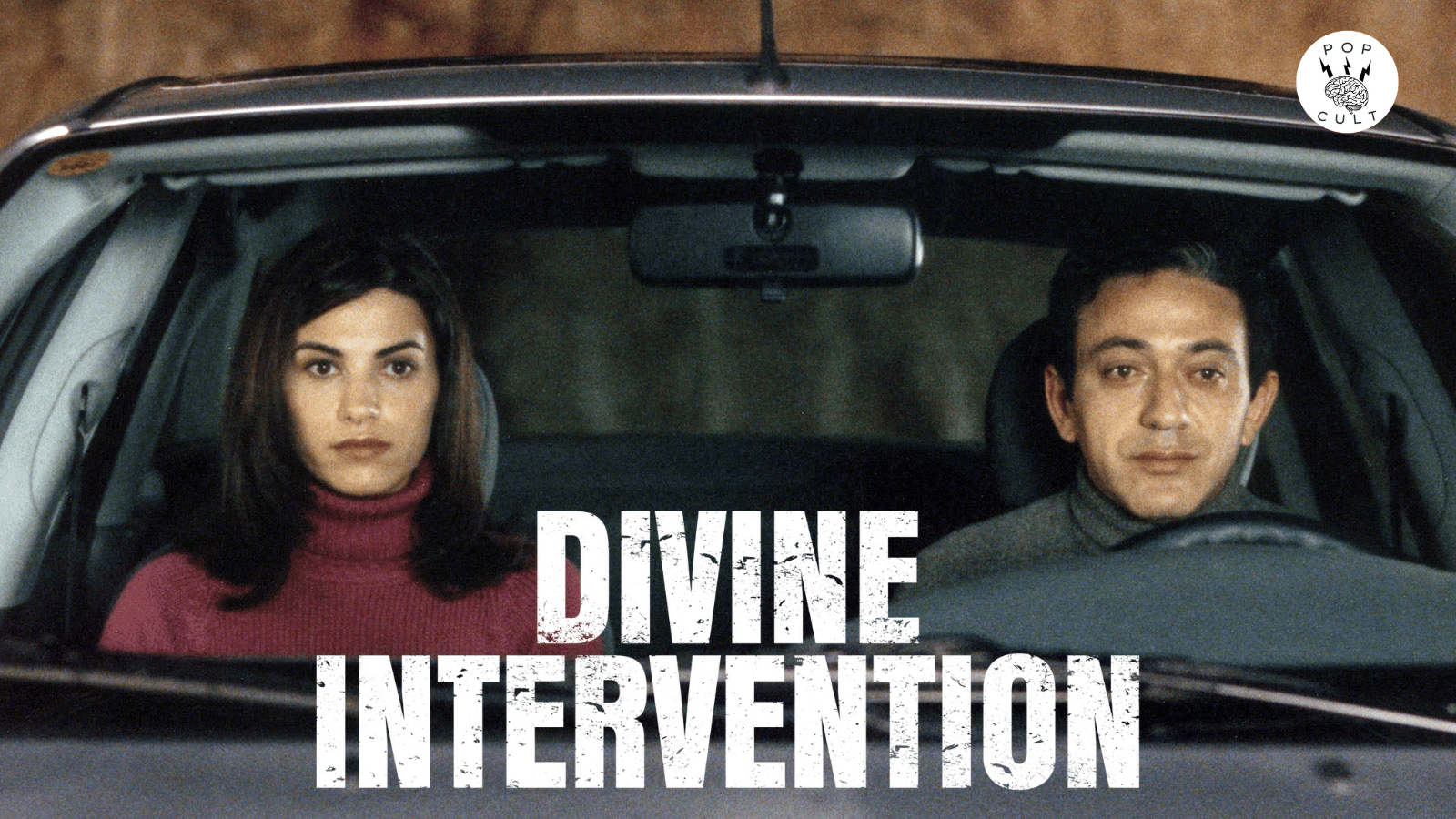
A man chucks a peach pit out his window, and it explodes a tank. A red balloon of Yassar Arafat’s face creates chaos at an Israeli checkpoint. Suleiman sits with a mysterious woman in a car meters away from a checkpoint. They hold hands out of view of the guards. This tiny moment of connection feels tremendous. Very intimate moments of human folly are juxtaposed with immense violence, and it is in this gnarled twisting of tones that you see why life in occupied Palestine is such a wounding experience.
This exchange between Suleiman and an interviewer about Divine Intervention depictions of violence is hugely illuminating at how the West views the Palestinian right to resist occupation and is a great note to end this review:
Interviewer: E.S. is a very meek and passive character, yet the film seems to be about his explosive fantasies. Are you afraid that people will interpret these images, such as the scene where the tank explodes and the ninja attack, as condoning violence? You’ve said that you’re a pacifist.
Suleiman: First, I don’t think there’s anything particularly violent in exploding tanks. But I don’t think that tanks should exist to begin with. The question really should be reversed. Should tanks exist? In fact, I think they should explode all the time. I’m just not going to be the one who does it.
Next film: Paradise Now

 PopCult Reviews
2 thoughts on “Movie Review – Divine Intervention”