
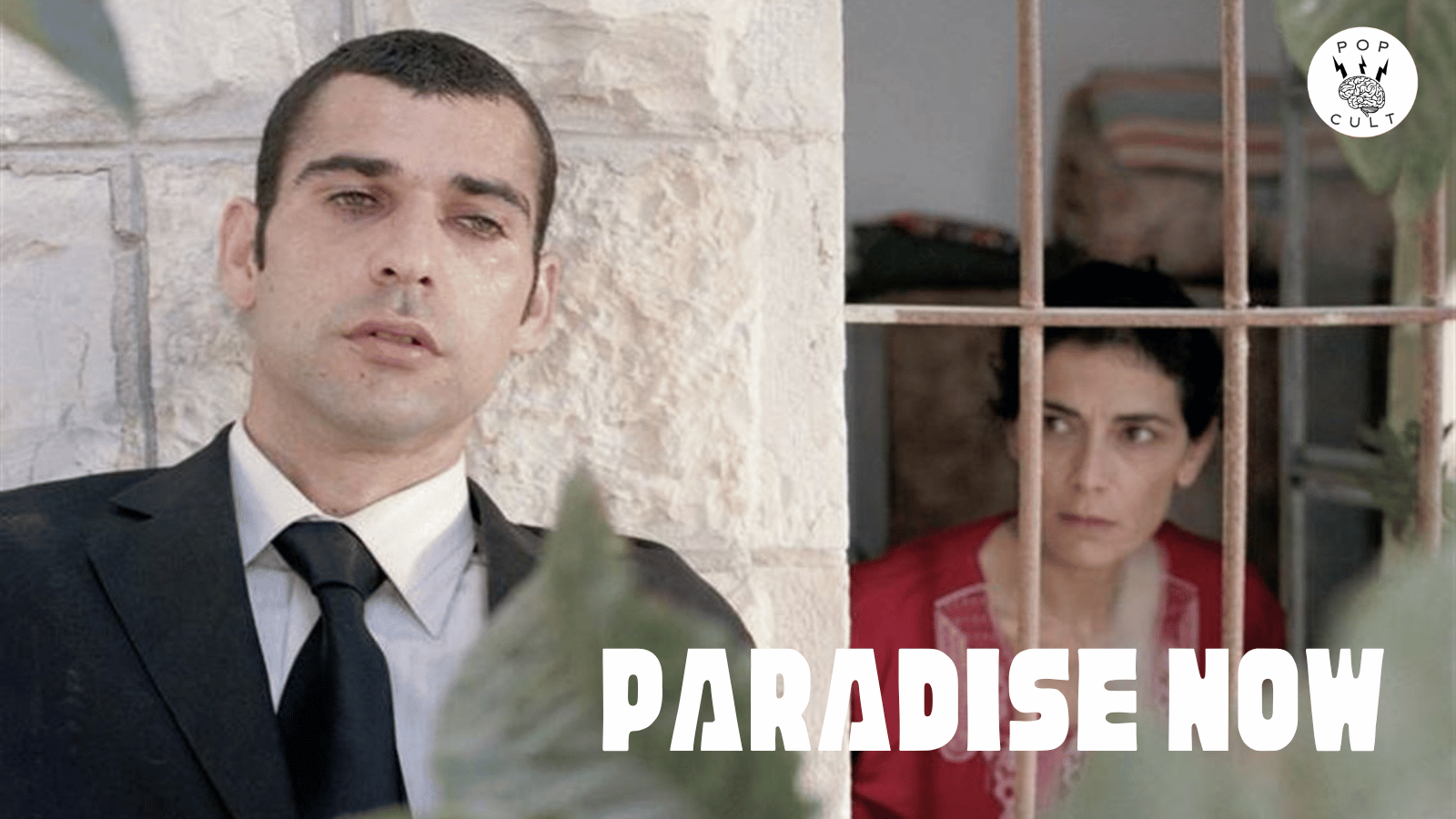
Paradise Now (2005)
Written by Hany Abu-Assad, Bero Beyer, and Pierre Hodgson
Directed by Hany Abu-Assad
It was once said that the suicide bomber was the “poor man’s atomic bomb.” There’s an immediate revulsion many of us in the West have when we see stories or hear about suicide bombings. I think it’s the intimacy of the act. Rarely do you see talking heads on the news react so strongly to stories of drone bombings or Western airstrikes. The suicide bomb seems to be an outgrowth of the act of self-immolation, the act of setting oneself on fire as a form of protest. The argument against suicide bombings has been that they kill many innocent bystanders. I would refer again to the formalized attacks on civilian populations by the West that are not held to this same standard. Paradise Now is the story of a suicide bomber and seeks to understand why a person would feel as if they have no other options to be heard.
Said (Kais Nashef) has lived his whole life in Nablus, in the West Bank. He works with his childhood friend Khalid (Ali Suliman), and they have been recruited together to take part in a suicide bombing attack on Tel Aviv. Their handlers come from an unnamed resistance group and have them record videos glorifying God on the eve of the attack. They say goodbye to their families, being told not to say anything about this being their final farewell. Said and Kahlid’s hair and beards are cut, they are put in suits, bombs strapped to their chests with a cord that detonates them. They are to set the bombs off at an Israeli checkpoint. One will go first. The other will wait fifteen minutes for the police to arrive and take them out.
But then, something goes wrong. The men have a break in the fence they can slip through, but there are guards present, and shooting commences. In the chaos, Said ends up by himself. Khalid returns to their handlers as they try to salvage the operation, unsure if Said is alive or dead. Meanwhile, their missing comrade goes on a strange odyssey. He moves like a ghost in the community he grew up in; he observes this place like he is outside of it already.
Paradise Now was the first Palestinian film nominated for an Academy Award. It was also the first Palestinian film I had ever seen and the only one until this present series. My college friend Rebecca asked if I wanted to see it at the theater. I’d never heard of it, but she knew I was someone who’d watch pretty much any well-made movie. I can remember my tears at the film’s final scene; it stuck with me, one of the moments I could remember almost two decades since I saw it.
Suha (Lubna Azabal) is the conscience of Said, a woman from his neighborhood, a potential love interest that will never be, and the daughter of a Palestinian revolutionary who sacrificed his life for the cause. She desperately wants to convince Said not to go through with this plan. Suha states that she would rather her father be alive today so she could be with him than the life she has now, living in the wake of his death. Said can provide his counterargument by speaking to how his father was a collaborator with the occupying force. The man was subsequently executed by a Palestinian group when his betrayal was discovered. Now, all Said wants to do is redeem his family name and get revenge. In his mind, the Israelis took advantage of his father’s weaknesses and thereby soiled the entire family.
What sticks with me most about Paradise Now is the genuine absence of moral judgment about what Said wants to do. The film neither condemns nor praises him. Instead, it allows us to understand what the Palestinian people experience daily and why they could be driven to commit such an act. When I saw it back in that theater nineteen years ago, I remember suddenly having a proper understanding as to why suicide bombers do what they do. I also saw how, put in these exact circumstances and offered no way to escape them, I might do the same. That is one of the things I love about a well-made film, especially on such a sensitive subject, that it causes me to grow in my understanding of another person in a different culture.
Paradise Now refuses to let the suicide bomber be an ultimately nameless, faceless plot device as they are when used in Western media. Instead, it opts for an honest, humanist conversation about what happens when liberation has avenues for peace removed. If a system is composed entirely of the most brutal methods ever devised to control a population, we have no right to be shocked or offended when the oppressed do whatever they can to strike back against that system. There is no bias here, just a portrait of a person who cannot see any other way left on the table. They should not be expected to submit to their oppressor as a path to peace. Peace with the conditions of subservience is not peace but slavery.
There’s a moment shared between Said and Suha. They talk about ten years prior when riots broke out in the West Bank. One of the consequences of this action was that the only movie theater in Nablus was burnt down. Suha has always been confused about why that place in particular was targeted. She asks Said, “But why the cinema?” he replies, “Why us?” Said reframes the conversation. Let’s talk less about why a building was chosen to be destroyed and why an entire people have been systematically murdered and tortured for decades.
One thing I’ve noticed since moving to Europe is that movie houses are predominantly playing American-made films. In a sense, they are propaganda wings of the American establishment, promoting their ideals through entertainment. I would guess that a movie theater in the West Bank is probably playing a lot of American fare as well; there is no substantial Palestinian filmmaking scene producing enough films to stock a theater regularly. If all we do is watch media pumped out of the States, we will never understand our world. If all we do is seek distraction from life, we will never live. You have to seek out the cinema of other cultures and cultivate a hunger to see new perspectives. Only then can you begin to understand humanity.

 PopCult Reviews
3 thoughts on “Movie Review – Paradise Now”