
Into the Odd Remastered (Mophidius)
Written and designed by Chris McDowell
Graphic design by Johan Nohr
You can purchase this game here.
You can read Part Two here.
Into the Odd is another in the OSR subgenre of tabletop roleplaying games. See my first post about Mork Borg for a more detailed definition of what OSR is, but the short one is it is a throwback to the original way of playing Dungeons & Dragons mixed with more contemporary elements. The result is gaming experiences with the nostalgic familiarity longtime players enjoy, with fresh takes that can help bring in new players. Into the Odd is a game I have heard a lot about since it began development in the mid-2010s. Chris McDowell hasn’t sat on his laurels and continues to refine the system with additions like Electric Bastionland and the recently funded Mythic Bastionland. Into the Odd has also inspired further hacks like Cairn and Knave, which have inspired more games. These come up fairly often as solo-friendly systems, so I decided to start at the source and, over time, try out the others to see which one I mesh best with.
So, what makes Into the Odd stand out from all the many OSR games out there? Two aspects are at play: a unique way of handling attributes & HP and a rich, evocative setting. Character creation is remarkably quick. You roll 3d6 for each of the game’s three attributes (Strength, Dexterity, and Willpower). Then it’s 1d6 for your Hit Protection (not Hit Points).
You roll and consult a table based on your highest attribute for your equipment. You will find a starter package of tools and weapons where the two meet. This table ensures that if you start with overall low stats, you get a powerful weapon or vice versa to balance things. All basic adventuring equipment is kept in the abstract; players can assume they have lanterns, bedrolls, rations, etc. Because this is an industrial setting, guns and explosives are commonplace.
The mechanics of the game are just as smooth as the character creation. Saving throws and ability checks are a d20 roll. A success is any number under the selected ability score. Want to make that jump across the pit? Your Dexterity is a 12; you roll a 15 and succeed. You roll a 9, and you fail. There’s no initiative rolling as the PCs and their allies always go first, and bad guys go second. There aren’t even attack rolls; players just roll damage with most weapons dealing either 1d6 or 1d8 damage. If the attack is obscured, the roll drops to a 1d4. On the flip side, if you or the enemy has a significant advantage, the GM can allow that damage die to be bumped up to 1d10 or even higher, depending on the circumstance. Enemies also get to jump to damage rolls too.
Armor can take some damage; the rest is taken from the Hit Protection, which maxes out at 6. What happens once that HP is gone? The player must pass a Strength save or suffer critical damage. Crit damage forces the character out of action until they can rest or are attended to by an ally. That damage is also subtracted from Strength. If both your Hit Protection and Strength end up at 0 simultaneously, you are permanently dead. Some enemies or items can deplete your Dexterity or Willpower, and those fall under the same rules. If they ever reach 0, along with your HP, you are either paralyzed or have lost your sanity. Healing comes naturally, though. A short rest restores your HP back to full. A few weeks of in-game downtime brings ability scores back to their maximum.
So, what do you do in this game? Well, it’s a dungeon crawler for the most part, set in an era comparable to the mid-late 19th century. Bastion is the largest city in the world and has been built on top of The Odd. It’s been determined the world is far too large for anyone to ever map completely, especially when you consider the seemingly endless caverns that weave through the ground below. A whole dungeon delving industry has been built up because of the valuable Arcana found down there.
Arcana are unique magical items of unknown origin that can do everything from mundane tasks to obliterating an entire army in one fell swoop. They come in three tiers: Lesser, Greater, and Legendary. Webbed Hands, a Lesser tier item, allows you to climb any surface like a spider. A potential Greater Arcana is the Book of Despair, which summons a 20 ft area of giant attacking tentacles that require a Strength save to pass by unharmed. You might find the Seal of Madness among the Legendary tier, which places symbols on any object. Someone attempting to decode the symbols takes d12 Willpower damage as it weakens their sanity. From a story perspective, the higher tier an Arcana is, the more consequences there should be for its use to reflect the danger of the item.
For my solo playthrough, I made use of a few extra tools. First, I used Alone in the Odd, a supplement designed specifically for solo play. It provides a Yes/No oracle and a Spark table to roll on, which offers words to inspire events and worldbuilding. I also used this fan-made character sheet because I loved the simple minimalist design. Very easy to read and see where everything is at. Finally, I used this online character generator, The Odd Generator, to give me who I was playing and their stats to add more randomness to my solo play.
My randomly generated character was Edmund Ellison. I had the following stats: STR (9), DEX (12), WIL (14). Alone in the Odd recommended setting your HP at 6 by default simply because you’re going solo. It’s a small amount of protection, even at its max, so I went with that. My starting package of equipment was a bottle of poison, a bottle of ether, a fishing rod, and a pistol.
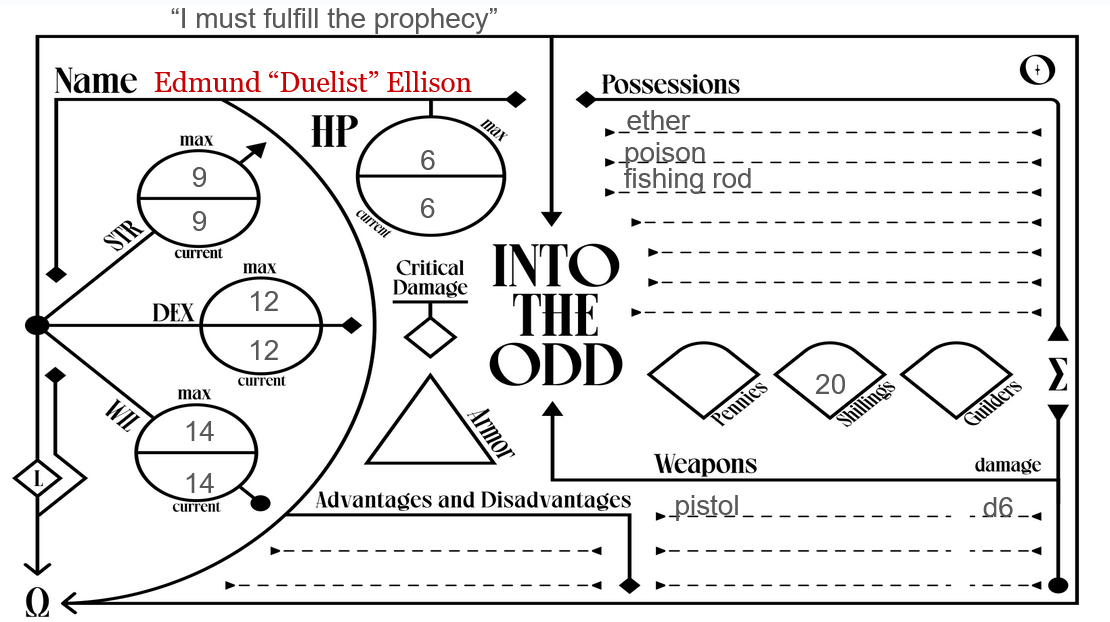
The one bit of flavor the generator provided me with was, “I must fulfill the prophecy.” I used a random online prophecy generator I found after a quick Google search and put together this: “When the moon turns bright, a deadly duel shall cause the fall of two kingdoms,” which led me to this background for the character:
Like the rest of the members of the Church of the Bullet, Edmund has heard the prophecy his whole life. It is why, now in his 23rd year, he wandered the great expanses of the Deep Country, his red holster with white accents strapped to his shoulder, and the ornate sanctified pistol he was given at 18 held within.
But once he left the comfort of the Church’s compound, Edmund found the world was not quite as simplistic as they’d let on. He was now a “missionary” meant to spread the gospel of the bullet. For the first year or so, the young man awkwardly wandered from town to town, stretching the meager coin he’d been given on his birthday to rent dubious lodging where he could find it. In the day, Edmund stood in the streets reciting the liturgy, slowly feeling his belief that this would do anything to improve such an odd world slipped through his fingers. By age 20, he wasn’t sending letters back home anymore. The holster was still there, hidden under a coat, and Edmund didn’t go out into the street to preach. Instead, he sought work where he could, so much of it short-lived. You couldn’t miss him, the tall, lanky figure with the long, dirty blond hair either pulled back in a ponytail or cascading down his shoulders.
Arcana-hunting was enticing: risky yet lucrative. Edmund wouldn’t be the first young person roped into the industry with big dreams of riches & comfort.
Edmund met Poddin Fox when he stopped at a healer’s office in Rosevar. The young man had returned from a particularly daunting excursion into the Underground that saw him thwarting the queen of an undead zombie clan living among the magma flats. Poddin’s first glimpse of Edmund was of a soot-scorched figure with the edges of his pants singed & in tatters. She wore suspenders, a dirty sleeveless shirt, and large black waders. Poddin’s hair, like a fox’s, was a fiery red, trimmed short in the style we know as a buzzcut. They made polite conversation in the waiting room. She waited for him until he left, exiting the healer’s with a slight skip in his step. Poddin mentioned she was off to the Deepcliff region, where she’d heard about high bids for rare Arcana. She needed a partner, and something about Edmund felt reliable. He agreed, and thus, a partnership was born.
Two years later, the duo found themselves before the Iron Coral in the far north, a few clicks from Hopesend, where the only ships headed to the poles could be found. In the future, an excursion that far might be in order. The stories of the legendary artifacts left behind by the Sphenis Kingdom were murmured about often past midnight among explorers in taverns when the ale was flowing freely. Instead, for Edmund & Poddin, this excursion to the frigid northern lands was focused on finding what they could in this giant, twisted maze of earth metals and marine life.
And our adventure in the Iron Coral will continue next week…

 PopCult Reviews
2 thoughts on “Solo Tabletop RPG Review & Actual Play – Into the Odd Part One”