
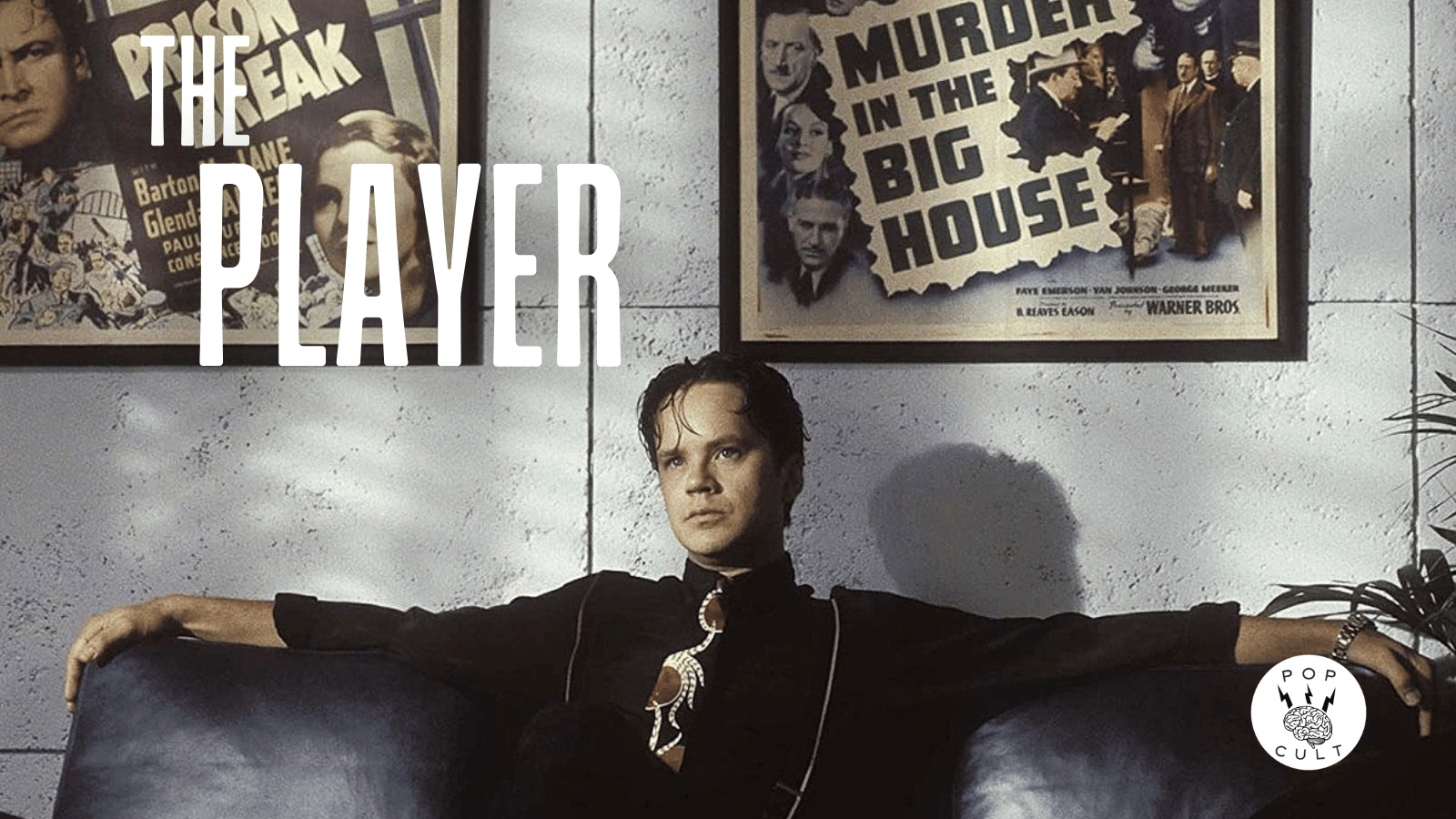
The Player (1992)
Written by Michael Tolkin
Directed by Robert Altman
Robert Altman has been one of my favorite directors since I first learned of him in college. I’d known of his movies, the Robin Williams-led Popeye, especially as a kid. It’s hard to nail down precisely what appeals to me about Altman, but his signature of having large, sweeping ensemble casts is one of them. While his stories might have a protagonist, they are not who the film is entirely about. Altman loves to let his camera wander like an eye, using advancements in sound recording to give the audience snippets of conversations. It’s the voyeurism of Hitchcock paired with a California pothead vibe. The Player couldn’t be a more perfect film for the director, who had struggled through the 1970s and 80s with a contentious studio system. Altman’s loose narratives and penchant for being over budget made the executives & accountants fume.
Griffin Mill (Tim Robbins) is a Hollywood studio executive worried about losing his job to up-and-comer Larry Levy (Peter Gallagher). Most days, Griffin listens to writers pitch their ideas and, more often than not, says no. That changes when he begins receiving postcards with death threats scrawled on him. The notes point to a disgruntled writer, and Griffin posits that it must be David Kahane (Vincent D’Onofrio) whose script he rejected. The executive goes to Kahane’s house and chats with his girlfriend, June (Greta Sacchi), unaware he’s watching her through the windows. She tells Griffin that David is watching a screening of Bicycle Thieves in Pasadena. The encounter goes poorly, to say the least, and leaves Griffin paranoid about what comes next.
If you’ve heard about this movie, you’ve probably heard praises for the opening sequence, which follows pairs of studio employees around the lot, peeking in on conversations where some ludicrous story pitches are being delivered. Buck Henry’s The Graduate II pitch is one of the highlights and is based on an actual idea to make a sequel to that film. It isn’t so ludicrous and outside the realm of reality, Texasville was a sequel to The Last Picture Show, so such things did happen. There have been attempts to make a sequel to Casablanca since that film was initially released. That opening shot is a 7-minute 47-second single take. They shot 15 takes, but it was the 10th that is shown in the final cut. It’s quite a technical accomplishment.
The Player also marked Altman’s Hollywood comeback after spending the 1980s working on independent projects, from teaching at the University of Michigan to an HBO comedy mini-series about the 1988 presidential election. They were successful, though; he could return to his old stomping grounds on his own terms. It is entirely appropriate that the picture is about the rotten nature of studio executives, how they are narcissists and consume others to feel powerful. The current state of Hollywood is just this version but a thousand times worse as finance bros have found their way into the system, dismantling it and making movies for tax write-offs. Imagine the field day Altman would have had with that were he alive and making movies today.
Griffin Mill’s perspective on movies is hugely reductionist. Everything must fit into a neat genre for him to understand and sell it to the studio. When Kahane asks why he’s at the theater in Pasadena, Griffin lies and says they are thinking about doing a remake of Bicycle Thieves. This is a movie nerd joke because the idea that a Hollywood studio would attempt such a thing is absurd. That film is ultimately about the horror a man feels realizing how he has betrayed his fellow man, and even worse, in front of his own child. One would think Griffin wouldn’t have batted an eyelash about taking what he wanted from another person; he essentially does worse here.
Throughout The Player, Altman is calling out praise for the writers. Michael Tolkin, who penned the original novel, is responsible for the screenplay here, so he’s ensured the writer gets their due credit in the story. The executives are no-nothing, uncreatives. They are in the business because of the money that was seen to be made, especially during the 1980s as the blockbuster came to dominate American movies. While being a satire, The Player never feels bitter. Altman doesn’t go after anyone so viciously or insert an avatar for himself to launch a screed at Hollywood. It’s a very clever way of looking at the system he hates while lightly poking away at it.
Griffin is a profoundly amoral character. He’s not necessarily sociopathic because I think even sociopaths can have an awareness of their mental illness. Griffin is presented somewhat sympathetically at first, mainly when the film introduces the threat of Larry Levy. The final shot of the picture flips this on its head. He’s no longer someone we’re rooting for by the end. Griffin is everything that is wrong with Hollywood, a person who sees others as pieces he can arrange on board for his own satisfaction. He manages to fuck with Levy’s ascendant trajectory, one of his least reprehensible acts. He fucks over the script reader he’s been carrying on a secret affair with to take someone else’s girlfriend. This is a character who learns nothing, eventually using money to solve the death threat problem.
Since October, as the American media establishment has shown its completely callous nature towards the suffering of Palestinians, I’ve been dropping some of my old favorites. Some people I suspected might not be great, and they are proving me right. Others have come as a surprise. They reveal themselves as interested in only one thing, hanging on to the sliver of fame they still have because it affords them comforts and money. They don’t care about the cost; in most cases, it appears to be their souls. The Player is such a perfect movie to showcase how the American film industry lost its soul long long ago. They can justify anything now and use money to bury any problem.

 PopCult Reviews
2 thoughts on “Movie Review – The Player”