
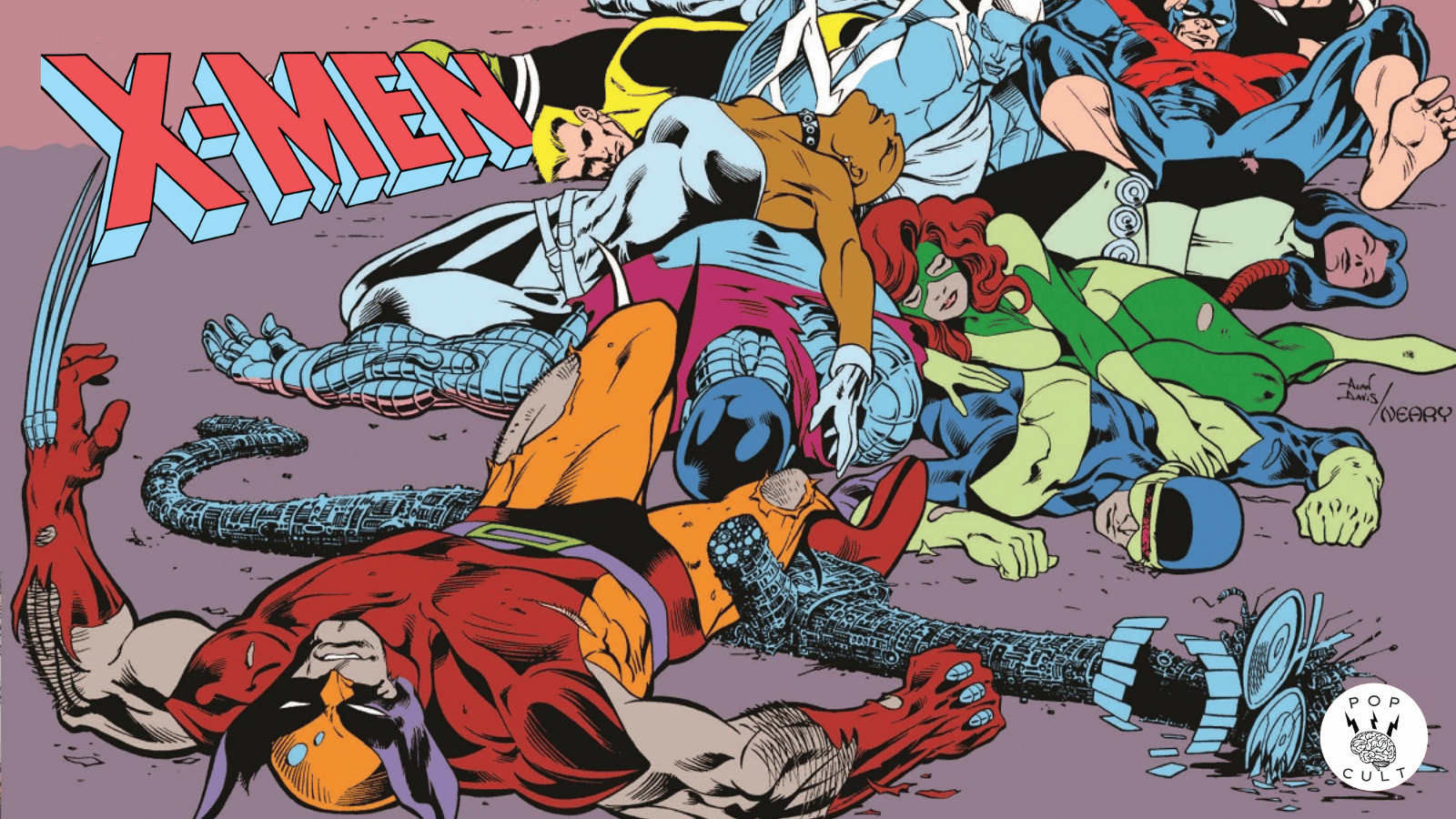
X-Men: The Fall of the Mutants Omnibus (2022)
Reprints New Mutants #55-61, Uncanny X-Men #220-227, X-Factor #18-26, Captain America #339, Daredevil #252, Fantastic Four #312, Incredible Hulk #336-337 & 340, and Power Pack #35
Written by Chris Claremont, Louise Simonson, Peter David, Ann Nocenti, Mark Gruenwald, & Steve Englehart
Art by John Romita Jr, Marc Silvestri, Walt Simonson, June Brigman, Todd McFarlane, Sal Buscema, Jon Bogdanove, Kieron Dwyer, Keith Pollard, Kerry Gammill, & Bret Blevins
Mutant Massacre was not the end of the shake-up Claremont wanted with the X-Men books. With the pending launch of Excalibur and Wolverine’s solo ongoing set to start, the writer stepped away from New Mutants, handing the reins to X-Factor writer Louise Simonson. The Fall of the Mutants would be a crossover in theme only; each of the three X-books at the time would have a contained storyline to dramatically shift the status quo. There are some light mentions of events in the other books, but nothing that would force readers to buy all three. The tie-ins to other comics are even less necessary and can easily be skipped (as I did with many).
I’ll go through the omnibus in the order in which the stories are presented, with the first being X-Factor. Coming out of the events of the Mutant Massacre, Warren Worthington, aka Angel, is presumed to be dead after losing his wings and being in a helicopter when it exploded. Iceman’s powers have reached new heights after being abducted by Loki and used in a plot against Thor. The X-Factor Industries facade is falling apart as the media has leaked information that Warren was actually a mutant.
The X-Factor portion of this collection is the best part, outshining the X-Men and especially the disappointing New Mutants. X-Factor didn’t start its run as a solid title; Bob Layton’s direction for the book with the dual X-Factor/X-terminators dynamic didn’t really work for me. The villains also felt like some of the most generic mutants ever created. Simonson came onto the book and began correcting the course without stomping through the halls and smashing everything up. Instead, she crafted a meticulous story to lead the original five X-Men down a new path.
X-Factor became a book that felt like two-in-one. Half the book contained stories involving the original X-Men, while the other half focused on the young mutants the team had rescued. Rusty, Skids, Artie, Leech, Boom Boom, and Rictor feel like a comic unto their own at many points. In Fall of the Mutants, they have a reasonably prominent arc. What contrasts this title from Uncanny X-Men is that Simonson writes X-Factor like a traditional team book. Claremont had begun to get restless around this time, and it was rare that X-Men followed standard tropes and storytelling structures; he liked to meander, to say the least.
It’s rapidly revealed that Cameron Hodge, the person in charge of X-Factor as a business, is actually a member of the Right, an anti-mutant organization intent on exterminating these people. This helps facilitate the end of the premise Layton had introduced during his short time on the book. But Simonson needs a new direction, which comes courtesy of Apocalypse. The now iconic X-Men villain had been lurking in the shadows for most of Simonson’s run, but his grand plan is finally unveiled in Fall of the Mutants.
Apocalypse assembles three mutants to serve as his horsemen: War, Pestilence, and Famine. The greatest, though, will be Death, a figure kept hidden from readers, who is being experimented on and genetically altered to become just that. I wonder if readers caught on fairly quickly as to who Death would be. It’s hard for me to suspend my knowledge about who it is, so I can’t gauge how shocking a reveal the story would have been. When Archangel arrives on the scene, it does feel like the original X-Men are being transformed and given a new direction. They also have Apocalypse’s Ship as a new headquarters by the book’s conclusion. Out of the three storylines here, X-Factor seems to have as happy an ending as we’ll get.
Uncanny X-Men begins with issue 220, where we get a story with only a couple of X-Men showing up. For the most part, this is a Storm story, following up on the Lifedeath storyline as she returns to Dallas to confront Forge. Something is most definitely wrong, as he’s missing. His mentor, Naze, happens to have come around looking for Forge, too, though his motives are not what he claims.
It’s the following issue, 221, where Fall of the Mutants really seems to kick off. The Marauders return for a rematch, this time with Malice possessing Polaris, which comes as quite a shock to Havok. Interestingly, both Summers brothers abandon their respective partners only to have that choice come back to bite them on the ass in quite dramatic ways. Havok’s is not as grandiose and epic as what will befall Cyclops, but they both should have probably considered staying more connected with their partners. We also get another fight between Wolverine and Sabretooth, an event that will become more commonplace in the following years.
Issue 221 also introduces Mister Sinister. Marauders mentioned him during the Mutant Massacre, but now we get a face to the name, and what a face! I would not be surprised to learn that this was a case of a name first and a design later. Motivation feels like an even more absent element. We don’t really know why Sinister wanted to kill the Morlocks during the Massacre or why he wants to destroy the X-Men. He’s just a bad guy with a bad guy name and who looks like a bad guy. Claremont initially thought to make the character a psychic projection of a child mutant, which makes sense based on that name. To say the character has taken a dramatically different direction in the decades that followed would be an understatement.
The rest of the X-Men’s part in Fall of the Mutants (#223-227) plays out, unlike many other X-Men stories up to this point. There are a lot of cosmic elements as we learn more about the Adversary and their plan to strike down Roma. It doesn’t feel like an X-Men story, in my opinion, more like Claremont is chasing a tone established by writers like Alan Moore, who was able to blend comic books with more esoteric & literary elements. The thing is, Claremont just was never at that level of writing, and so this feels clunky in many parts. It’s certainly dramatic, but there isn’t enough information given to X-Men readers about who Roma is. She had been part of Claremont’s Captain Britain run, which I would guess most of the audience would not have had access to at the time.
The big shake-up ending sees the X-Men killed and immediately resurrected by Roma. The catch is that the public only saw them die, and so a decision is made to keep it that way as the heat from authorities and enemies alike. Thus begins the Outback era of the X-Men, where they hid in Australia while still dealing with threats. I appreciate Claremont tossing Colossus back into the mix in the eleventh hour. Nightcrawler and Kitty Pryde remain behind on Muir Island and eventually become members of Excalibur. However, this era’s team may be one of my least favorite: Storm, Wolverine, Colossus, Rogue, Longshot, Dazzler, Psylocke, and Forge. I don’t find them to be a very visually interesting group, unlike the All-New X-Men at the start of Claremont’s run.
I wasn’t a massive fan of the New Mutants part of this story. Artist Bret Blevins has a more cartoony style, and there are moments where that works and others where it does not. I think the grotesque design of the central antagonist of Dr. Animus isn’t bad. When the inking is done just right, he evokes the perfect sense of horror. However, how the New Mutants are drawn makes them look silly, like Teen Titans Go…well, maybe not that extreme. This undercuts the gravitas of a particularly harrowing moment near the end of the story, where a beloved team member is killed. This is Simonson’s initial arc after taking the book over from Claremont, and it does not inspire much confidence in me.
This is where we stop for now. I’ll return to Claremont’s X-Men in September to wrap up his sixteen-year run and see where it all went wrong and what drove him from the book he made into a golden goose for Marvel Comics.

 PopCult Reviews
2 thoughts on “Comic Book Review – X-Men: Fall of the Mutants Omnibus”