
Millennium Actress (2001)
Written by Sadayuki Murai and Satoshi Kon
Directed by Satoshi Kon
Perfect Blue was my introduction to Satoshi Kon, which blew my mind. It was my first time seeing anime that wasn’t fantastical but grounded in reality. However, that didn’t stop Kon from showing us why animation was the best way to present this story. He did things with animation that were impossible with live action or too cost-prohibitive. Still, it felt right at home with any Hitchcock or De Palma psycho-thriller. Over the 2023 holidays, we watched Tokyo Godfathers, another film whose premise doesn’t automatically lead one to animation. However, Kon shows us again why he could only tell this story the way he wanted with the near-limitless possibilities of the form. Going into Millennium Actress, I wondered how he would showcase the art form with this film.
TV interviewer Genya Tachibana and his cameraman Kyoji rush to meet with Chiyoko Fujiwara, the best-known of films made by Ginei Studios. The film production company is being demolished after going bankrupt, and Genya wants to celebrate Chiyoko’s contributions to cinema through this interview. As the elderly actress begins to tell her story, we start to experience it alongside her; however, Genya keeps popping up in these surreal memories, participating in the events through Chiyoko’s beautiful descriptions. We learn that Chiyoko helped a political dissident as a teenager and left a particular key in her possession, which he said he would collect from her one day. As the years pass, she begins searching for this man and takes a small part in a film. That balloons into an illustrious decades-long career, and the whole time, she hopes the man will see her, and she can return his key to him.
While Perfect Blue is a dark, disturbing meditation on how dangerous it can be when you are a featured performer, Millennium Actress is more gentle. It’s a love letter to movies laced with melancholy, reflections on a life that’s passed its main character by. Through the roles Chiyoko plays, Kon can reference Japan’s greatest films. Early on, her life resembles the quiet slice-of-life nature of a Yasujirō Ozu picture. When World War II occurs and Japan lies devastated we see images that remind us of Gojira. Chiyoko will play roles in samurai-era epics that recall Akira Kurosawa’s Ran and Throne of Blood.
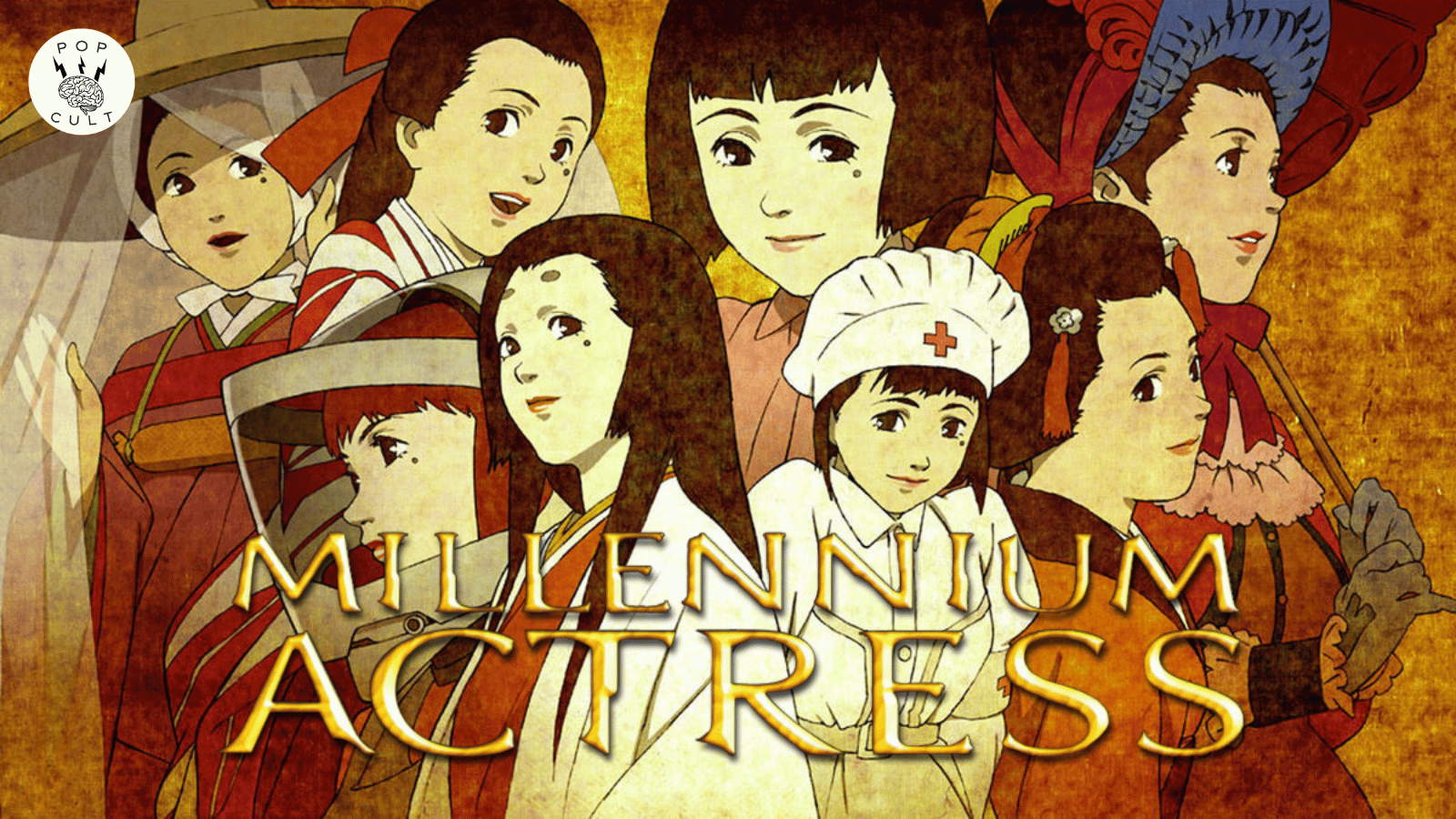
I particularly loved the character design throughout the film. It was a perfect mix of anime and realistic features. Rotoscoping was likely used in some of these sequences, but it’s never done in the way that this technique can sometimes take away from animation. It added life to sequences and helped ground the reality of an otherwise surreal film. For obvious tonal reasons, the picture’s colors are much brighter than Perfect Blue. There’s the additional element of moving through different eras of filmmaking, so what we see on screen reflects those styles and particular filmmakers.
I particularly enjoyed how what seemed to be a narrative quirk with Genya showing up in Chiyoko’s memories becomes something more than that the further we go in the narrative. You’ll likely assume Genya is just a huge fan, but then we learn he has a connection to our star. His story is intertwined with hers in a very wholesome way, a counterpoint to the mentally disturbed fan of Perfect Blue. In fact, Genya knows something Chiyoko doesn’t, which adds to why he was so frantic in the opening scenes about wanting to get to her home and start the interview. I loved how something that felt like a character trait to add flavor to the movie has a crucial role in the plot.
The theme of memory is crucial, particularly how our retroactive perception of an event. Chiyoko has found a more significant meaning in each of her roles based on when she played them in the course of her life. The search for the mysterious man from her past is far more than just a teenage infatuation or a lifelong love story; he was an artist who inspired Chiyoko to pursue a career as an artist herself. Then, through her art, she can articulate things about being a human, about being Japanese, which helps her understand herself even better. Kon shows that, like Perfect Blue, he has a mastery over multi-layered stories, narratives that seem like one thing but go on to reveal something far more complex. What a delight to watch.

 PopCult Reviews
One thought on “Movie Review – Millennium Actress”