
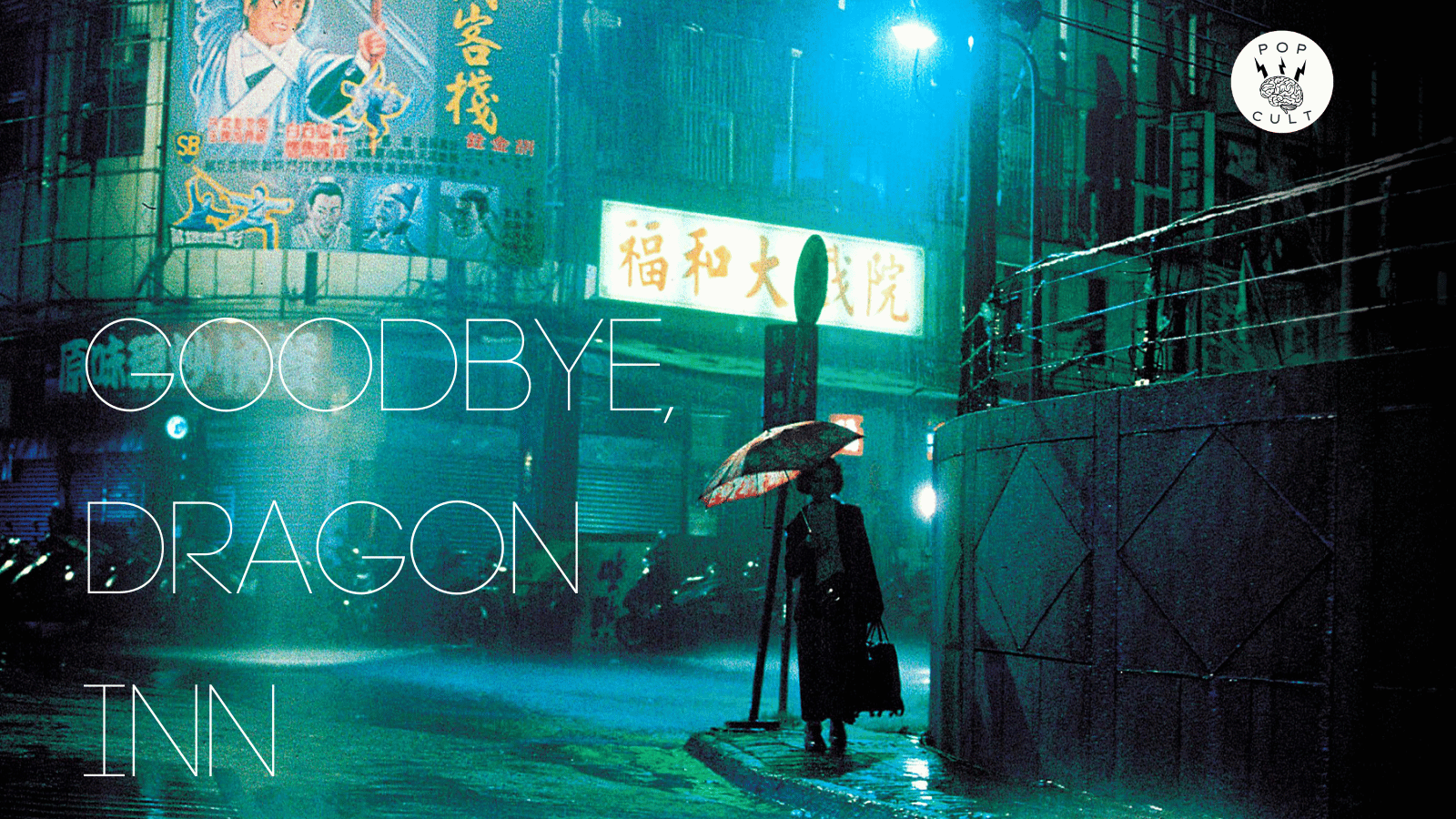
Goodbye, Dragon Inn (2003)
Written by Tsai Ming-liang & Sung Hsi
Directed by Tsai Ming-liang
Since March 2020, I have only seen a single film in a movie theater, and that was here in the Netherlands. The dangers associated with COVID-19, not just death but permanent or even temporary disabling, just made the act of going to the theater simply not worth it. I’ve felt justified in my choice the more horror stories I hear from the States about people talking at full volume or scrolling through their phones during the movie as if they were in their own house. I would consider attending an art-house theater because the crowds would be smaller and more respectful. But even then, most of my film-watching life will be at home for the rest of my life. Before COVID, I visited the theater at least once every other week. But life is change, and we have to move on with it.
An old cinema in Taipei is showing its last film ever, the classic 1967 wuxia picture Dragon Inn. The ticket woman, a physically disabled person, hobbles through the cavernous building, searching for the projectionist to give him a steamed bun. A Japanese tourist enters the theater in hopes of finding a discrete homosexual encounter. Many people wander the halls, but the visitor quickly learns that the place is considered to be haunted. Two of the actors from Dragon Inn encounter each other in the theater lobby, where they speak briefly about their lives.
This is a perfect example of slow cinema, a type of cinematic storytelling I would suspect would be difficult for many filmgoers weaned on the MCU or other big-budget algorithmic content. Slow cinema is a style that takes its time and views its subjects through an observational lens, often with little to no dialogue or commentary. Takes are usually very long, to the point that if you are used to quick cuts, it will feel excruciating. Slow cinema can be some of the most emotionally resonant in that it focuses on establishing mood & tone, and through those elements, it defines its characters. We’re used to seeing plot or dialogue as the critical filmic tools for developing characters. This more ambient way of making movies is such a unique experience.
Because filmmaker Tsai Ming-liang employs such long takes and is in no rush, the movie takes on a layer of texture I have rarely experienced in my movie-watching life. The heavy rain falling outside the cinema adds to the feel of the setting. It affected me so profoundly because the small town I grew up in had a rundown theater with leaks in the roof that required buckets to be placed around the building. I saw Blade Runner 2049 in that decaying cinema, and my surroundings helped add to how I experienced that film. That is precisely what Tsai wants to evoke in his audience: to trigger our memories of being in theaters and watching movies in those buildings.
Movies are memories and ghosts. They take us to places from our past and to places we’ve never been before. They can be a communal experience or something you do alone in a darkened theater. I remember how, during my college years, I would try to stay on campus over the summer whenever I could. Going back home was an increasingly painful experience. When I wasn’t in class or begging for donations working at the campus call center, I would walk to the nearby public library, filling my backpack with books that would last a few days. Then I’d walk to the movie theater just a couple blocks away, buy one ticket, and theater hop until dark. I didn’t often go for the bigger releases. I was lucky that this theater showed many foreign and indie films alongside those. During this time, I saw a bevy of movies that helped build my love of movies. It’s a nostalgic experience I know I will never have again, and I’m okay with it living as a memory I can revisit.
In Goodbye, Dragon Inn, we watch people watch movies. When you think about it, that’s a perspective we rarely, if never, have in our lives. Seeing someone watching a movie can show us something about ourselves. The Japanese tourist grows impatient; the movie is the last thing on his mind, but he needs somewhere to go to get out of the rain, and he’s yearning for intimacy. The ticket woman doesn’t seem to find much magic in the movie; she is just a person doing her job. However, Tsai juxtaposes her with the image of a warrior woman in the film at a certain point that hints at the grander narrative in which he sees her taking part. One of the stars of the movie being shown watches while his eyes fill with tears. For him, the movie is a way to return to an essential time in his life, a period that shaped who he is now.
Watching a film like Goodbye, Dragon Inn and feeling it doesn’t resonate reveals something about you and your relationship with cinema. You may enjoy movies in a very casual, passive manner. Nothing wrong with that. I feel the same about many other things I do occasionally. If you are someone who thinks that film is an aspect of life you cannot live without, and I am not talking about Star Wars or Disney here, I’m talking about movies as art, then Goodbye, Dragon Inn is a beautifully mournful story about the loneliness and beauty of loving these things.
Beyond just movies, this is a film about not knowing what it feels like to experience the end of something until you reach that moment of conclusion. The two theater employees feel so distant from each other during the movie that when the place closes up, they wander away into the darkness. Like life, we won’t know what it feels like for it to end until we are in that moment. I don’t think it will be as melodramatically profound as so many people and pieces of art try to make it out to be. It may very likely be this quiet, uneventful, but ultimately final. There may be others around you when the moment of death comes, but it will be you alone who knows what that feels like in that space & time. Tsai finds such heartbreaking beauty in the solitude of that moment.

 PopCult Reviews
“Movies are memories and ghosts. They take us to places from our past and to places we’ve never been before” so true.