
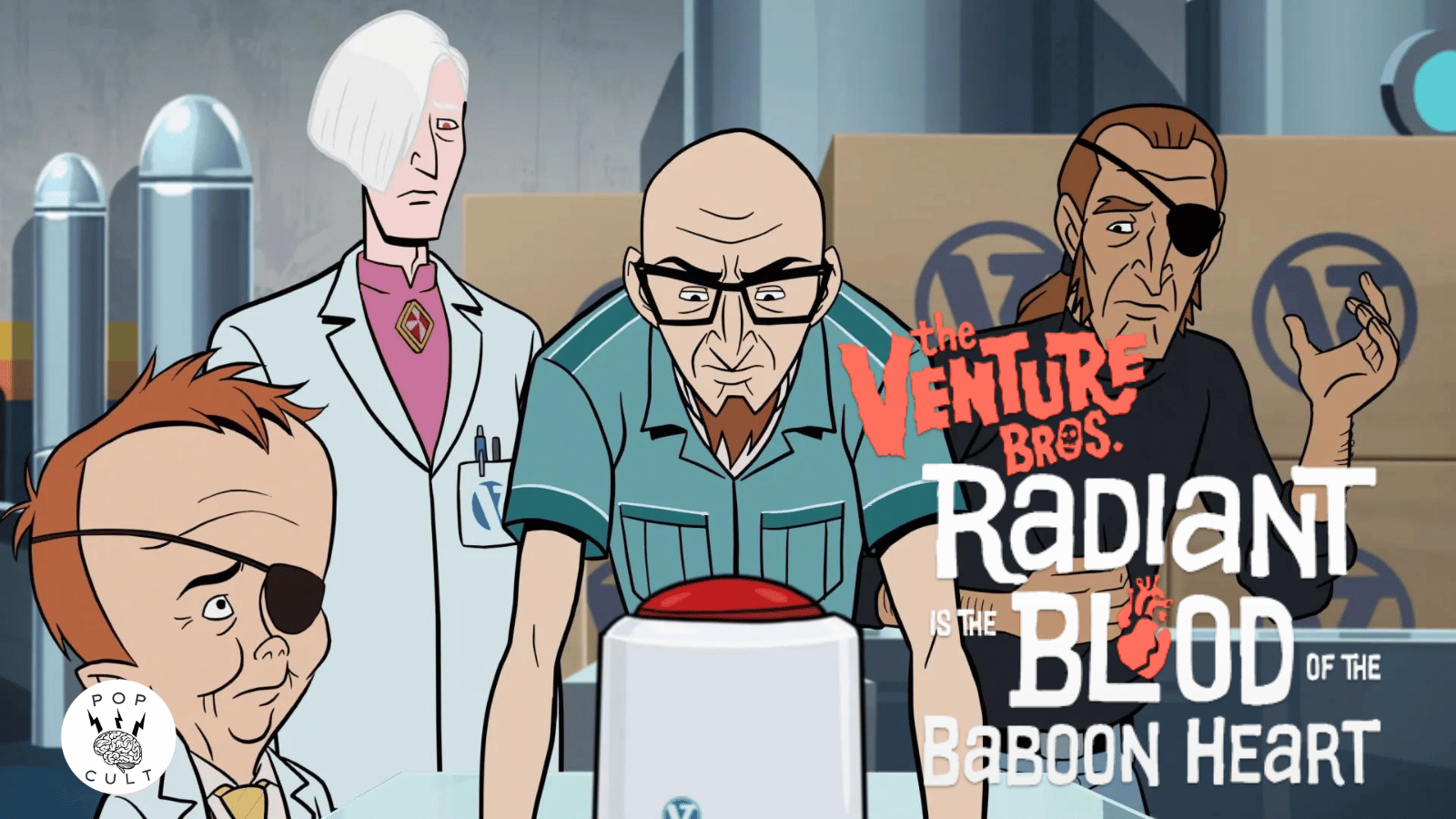
The Venture Brothers: Radiant Is the Blood of the Baboon Heart (2023)
Written by Jackson Publick and Doc Hammer
Directed by Jackson Publick
In 2020, series creator Jackson Publick announced on Twitter that Adult Swim had canceled The Venture Brothers. He and co-creator Doc Hammer had been in the middle of writing season eight when they were informed. After eighteen years, Adult Swim decided they no longer wanted more of this show. Publick & Hammer took what they had for season eight and reworked it into a script for an eighty-four-minute feature that would serve as the series finale. This film was released in 2003, marking the 20th anniversary of The Venture Brothers.
After the events of the season seven finale, Hank Venture is missing. Dr. Venture has enlisted the help of OSI but is too busy with his new product launch to care that much. Dean Venture is far more concerned. It’s mainly because Dean’s betrayal is what sent his brother packing. Doctor Orpheus and his Triad are called in to help, which sets Dean on a journey back to where the show started.
Meanwhile, Hank is experiencing an identity crisis as the various personas seen throughout the series begin engaging him in a dialogue. The Monarch and 21 are courted by ARCH, a new villainous organization that seeks to topple the Guild of Calamitous Intent by providing their members with instant armies and teleporting attack ships. As with all Venture Brothers plots, these seemingly disparate stories will inevitably become entangled. The result will answer many questions fans have had over the years.
With a series like The Venture Brothers, there isn’t an ending. Based on the tropes of pulp fiction, especially Saturday morning cartoons and comic books, none of these formats is known for having endings to their stories. By their very nature, these exist as perpetual merchandising machines. The cartoon is on to get the kid to nag their parents into buying them a toy or cereal or some other junk. The comic book’s serialized form may have endings to arcs, but the main characters never stop. There won’t be an end to Spider-Man or Batman. Even if someone writes “an ending,” it won’t be canon, or it will be retconned when new creators come on board. The Venture creators know this, so they provide an ending that reminds us these characters will keep living and having adventures; we just won’t be able to see them anymore.
Radiant Is the Blood of the Baboon Heart is not made for the unfamiliar to jump in and catch up. This film concludes the series and doesn’t make it anywhere close to a starting point for new fans. It does reward someone who has watched through every season and reminded me of how much Hank and Dean have grown. Initially, they were riffs on the bygone naivety of the Hardy Boys and Jonny Quest. By this point, the boys are growing into young men. They still retain some of that naivety from their early days, but it’s fading fast, and they are forced to deal with more complex problems.
Hank has become far more zen-like as he’s gotten older, willing to play & imagine like a child but with a solid moral center. Dean started out entirely consumed by his anxieties, and while they were still there, he better understood the role his father played in making him like this. He’s also the first brother to discover they are both clones, which, when he reveals this fact to Hank, just slides off his back. To Hank, being a clone doesn’t change the fact that he knows he is “Hank.” Dean is searching to discover who he is, attending college to shake off his father’s pressure to be another him. Hank is just Hank; he doesn’t feel a strong desire to be anything other than that.
There’s a subplot in Radiant about Dr. Venture mass-producing Helper heads as a riff on the Amazon Echo or similar devices. These end up getting hacked by ARCH and serve to create a climatic set piece for the film. There’s also a meta-commentary about mass production of this type of entertainment. Sam Raimi’s Spider-Man was the only Marvel property to have seen box office success when The Venture Brothers started. By the time it ended, Marvel movies had thoroughly saturated pop culture and had become stuck in a boring, repetitive mire. Part of this is that the people making so many comic-based properties don’t love the genre.
That doesn’t mean I believe fanboys are the best group to go to when making these shows and films. It’s not about being a fan of a particular character or story but of a genre – a tone. Hammer & Publick showcased that being a fan of the Silver Age style stories of their youth with a mix of endearment and parody makes for a compelling show. I don’t think the Venture Brothers would work if they simply mocked 1960s-70s cartoons and comics. You have to love something to be able to poke fun at it effectively. The Giffen & DeMatteis run of Justice League will always be one of my favorites. They were writers who both loved comics but were also sophisticated enough to know what was silly about the genre.
The Marvel machine (you can replace it with any franchise) struggles to keep making stories people want to watch. In many instances, they have leaned into cultural representation, which is a good thing, but more is needed to maintain the quality of stories. I like that Marvel can spotlight diverse characters, but they waste them on exposition-heavy and boring stories. With the recent writers’ strike, we heard a lot about efforts to replace writers with AI-driven material to not charge less but to transfer more profits to the non-creatives. While incel Alpha bros will say a film or show failed to find an audience because it was “too woke,” the correct answer is that these things failed to find an audience because they were just not well written. That can be the writer’s fault, but it’s more studio mandates imposed upon writers where stories are simply a means to drag out a franchise into multiple algorithmically produced pieces of content.
There was never a doubt in my mind while rewatching and watching the Venture Brothers that Publick & Hammer loved these characters, this world, and the style of stories they were telling. You can feel it when someone is having fun making art. It would have been very easy for The Venture Brothers to slide into parodic cynicism, yet the opposite is true. The more we knew these people, the more they felt like family. Publick & Hammer grew as people, starting the series with jokes cracked about Dr. Girlfriend’s gender to understand that such jokes are relics of a bygone era and weren’t funny even then. By the end of the series, Dr. Mrs. The Monarch’s gender is simply one aspect of a fascinating character. She’s such a fully realized character who simultaneously exists as multiple things and is one of the series’s most dynamic, compelling figures.
In 2022, Adult Swim executives on a New York Comic Con panel stated they were still open to more Venture Brothers. Publick responded on Twitter that if this were true, the show would be in production right now, and the creative duo would have been at NYCC. I don’t want them to make any more. Where Radiant ends is the perfect place to stop. The Monarch will always find a reason to hate Rusty, but he will never kill him. Hank and Dean will eventually grow up and become adults with the same mental struggles we all have. Brock will always have another mission to be sent on by OSI. Sergeant Hatred will always be manning the reception desk in VenTech Tower. Many exciting stories will happen to these characters; we just don’t get to see them anymore, and that’s okay.
Go Team Venture!

 PopCult Reviews
One thought on “Movie Review – The Venture Brothers: Radiant Is the Blood of the Baboon Heart”