
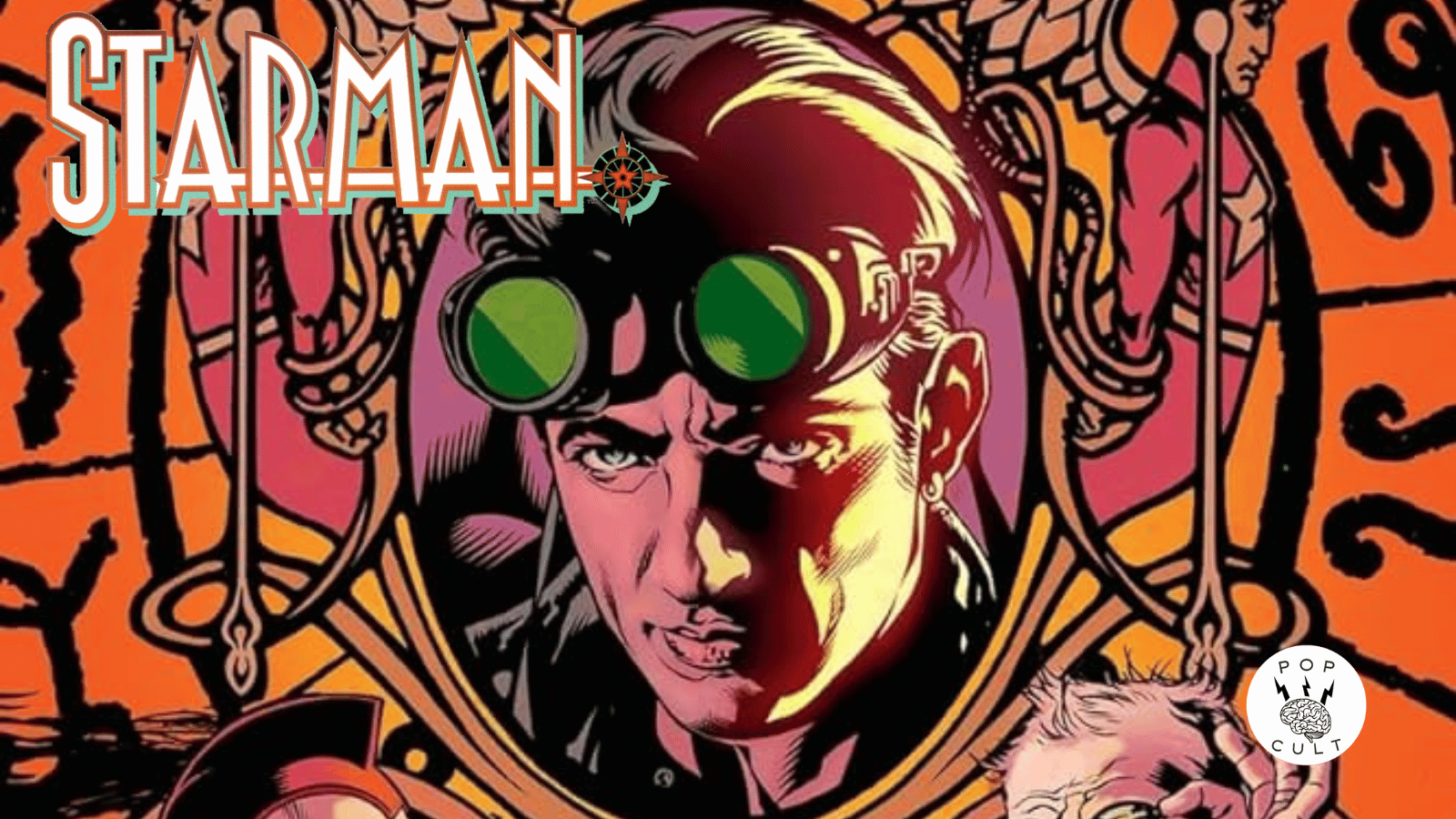
Starman: The Cosmic Omnibus (2020)
Reprints Starman #0-42, Starman Annual #1, The Shade #1-4, Starman Secret Files #1, and The Power of Shazam #35-36
Written by James Robinson (with Jerry Ordway)
Art by Tony Harris, Teddy Kristiansen, Kim Hagen, Bjarne Hansen, Christian Højgaard, Guy Davis, J.H. Williams III, Gary Erskine, Steve Yeowell, Craig Hamilton, Dusty Abell, Jerry Ordway, Ray Snyder, Matthew Smith
James Robinson walked so Geoff Johns could run. In 1995, to celebrate the 10th anniversary of Crisis on Infinite Earths, DC Comics rolled out Zero Hour: A Crisis in Time. By the end of the mini-series, things were more or less the same with a few tweaks. Part of the changes was the rollout of a handful of new titles: Extreme Justice and REBELS continued storylines started in the pages of Justice League America and LEGION, respectively. Manhunter and Fate introduced new characters using legacy names. Primal Force was a magic title, while Xenobrood was about human-alien hybrids, seeming like a play on some of Image’s popular books. None of these last very long. There would only be one book post-Zero Hour that would go the distance and run for 81 issues, Starman.
Starman continued the legacy of the Golden Age hero of the same name. Ted Knight was an astronomer in Opal City, and in the early 1940s, he developed a device called a cosmic rod, which harnessed the power of distant stars. He fought crime solo, partnered with Black Canary, and was a founding member of the Justice Society of America. He has a somewhat illustrious career, though not as renowned as his colleagues Green Lantern and The Flash. After briefly returning to glory alongside the JSA, Ted was aged up to where he should have been and retired. His son David picked up the mantle, and their home in Opal City appeared to have a new Starman. And in the opening pages of Starman #0, David is shot and killed.
The legacy of Starman doesn’t end there. Ted’s other son, Jack, an angsty fellow dedicated to collecting nostalgic paraphernalia, is forced to take up the Starman name despite not wanting to be a superhero. His dad’s old nemesis, The Mist, is behind David’s death, and a reign of terror spread across Opal in the first four issues of Starman. By the end, Jack is wielding a new device – the cosmic staff and is forced to kill The Mist’s son to protect his father and other innocents. This is the beginning of a strange & beautiful journey in a superhero’s life that provides a genuinely happy ending when we get there. A lot happens in between.
James Robinson modeled Jack after himself somewhat. He was also an avid collector. It’s also very evident how influenced he was by Alan Moore’s Swamp Thing run. Vertigo was DC’s Mature Readers imprint throughout the 1990s and the 21st century. Starman is a book that would have been under that banner, which is why it’s so fascinating that DC kept it in the mainstream universe. Throughout the series, Robinson would use recurring story types: Times Past would tell stories from Opal’s history, usually focusing on Matt Savage’s tenure as sheriff in the 19th century, Ted Knight’s exploits in the Golden Age, or spotlighting another character as the build-up to a larger storyline. Talking with David happened annually and involved Jack slipping into Limbo, where he could speak with his deceased brother for a few hours. The Shade’s Journal were stories from that reformed villain’s past as he would essentially be the co-star with Jack.
The Shade is a mysterious figure, English in origin, who possesses control of shadows. Initially, he was one of the original Flash’s villains, but Robinson chose to use him as a mentor figure for Jack. Ted served a similar purpose, but The Shade’s supernaturally long life gave him access to more direct information. It also created tension because Jack didn’t fully trust The Shade when they first met, and it would take the entirety of the series for them to finally come to a place of mutual respect.
The Shade was also important to the third central character in the book, Opal City. Robinson clearly had a great time worldbuilding, and by the end of the series, the reader will feel like it’s a real place with a rich history, diverse districts, and fascinating citizens. It was heavily influenced by Art Deco and European styles while in the middle of a Midwestern prairie. Robinson wanted to create something like Batman’s Gotham or Superman’s Metropolis – a unique location perfectly paired with its beloved superhero.
Starman fought several different villains in the first half of the series. There is, of course, the Mist and his son and daughter, Nash. Nash becomes a significant part of Jack’s life when she attempts to get revenge in issues 12 through 16, “Sins of the Child.” That storyline includes an element that would be much more controversial now. Part of Nash’s plan is to drug and sexually assault Jack so she can become impregnated by him. Her desire is to teach his own offspring to hate their father. That wouldn’t be resolved until the comic’s final arc. It feels very gross, but at the same time, we’re supposed to see Nash as a creepy, horrible villain. It was plot beats like that, which made the comic feel like it was meant to be published as a Vertigo title.
Jack Knight had plenty of allies. The O’Dare family was a bevy of redheads whose dad had been Ted Knight’s chief contact in the Opal City PD. Each family member had a different point of view, but all focused on protecting their hometown. Jack would liberate Mikaal, an alien who had briefly operated under the name Starman in the 1970s. When Jack finds him, Mikaal is an amnesiac imprisoned in a circus sideshow, but he quickly begins to regain his memories and the source of his power. The villainous Solomon Grundy would briefly serve as an ally, and Robinson would develop this character’s backstory in great detail. With each death, Grundy reincarnates but with a new personality. The heroic Grundy we meet here eventually sacrifices himself for the greater good, and Jack solicits Batman’s help in a failed attempt to keep the zombie as a good guy. There was also the ghost of Jon Valor, the Black Pirate, whose spirit would call on Jack and others when someone required help.
Once Robinson had a firm handle on Jack and Opal, he would start to have the character act with other established characters in the DCU. There was the previously mentioned Batman team-up. One of the best stories in the run is Jack teaming up with the elderly Golden Age Sandman for one last adventure, which includes many references to the beloved Vertigo book Sandman Mystery Theater. There’s a four-part crossover with The Power of Shazam that puts Starman and Captain Marvel at odds over whether a Golden Age hero had been working for the Nazis or not.
Robinson wasn’t afraid to sideline Jack entirely to focus on other characters. The Times Past stories spotlighted other characters. Matt O’Dare gets a lot of page time when he learns he is the reincarnation of the Old West hero (insensitively named) Scalphunter. During this period, The Shade got several short stories in the Showcase anthology series and eventually his own four-issue mini-series that established a multi-generational feud with the criminal Ludlow family.
By the time you reach the halfway point of Robinson’s run, he’s established a strong foundation. And then he brings Will Payton into the equation. Payton had acted as Starman briefly in the 1990s and died in space during the Eclipso incident in 1993. Jack meets a woman named Sadie, and they build a casual relationship that becomes much more intimate over time. She eventually reveals that she is Will Payton’s sister and believes he’s not dead. Jack decides to find out if Will is alive, which is where this volume concludes and the next one begins.
Most of this book has aged wonderfully. There’s a period when regular penciller Tony Harris leaves, and the art quality dips. Harris and Robinson were so perfectly paired that it feels jarring when the artist is no longer on the book. Starman feels far more mature than most of the superhero books of its era. There’s also a clear sense that Robinson has planned a lot of pieces in advance, with each arc or stand-alone story serving to build towards something grand. There’s a solid argument to be made that stories in this first half are better than what is to come, but in my following review, I’ll defend the post-Tony Harris half of the book.

 PopCult Reviews
One thought on “Comic Book Review – Starman: The Cosmic Omnibus Volume One”