
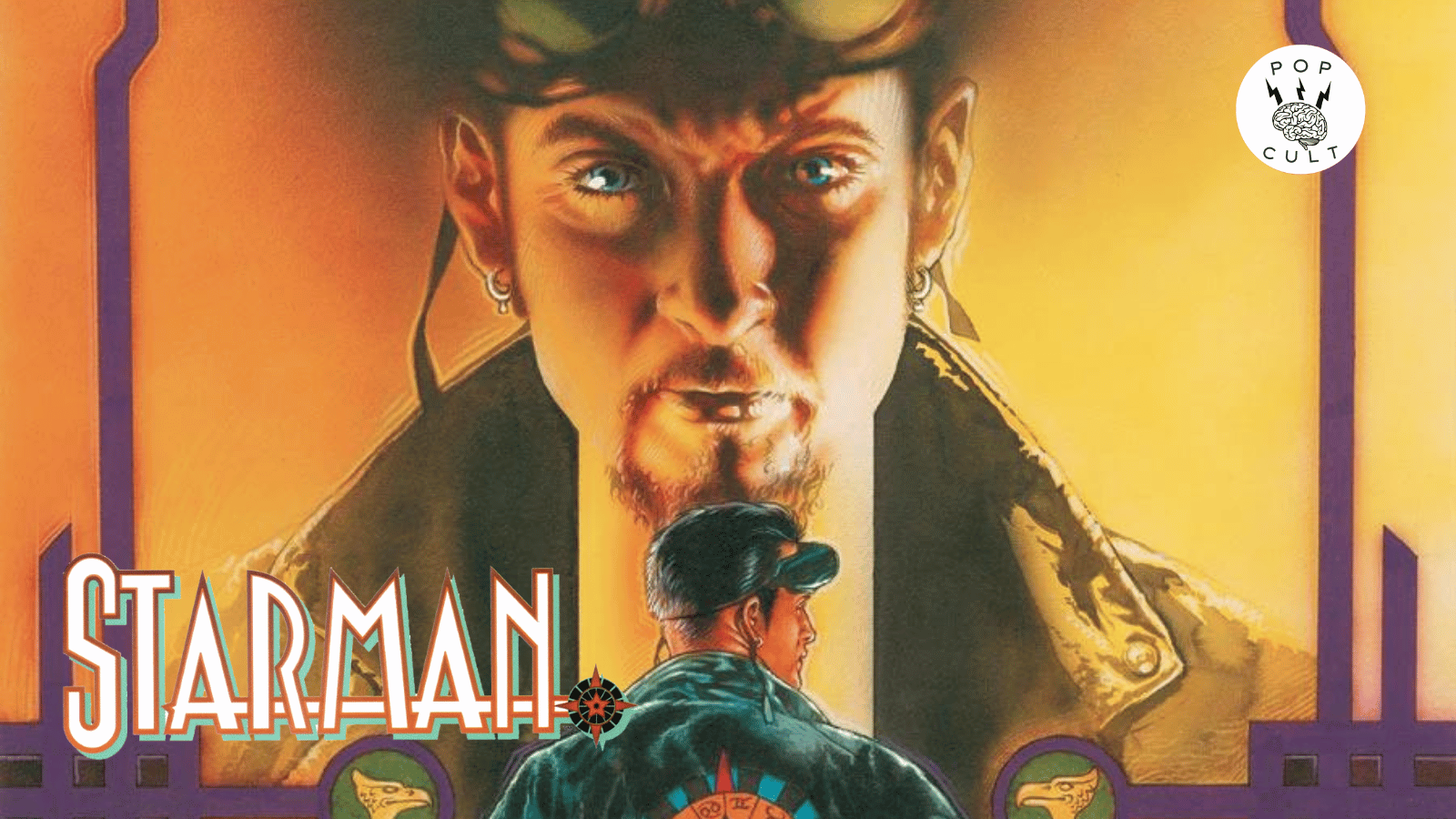
Starman Omnibus Volume Two (2022)
Reprints All-Star Comics 80-Page Giant #1, Batman/Hellboy/Starman #1-2, JSA: All-Stars #4, Starman #44-81, Starman #1,000,000, Starman: The Mist #1, Starman/Congorilla #1, Stars and STRIPE #0, and The Shade #1-12
Written by James Robinson with David Goyer & Geoff Johns
Art by Tony Harris, Peter Snejbjerg, Mike Mayhew, Dave Ross, Mike Mignola, Mike Mckone, John Lucas, Brett Booth, Lee Moder, Cully Hamner
The second half of James Robinson’s Starman is mainly comprised of two storylines: Stars My Destination and Grand Guignol. Intermixed within are Times Past stories, filling in gaps in the backstories of the Golden Age Starman and Scalphunter. There’s a brief interlude for the DC One Million crossover that Robinson still uses to build on the legacy themes so prominent in this work. It should also be noted how popular Starman was at this point. It was enough to warrant a crossover with Batman and Hellboy. That’s amazing for a character who took his bow in the last issue of his series and hasn’t been seen since. Very few comic book superheroes get this sort of finality to their story. Yet, DC has never brought Jack Knight back.
Stars My Destination sees Jack and Mikaal traveling into space in search of Will Payton, the Starman of the early 1990s. Will’s sister Sadie had become Jack’s girlfriend, and she believes her brother is still alive despite many heroes witnessing the former Starman’s death. Mikaal goes along hoping to learn the fate of his people, whom he last saw in the 1970s. The two Starmen go on an incredible odyssey that touches on many other DC Comics storylines while providing finality for Will Payton.
Their first stop has them landing on the blue planet from Alan Moore’s Swamp Thing run. One of Solomon Grundy’s copies ended up here, and because of his connection to the Green, he can grow weapons and manipulate the planet’s flora to his advantage. It’s this battle where Mikaal has his first conversation with the spirit of David Knight, and this will continue for a couple more times. Once in space, Mikaal also begins undergoing changes, becoming more physically aggressive and seeing his power grow.
The Starmen will pass through a dark mass in space, which they later learn is The Shade of the future. It hurtles them to the 31st century, where Jack meets Thom Kallor, aka Star Boy. Mikaal also learns that Umbra, a shadow manipulator, is from a species that branched off from his own. Pinballing through time & space, the heroes visit Krypton and meet a young Jor-El. It turns out Jack Knight was the person who put the scientist’s attention on Earth, which led to his sending his infant son there years later. They return to the present only to become embroiled in espionage on Rann, where they work with Adam Strange.
All the while, Robinson drops one-off stories, keeping us caught up on what is happening back in Opal City. It’s not good. The Shade’s powers seem to be taking him over, and people start turning up dead, killed by shadow creatures. The O’Dare family is on the case but gets help from a host of heroes coming to town: Black Condor, Phantom Lady, and Elongated Man & his wife, Sue. Hordes of villains with vendettas against various Opal City citizens start amassing, and a war is clearly unfolding.
After a brief crossing of paths with Space Cabbie, Jack & Mikaal end up on Throneworld, where they learn about a Starman none on Earth had ever encountered. Robinson takes a one-off character, Prince Gavyn, who used the moniker and ties his story into Will Payton’s. Gavyn’s body was destroyed, but his consciousness ended up in the body of Payton, leading to his tenure as Starman. Upon Payton’s death, that soul traveled back to Throneworld, where a despot took over. Jack & Mikaal help lead a revolution that ends with a strange hybrid of Gavyn & Payton existing in a single body.
It’s a fun adventure connecting Jack Knight to many points in the DC Universe. You can see the template for Geoff Johns being built during this, the way he uses legacy characters to create a sweeping multi-generational story for DC Comics. When Jack returns to Opal, he finds a city on the verge of collapse. The Shade and his villainous hordes have taken over the place. Heroes fight back as best they can, but they are quickly overwhelmed. All is not what it seems and Robinson isn’t going to leave The Shade as a villain. In fact, this story retroactively explains why he had a period of villainy in the Golden Age that allows him to keep his honorable, heroic nature intact in the present day.
The finale of Grand Guignol features a couple significant deaths. If you had asked me if I would get teary-eyed over the deaths of such obscure characters, I would have said it wouldn’t happen. That speaks to the power of Robinson’s writing. He gives one character, in particular, a grand send-off that reiterates the hero that person truly was and is. By the end of Grand Guignol, you can feel that this series has to have an ending. Jack isn’t the kind of person who will keep doing superheroes until he dies. This was something he did out of necessity when his brother was killed. Robinson allows Jack to wrap up every single loose end. One of those is a three-part time travel story that sends Jack back to 1951 to learn who the mysterious Starman of a single year was. It also allows him to meet his father when he was a younger man while Jack tries to keep his identity secret so he doesn’t mess up the timestream.
One of the most significant changes is that regular penciler Tony Harris left and was replaced by Peter Snejbjerg. These are two very different artists, with Harris taking a photorealistic approach while Snejbjerg is much more cartoonish. This results in each half of Starman having a different feel, one more grounded and the other playing in the realm of the fantastic. In the last year of Starman’s run, Robinson and frequent collaborator David Goyer launched JSA, a continuation of the Justice Society in the modern era. He only stayed for a short time on that book, handing it over to Geoff Johns.
From there Robinson hopped between DC, Marvel, and Image. Eventually, he was part of a new creative direction on Superman and the Justice League, the latter considered one of the worst runs in that book. At the time, the Justice League was the victim of much editorial interference, so I don’t know how much can be directly blamed on Robinson. Part of that is reprinted here in the Starman/Congorilla one-shot, where Mikaal is now the hero bearing that moniker.
We also get The Shade 12-issue mini-series, which stands out as a weird part of the Starman series. It was published a few months into the New 52 reboot, which sought to give a hard reset to most DC characters. The problem is that it clearly occurs following the events of the Starman comic. However, with that new timeline, it doesn’t seem like Jack Knight could have had his career in that new reality. My guess is that Robinson was already writing the book when the New 52 initiative fell into everyone’s laps and he just went on with what he was doing.
Starman is a comic worth revisiting because it came out when comic publishers seemed open to new, strange ideas. DC gave Robinson much control over the book, allowing him to depict characters in complex adult relationships. We even have Mikaal in a same-sex relationship, though that was concluded in a rather disappointing way. Much like Grant Morrison’s JLA, Robinson’s Starman introduced many of us young readers to a new way of storytelling before we dipped our toes into the work of people like Alan Moore or Neil Gaiman.
Part of me is curious about what Jack Knight would be up to these days, but I also appreciate that you get the end. Jack gets to live happily ever after, has a family, and doesn’t have to keep risking his life forever. It’s the ending his dad wanted for him, to not have to take up the cosmic staff and fight villains forever and ever. Robinson may have called the book Starman, and he was a big part of it, but you could have also titled it Opal City, and nothing would have to change. Jack, without the citizens of Opal, wouldn’t feel the same. We get to see characters grow and change, which is a rare treat in the world of superhero comics.

 PopCult Reviews
2 thoughts on “Comic Book Review – Starman Omnibus Volume Two”