
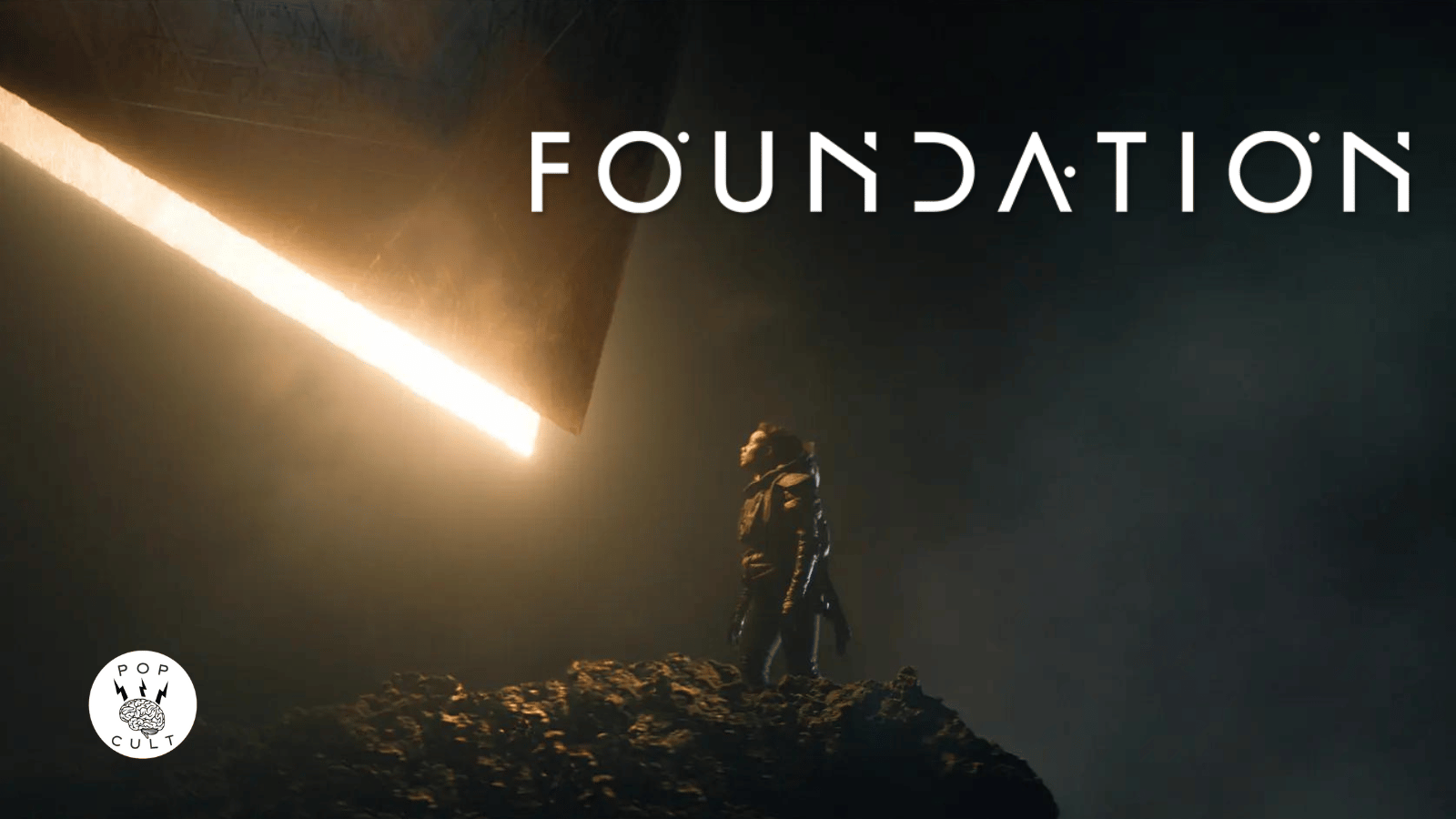
Foundation Season One (AppleTV+)
Written by David S. Goyer, Josh Friedman, Olivia Purnell, Lauren Bello, Leigh Dana Jackson, Marcus Gardley, Caitlin Saunders, Sarah Nolen, and Victoria Morrow
Directed by Rupert Sanders, Andrew Bernstein, Alex Graves, Jennifer Phang, and Roxann Dawson
You’ve bought a reprieve, but war with Empire is inevitable. In the meantime, remember this day, remember what we’re striving towards. I know a thousand years can seem like an eternity, but it’s the blink of an eye when measured against the whole of human history, and it could so easily slip through our fingers if we’re not vigilant. – Hari Seldon (Jared Harris)
I didn’t think I would get choked up watching the season finale of Foundation the other night, but hearing these words & reflecting on what lies before humanity in this very dark moment, I couldn’t help it. Foundation is an adaptation of the Isaac Asimov book series of the same name. It is an expansive, sweeping story covering an amount of time that’s hard for us to grasp. By the season’s end, we’ve jumped 150 years beyond our starting point, and that’s a drop in the bucket. At its core, this story is about the importance of humanity over any system of government we create, yet we need systems to ensure everyone is on the same page. That’s a tricky balancing act, but one our species has to tackle whether they want to or not.
Gaal Dornick (Lou Llobell) is a young woman from Synnax, a planet in the Galactic Empire where intellectuals have been executed by religious zealots for accurately predicting the ongoing ecological collapse. Gaal taught herself mathematics, and after solving an old equation, she garnered the attention of many influential people from off-world. One of those is Hari Seldon (Jared Harris), the developer of psychohistory, an algorithmic science that allows people to predict future events and their outcomes. The Empire is ruled by a clone trio made from the first emperor, Cleon, over four hundred years earlier. They are Brother Dawn (the youngest), Brother Day (the middle & the one who holds the most power), and Brother Dusk (serving as a head of state rather than an active leader).
Empire, as they are called, find Seldon’s predictions of their inevitable fall treasonous and want to get rid of him. Seldon agrees for him & his followers to go into exile, where they will build the Foundation in the outer worlds. This will preserve all the accumulated knowledge of the human species so that once humanity makes it through the tens of thousands of years of darkness to come, it can emerge better than ever. Many events occur during that journey, leaving the Foundation wondering if it can fulfill this goal. Meanwhile, Empire begins to experience the cracks in their power that will lead to the collapse and they are intent on ensuring it does not come to pass.
The acting in Foundation is certainly a mixed bag. The more notable actors like Harris, Lee Pace, and Terence Mann are outstanding. We get a guest appearance by actress T’Nia Miller, one of the season’s best in two episodes. I wish she could have been a regular because she is strong compared to some of the regular cast members. There’s also Laura Birn, a Finnish actress, who plays Demerzel, the majordomo to Empire and one of the last surviving androids from the Robot Wars long ago. Her arc in season one clearly indicates something bigger coming in the next season. I will say the performances here are far better than Apple TV+’s last science fiction series I watched, Silo, which absolutely wasted its cast.
While not every episode is solid, the concepts being juggled around in this show are absolutely fascinating. The whole premise of Empire – a person who is always represented at three stages of their life – is such a fun thing to ponder. The youngest is always raised by his older selves making them both brothers, father & son, and the same person. The show just dips its toe into the complexity that would come with such a system. The purpose is to maintain consistency as the first Cleon brought peace the galaxy had never known.
However, that peace is predicated on some pretty horrific acts. Early on in this season, we see Brother Day order the simultaneous execution and genocide of two warring planets he blames for a terrorist attack on the homeworld of Trantor. The next Brother Day (we jump 35 years in the first couple of episodes) ends up punishing a potential assassin in a manner that redefines cruelty. Empire is clearly the show’s villain, but it is also developing him so that he’s not a one-dimensional Ming the Merciless.
Game of Thrones is an undeniable structural influence on Foundation. I have not read the books, though I am very interested now, but I have seen they are not very character-centered but more about the big ideas Asimov is playing with. The show can’t really do the same, so it gives us serialized stories that spotlight multiple characters in each episode. The three parts of Empire each have very interesting arcs, while Gaal goes on a strange odyssey of her own.
We spend lots of time with the Foundation colony on Terminus, especially with Salvor Hardin (Leah Harvey), one of the first children born on the planet who now serves as a warden, ensuring the inhabitants are protected from the elements and native predatory animals. There’s also that strange vault that was there when they arrived, which projects a null field that will knock anyone who comes close unconscious. Like Game of Thrones, many of these stories involve a character going away from the rest, discovering something about themselves or the political situation they are in, and by the end of the season, reuniting, where what they learn sends ripples through the larger narrative.
The scenes I was the most engaged in were anything with Pace, Mann, and Birn. I’ve always appreciated strongly written & performed villains who make the audience seesaw back and forth. They have moments where you empathize with them, only for the character to ignite all that goodwill by revealing a sadistic side of themselves. The best villains are not those you cheer for when they fall, but those you feel are utterly tragic. They could have easily taken a different path, but their hubris wouldn’t allow them to. The current three throne-holders of the Empire aren’t the cause of these problems, but they do perpetuate them by adhering to a centuries-long system because that is what they do. We see how that is fracturing by the end of season one, and I expect the three Cleons will eventually turn on each other.
I don’t think Foundation will appeal to everyone. It is very sweeping in how it will make large jumps in time, but I found the world-building fascinating. This is a space opera that isn’t derivative of Star Wars or Dune; it really feels like Asimov created his own niche in the subgenre of science fiction. I am interested in picking up at least the first book and reading it. As I’ve been playing a lot of Starforged and other science fiction tabletop RPGs solo lately, things like this are great fodder for new ideas to toss into the mix.

 PopCult Reviews
One thought on “TV Review – Foundation Season One”