
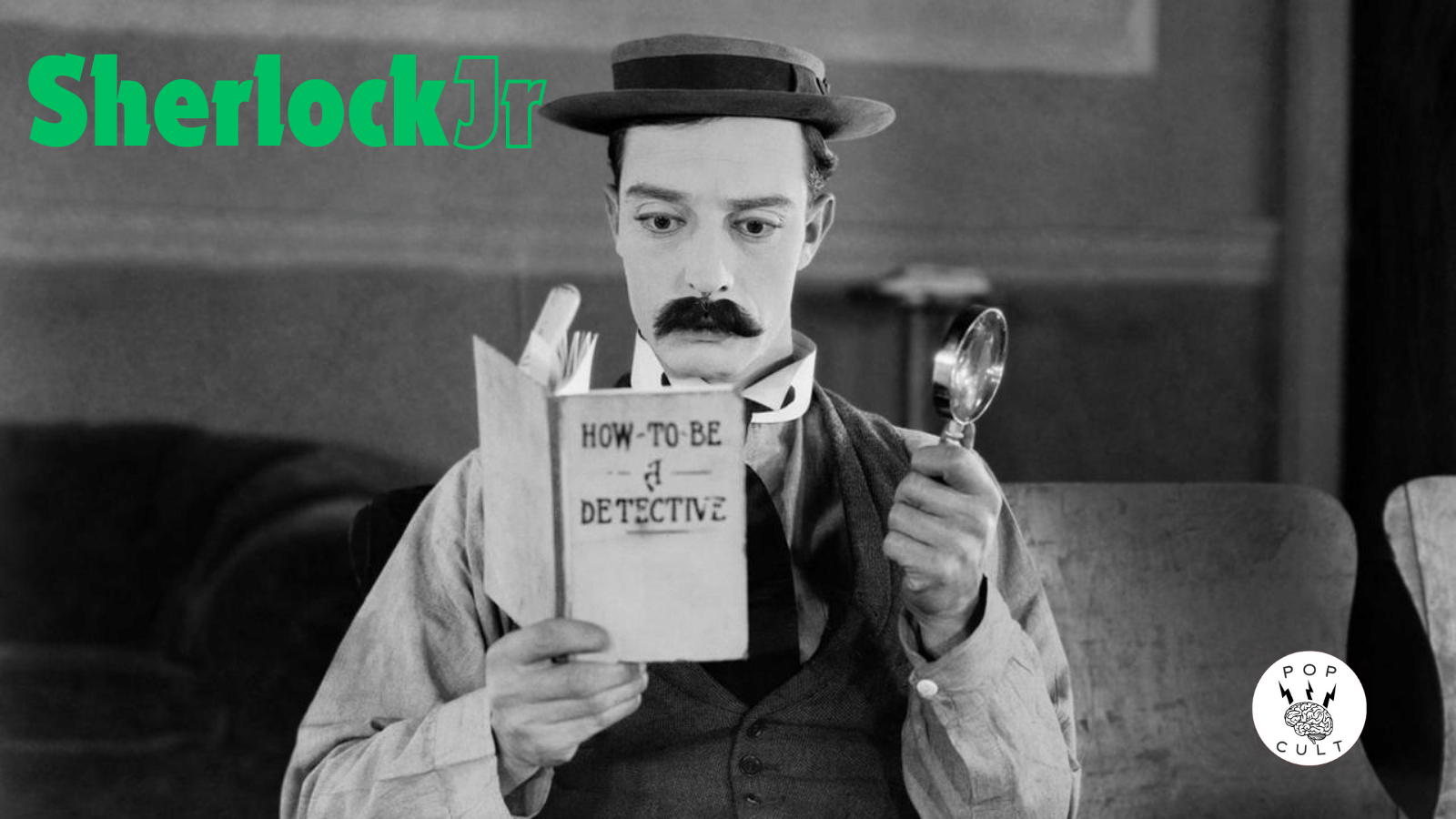
Sherlock Jr. (1924)
Written by Clyde Bruckman, Jean Havez, and Joseph A. Mitchell
Directed by Buster Keaton
There are motion picture cameras. You can film yourself moving rather than just still photography. What do you do with this? That was the situation a handful of people found themselves in following the invention and popularization of movies. It might make sense at first to film people performing plays, operas, or similar things. But that’s a rather flat thing to do. The camera can move and control the audience’s perspective. How can you move that camera to make impossible things seem real? Joseph “Buster” Keaton was one of those people in the early days trying to figure out what this new medium could be capable of.
Sherlock Jr. is a movie about movies, about how such a young medium was known to help people escape from the harsh realities of life. Keaton plays the Projectionist who moonlights as an amateur detective. He’s in love with the Girl (Kathryn McGuire). His rival for her affection is The Local Sheik (Ward Crane), who eventually frames the Projectionist for the theft of the pocket watch of the Girl’s father. Through a series of sight gags, the Projectionist navigates the waking world and his dreams to solve this mystery. It won’t surprise anyone to know that eventually, he gets the Girl, and the bad guy pays for his crimes.
According to Keaton, Sherlock Jr. was born out of a single visual idea. The image was of a man walking into a movie screen and becoming part of the film. Sherlock Jr. is also notable in that Metro Goldwyn Mayer Pictures was formed one week before the picture was released in theaters. The studio came out of theater magnate Marcus Loew needing more quality content to show in his movie houses.
There were many poorly made new content or old pictures that audiences had seen many times. Loew solved this by purchasing three smaller film studios: Metro, Goldwyn, and Mayer. The head of that last studio, Louis B. Mayer, would be put in charge of MGM. Producer Irving Thalberg was responsible for the studio’s day-to-day production. MGM would produce over 100 films in its first two years, with 1925’s Ben-Hur becoming its breakout picture. But let’s go back to just one week after the studio formed.
During early screenings in Long Beach, Keaton found that audiences were astonished by the special effects, yet he heard very little laughter. I agree that the special effects in this movie, all in-camera & analog, are still an incredible magic trick today. When Keaton enters the movie screen, the images around him change, and he keeps interacting with objects. I was stunned. This is probably an instance of holding him in the frame, cutting, putting up a new set, and then rolling again, but it is done so seamlessly. I see digital effects today that struggle to pull off a similar teleportation effect without glaring technical flaws.
Despite numerous re-edits, Keaton released the film dissatisfied, seeing it as a career low after working in entertainment for twenty-five years. Many papers appreciated the technical prowess that Keaton displayed in the feature. They felt the screen tricks were some of the best ever put to film, but just like those early audiences, they didn’t find the gags particularly original or funny. Variety said it was as funny as “a hospital operating room.” Keaton’s character had little development, and the gags felt more like a machine going through its routine than new comedic ideas.
What Keaton and many of these critics seemed to not notice at the time was that the premise of the film had a certain sophistication that other comedies of the time lacked. By framing a large portion of the picture as a dream fantasy, it took the audience into the realm of the surreal. The Projectionist falls asleep while a movie is playing, and his dream self arises from his body, walking down the aisle and onto the screen. The movie is a crime melodrama wherein the Projectionist gets to fulfill his fantasy of being a master detective and catching the villain. He’s awoken at the end by the Girl who tells him that, off camera, her father has figured out it was the Local Sheik behind the theft. So, our hero doesn’t save the day.
Sherlock Jr. is a wonderfully minimalist comedy. It doesn’t overcomplicate the plot and keeps everything bare bones. That initial idea is where the magic comes from. What if we could just walk into the films playing on our screens. Humans have been chasing that since the first story was told. The narratives we weave are often far more straightforward than the actuality of the human condition. This makes them quite tantalizing, we develop a desire to escape into scenarios where good & evil are clear-cut and defined. Most often, we are on the side of good, and everyone who opposes us is evil. If only life were that simple.
Today, Hollywood does nothing but feed audiences films based entirely on spectacle and the concept of escapism. The widespread proliferation of the multiverse is the latest evolution of escapism. The horrifying reality of this world is just one facet of a multi-sided infinite reality. I don’t know about you, but that feels even worse than living in a singularly awful reality. There’s something better, and we just can’t have it because only that reality can be like that? How nihilistic.
What I enjoyed about Sherlock Jr. was Keaton’s melancholy nature throughout the affair. His deadpan looks and reactions imply a slightly sad character whose life just can’t become what he wants. His dreams are fruitful and exciting. That doesn’t mean real life is constantly terrible; it’s just that people like him often get bullied by people like the Sheik. In the world of stories of fantasy, he can be a clever, cunning detective. So many have a ravenous desire to be the hero of their personal story because they incorrectly see life as something experienced entirely as an individual.
Cinema likely doesn’t exist without people like Keaton. This is why if you watch Sherlock Jr., you may not see the film as anything special. That’s because so many came after borrowing, stealing, and repurposing its many parts. It still speaks to something inside us that wants to escape, that knows the world as it is, and that doesn’t mesh with who we know we are. The problem is that we can dream all we like, but eventually, we must wake up and return to this deeply flawed world. Nothing will change in our dreams, it can only happen out here.

 PopCult Reviews
One thought on “Movie Review – Sherlock Jr.”