

A Feast of Snakes by Harry Crews
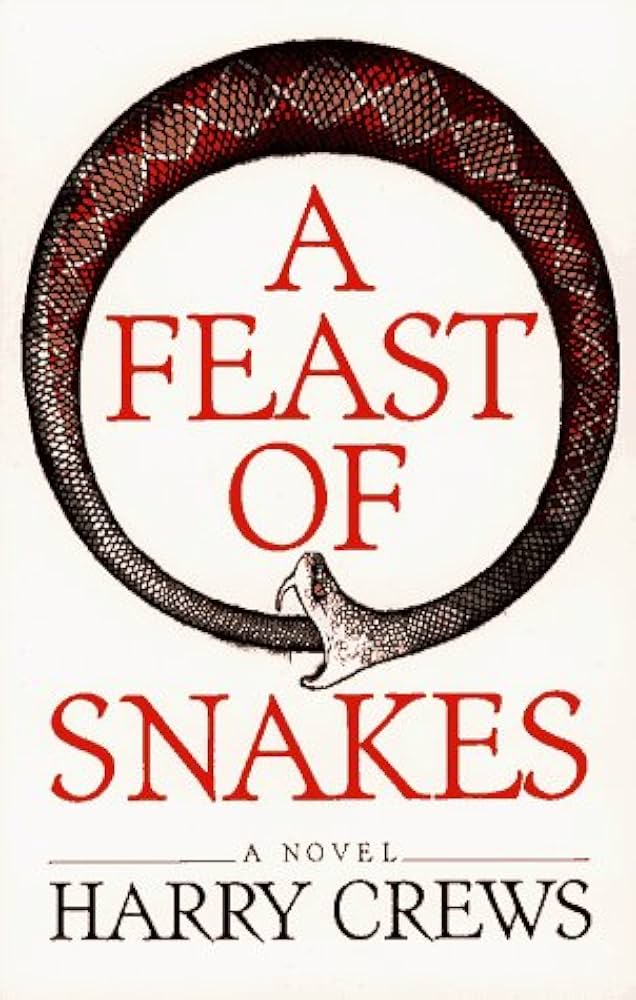
Without a doubt, this was the best thing I read over these last two months. I found a scanned PDF of the Salon.Com Reader’s Guide to Contemporary Authors online. That book played a pivotal role in shaping my reading as an undergrad. It was published in 2000 and has never been updated, providing a snapshot of what was seen as prominent contemporary lit circa the turn of the century. Crews has a write-up in that book where his work is compared with Kafkas and described as presenting a parade of social misfits against a Gothic Southern backdrop. That explains A Feast of Snakes perfectly.
Set in Mystic, Georgia, circa 1975, we follow Joe Lon Mackey, a former high school football star turned alcoholic abusive husband. His town is home to the Rattlesnake Round-Up, where people come to kill and eat the area’s ubiquitous hibernating snakes. This brings Joe Lon’s high school flame, Berenice, back from university and her new beau. There’s a sleazy sheriff with a penchant for falsely arresting women and raping them, which he does to Lottie May, a young Black woman in the community. Joe Lon’s sister, Beeder, is a shut-in who has lost a grip on her insanity after witnessing their mother kill herself. Joe Lon’s dad raises pit bulls for a brutal fighting tournament. Amidst all of this roiling evil & chaos, it becomes clear that our protagonist will face a mental & spiritual breaking point.
This is certainly not a novel for everyone, but I loved the rotten, seedy atmosphere Crews was able to immediately establish. This is the deep South as filtered through the horror-melodrama of Lynch’s Twin Peaks. Characters are grotesque, and toxic masculinity is put on display as something absolutely abhorrent that forces men to behave in horrific and nasty ways. A Feast of Snakes is a perfect example of having a central character who we aren’t supposed to want to be like but whose perspective is one of a person who knows the things they have been taught are wrong & cruel; they just don’t know how to be anything else.
Snow Crash by Neal Stephenson

I have been trying to read more science fiction lately, and Snow Crash is a key piece of the cyberpunk lit scene in the late 1980s/early 1990s. Right away, I saw how Ernest Cline ripped the book off for his dismal “‘member berries” novel Ready Player One. Snow Crash is the far better book, with a better sense of humor and more robust worldbuilding. That said, the further I got into Snow Crash, the more annoyed I became with it, and the finale was a reasonably big disappointment.
Sometime in the 21st century, the U.S. federal government has ceded almost all of its territory to private corporate interests. Los Angeles is one of those places. Gated communities have sprung up for every ideology and cultural group imaginable. Policing is handled by private security forces, and imprisonment is based on what the arrested person can afford. Couriers deliver all mail using magnetic harpoons to surf between cars on the densely packed freeways. Then there’s Metaverse, where you can drop exorbitant amounts of money to live a life of luxury even if your meatspace is one of toil.
Hiro Protagonist is a freelance hacker and pizza delivery driver working for the Mafia. On a potentially doomed run to beat the clock, Hiro gets help from YT, a teenage courier who completes the order before the 30 minutes are up. While in the Metaverse, Hiro encounters a strange virtual drug called Snow Crash, which gives the user physical brain damage in the outside world. While Hiro researches the connections between Snow Crash and stories from ancient Mesopotamia, YT gets a job making deliveries for the Mafia, which gives her a different angle on the origins of this substance.
Published in 1992, Snow Crash is remarkably prescient in the way it talks about the decline of the federal government and its replacement by craven corporate interests. The Metaverse is also a great summation of how working-class people would be given virtual luxury to placate them. There were parts of the novel that were funny. However, it started to drag near the middle of the book. One element that made me very uncomfortable was how sexualized teenage YT was, up to the point where she has a sex scene with a man in his thirties that is framed as enjoyable for her. It felt highly gross, and there really wasn’t a reason her character needed to be underage in the first place. She could have been in her early 20s, and I don’t think much about the book would have to change.
The Koran for Dummies by Sohaib Sultan

I was raised in an evangelical Christian home, so when it comes to the Bible, I think I have a slightly better-than-average understanding of the book’s structure, themes, characters, etc. I’m certainly not a believer, but I can catch allusions to the Bible in other pieces of art & media. Like most Americans, I don’t know much at all about Islam and The Koran. I decided to do something about that, but I wanted to start from a basic starting level. The Koran for Dummies was a great place to start, providing an overview of the religion and its core text.
One of the things this book did was help show the relation between Islam and the other Abrahamic religions, Judaism and Christianity. In the same way, Christianity was a revision & clarification of some aspects of Judaism, and so was Islam for its predecessors. It was also a means to shift the practices of tribal Arabs into a more progressive social structure. That’s why things like alcohol are prohibited, as it was a significant social problem in the region. Overall, my takeaway was that the Koran is somewhere between the Books of the Law in the Koran & The Bible.
It’s non-chronological and focuses more on themes rather than stories. The organization of The Koran for Dummies is pretty perfect, going from a broad overview of the text to delving deeper, one layer at a time. It was published a few years after 9/11, and the author explicitly says he wants to address many misconceptions. In that regard, he goes through a more lengthy explanation of jihad and how it is not exclusively about armed conflict. My understanding is that it is about the struggle of being Muslim in a world of temptations & challenges. It does touch on the need for violence if you are being oppressed, which I think is something that all of us can agree is a reasonable response. Self-defense can be an essential part of living in this world. There’s also a section about The Koran and Women, which further details Western misconceptions about how women are seen within the religion. Additionally, the author touches on the various sects of Islam – Sunni, Shia, and others – emphasizing how there are schools of interpretation and which are considered more mainstream and fringe.
I don’t think I’ll be converting anytime soon, but I liked getting an overview of one of the most prominent religions on the planet. I think it’s rather strange that we don’t get this education by default, and it reveals an agenda by the fact that we don’t. I remember attending a VBS (Vacation Bible School) program where an old lady used felt cutouts to go through some scripted story. It was about a child in a Middle Eastern country and framed the Islamic characters as worshiping the Devil. Just a few years later, I was very annoyed to find that Muslims worship the same god as the Jews & Christians, and I had been lied to. For me, I just cannot submit to some invisible deity, especially with the tremendous suffering in the world. The argument that the universe is so complex that it must have been created doesn’t work for me because, based on that idea, that deity is so complex, so it must also have been made by something; therefore, shouldn’t I worship that entity? And it goes on and on and on.
I think it is important to learn about other religions and cultures because you gain a greater understanding of the world. This year, I have spent a lot of time reading and listening to other people’s perspectives, which has overhauled how I see the human experience. It’s very easy to see your own point of view as the universal one, but it’s absolutely not the truth.
The Importance of Being Ernest: The Life of Actor Jim Varney by Justin Lloyd

I’ll announce it here, in July, I’ll be doing a film series I’ve titled Ernest Saves the Summer, where I watch and review every single Ernest film (save the one I did in May per Patreon request). As part of that, I decided to learn more about Jim Varney, the man behind the vest. I grew up watching Ernest movies and lived less than an hour from Varney’s house in White House, Tennessee. We saw him once in person while tagging along with my mom to the grocery store in the early 1990s. I also saw the commercials where Ernest got his start all throughout my childhood in TN.
This biography, written by his nephew, isn’t a piece of great literature but provides many fantastic details and insights into Varney’s life outside of the Ernest media. He was born and grew up in Lexington, Kentucky. At a young age, he became enamored with theater, and from there, it was his life’s goal to become an actor. Much like Ernest, he took on lots of odd jobs along the way to pay the bills, but his passion was in performance. Varney was a classically trained actor who loved Shakespeare especially. He wasn’t a snob, though; he also did children’s theater. He admired the actor’s ability to inspire the audience’s imagination.
Ernest was a character who came after working with John Cherry and his advertising company for a few years. Initially, Varney did a series of commercials as his boot camp Sergeant Glory character. In 1980, the Ernest commercials began filming around Cherry’s house in Nashville. Ads were done for regional markets, leading to many viewers thinking they were made in their locale. Ernest was talking about a business in their community, after all. By the mid-80s, Ernest had exploded in popularity, and the ad firm was selling merch after demand from viewers. They would get a film deal with Disney through their Touchstone Pictures division, and the rest of the world would finally meet Ernest.
Varney sounds like a fascinating person, and his personality was so unlike the characters we all saw him as. He was married twice, always seeming to end things on good terms and remain friends with the women he dated. Varney never had biological children but helped raise his first wife’s two sons. One of his later partners said Varney never really got over the end of that first marriage. It also sounds like he was very much into Wicca and Appalachian paganism. His career was much more than Ernest, but he never resented it because he had garnered many opportunities. My takeaway was that Varney seemed like a genuinely kind, lovely person who probably had ADHD. As we work through his films, I’ll share more details about his life in July.

 PopCult Reviews
One thought on “Book Update – May/June 2024”