
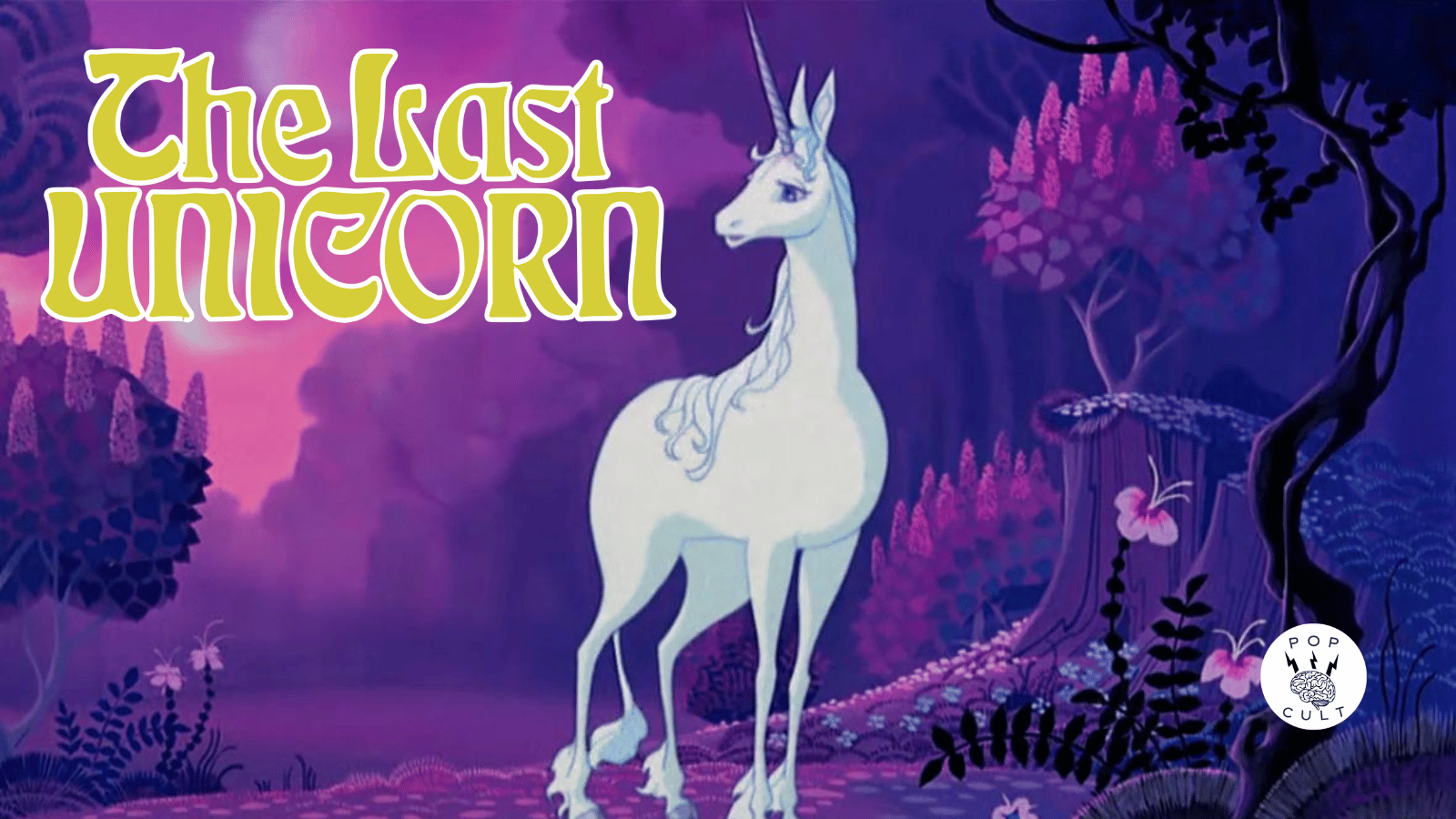
The Last Unicorn (1982)
Written by Peter S. Beagle
Directed by Arthur Rankin Jr. and Jules Bass
I grew up with a very inconsistent standard of what I could and could not watch because of my parents’ reactionary right-wing Christian beliefs. He-Man? It was not allowed because he called on the power of Greyskull, not Jesus. Lord of the Rings and the Chronicles of Narnia? Perfectly fine because it was some sort of metaphor for Jesus. The Last Unicorn was one of those movies that would air around Easter or Thanksgiving on television. I would catch promos for it but was never allowed to watch because it was “of the Devil.” By the time my youngest siblings reached high school age, my once religiously dogmatic parents had abandoned these strictures but still kept them in their pockets as a cudgel to judge other people. So, after all these decades, I finally got to see The Last Unicorn, and it was, um…okay.
The titular last Unicorn (Mia Farrow) learns she is the final in her line after overhearing hunters discussing the Red Bull, a devilish entity that has found and dispatched with the other unicorns. The Unicorn embarks on a journey that leads her into the clutches of Mommy Fortuna (Angela Lansbury), a witch who runs a traveling carnival. The magician Shmendrick (Alan Arkin) takes pity on the creature and helps her arrange an escape, but not without great conflict. Eventually, The Unicorn and her growing number of allies find the origin of the Red Bull and take a risk to save her horned brethren and restore the glory of the unicorns to the land once again.
I’ve seen several takes on The Last Unicorn from queer people who discovered it as a child and found a metaphor within that really spoke to them. I think that is a fantastic thing and one of the great experiences of movies when you are a kid. To find something that speaks to who you are even if the environment you are in does not is such an important thing for media to do, while so much of it is otherwise harmful. I don’t want to diminish any of those perspectives on the film, but I will say I didn’t really enjoy this one. I don’t think I was able to lose myself in this picture in the way I might have as a kid, and it doesn’t have a nostalgic connection, so overall, I was very bored.
The animation style in The Last Unicorn is a reminder of a lost craft. It’s Rankin & Bass, so it’s very similar to The Hobbit, which they made a few years prior. The images drip with that 1970s fantasy psychedelia vibe where artists who trained to make commercial art dropped acid and let it turn their clean lines into something more fluid. The result is a world that feels magical and dangerous. The Red Bull sequences allow the movie to break with the concrete and play in the abstract, with forms flowing and swirling like waves. Speaking of waves, the moment when the other unicorns return out of the sea is an excellent hand-drawn animation.
The problem with The Last Unicorn is its plot and pacing are incredibly muddled. As with most children’s fare, the movie’s themes are clearly communicated. Yet the script could have made these a little more complex. Peter Beagle, the author of the novel, pens the screenplay, and I think we got a very faithful adaptation, though I have never read the book. If you are a child and see this, it is just the suitable complexity to get you thinking, but as an adult, I found very little here that kept me engaged.
The Last Unicorn wants to be a musical, and that’s one of its weakest aspects. Nothing about this story screamed that it needed songs. They feel forced and partly an attempt to pad out the run time. I didn’t find any of them particularly memorable and never felt they added to what the narrative had already established. I think this is an instance where the ideas Beagle wants to tackle are highly admirable, but the execution is clumsy as hell. I love musicals, but the songs have to serve a greater purpose than “it’s a children’s animated movie, so it needs musical numbers.” Wait until you see Jeff Bridges as the prince attempting to sing one of the songs in the second half. Yikes.
The animation here was apparently done by many artists who would go on to join Studio Ghibli. I think that studio is a good comparison for this movie. Ghibli addresses many of these themes in their work but can execute them more cleanly. Part of that is different cultural expectations. In the U.S., animation was (and by some, still is) seen as a children’s medium, thus the expectation of simplistic songs. Movies like Spirited Away, Ponyo, or My Neighbor Totoro don’t need songs because they communicate their complex ideas seamlessly through animation and storytelling. I think The Last Unicorn, made under the supervision of Hayao Miyazaki, would have been a far better experience for me, to be honest.
I think this would probably still stand up for modern children’s audiences. The film is a bit scary, which I think modern kids’ fare lacks while presenting them with some worthwhile themes to explore. It definitely has some of that Lisa Frank campiness, but that just adds to its charm. While The Last Unicorn isn’t for me, I have full confidence that this is one of those movies that finds its audience, and the children who need it will love it.

 PopCult Reviews
One thought on “Movie Review – The Last Unicorn”