
Godzilla, King of the Monsters (1956)
Written by Shigeru Kayama, Takeo Murata, and Ishirō Honda
Directed by Ishirō Honda
6 August 1945. Hiroshima, Japan. Three American B-29 heavy bombers passed over the city. One of them, the Enola Gay, dropped a 15-kiloton atomic bomb. That is the equivalent of about 15 thousand tons of TNT. Over 100,000 Japanese civilians were killed. Those who didn’t die immediately were blinded by the flash of the bomb, were crushed under the weight of collapsing buildings, suffered radiation poisoning the following days and months, and more. The U.S. would drop another even larger bomb on Nagasaki. There were plans to drop yet a third bomb on Japanese civilians. Japan had been in talks with the Soviet Union to surrender and end the war. For the United States, a post-war era in which the USSR was seen as a hero was a danger. The atomic bombings of Japan are up there with the Holocaust as some of the most horrific acts of violence humanity has committed on itself. It’s no surprise that many films have been made about this event and the atomic bomb itself. In this series, I want to look at how the bombing is analyzed and made a part of the culture, both through the eyes of the Japanese and the perpetrating nation, the United States.
An injured American reporter named Steve Martin (Raymond Burr) lies in a Tokyo hospital hallway with dozens of others injured in a recent attack. He recalls in flashback the events that led up to this moment, beginning with multiple ships vanishing offshore. Some victims wash up, and Martin travels to their location to find out what they know. He discovers a legend of a creature locals call “Godzilla.” They claim he is a sea monster god. Martin follows a group of researchers who find the island has massive radioactive footprints and prehistoric creatures. Eventually, they face Godzilla and determine that multiple hydrogen bomb experiments awakened the monster. Eventually, Godzilla emerges from the sea and goes on a rampage, devastating Tokyo. A device is developed to turn oxygenated water acidic and kill all life in the area. A team manages to deploy the device, not without casualties, and Godzilla is dead for now.
You might notice I watched the U.S. dubbed/re-edited version of Godzilla. I did that for a reason. I wanted to talk about how Godzilla is meant to be a metaphor for the atomic bombing of Japan yet was recontextualized by the U.S. to soften that aspect. The original Japanese language Gojira was shown in the United States, but it was released to a much smaller audience, primarily unnoticed at the time. King of Monsters cut fifteen minutes from Gojira, mostly scenes that make the connection between the monster and the bomb clear cut and moments that show the Japanese military in a positive light. This American remake also promoted the idea that Godzilla was a “cheesy” concept by leaning into the same tropes as many other B-movie science fiction fare of the era.
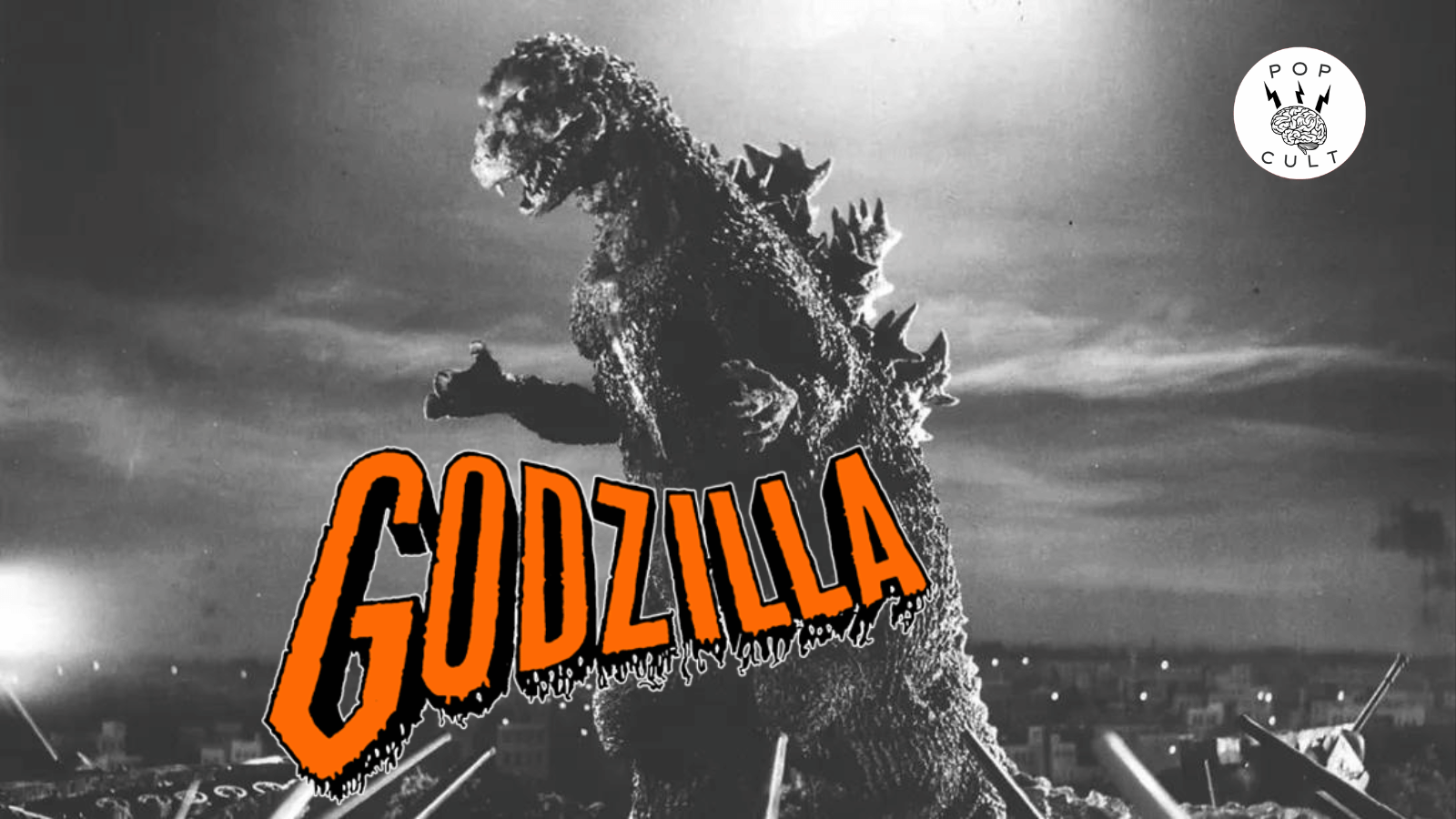
One element of Godzilla lost to Western audiences is the creature’s look. His furrowed skin/scales are intended to resemble the keloid scars survivors of the bomb had on their bodies. By bearing the same scars as the Japanese people, Godzilla’s rage is the rage of Japan. Yet he also manifests the Biblical-level destruction they were forced to go through. The bomb never differentiated between the fascists loyal to the Empire and the average Japanese citizen trying to survive in a crumbling society. It was one of the most horrific acts of collective punishment we have ever seen, and it was concentrated in this roaring monster with a breath that could vaporize a city.
Hollywood made a concerted effort to scrub the original of its political message. This is one of the great evils of capitalism, taking something meaningful to another culture and cutting it up in a manner that it can be sold to the society being critiqued. Allowing Americans to become empathic with the people their nation has victimized would undermine the national agenda of “prosperity” in the wake of the war. Thus, we got the 1960s and 70s with Godzilla devolving into a cartoon complete with a baby version of him. The link to the atomic bomb has been torn away with subsequent Western adaptations.
In the 1998, Roland Emmerich remake, Godzilla is awakened by French hydrogen bomb tests, removing all guilt from the American protagonists. They are victims, just like Tokyo in the original film. Godzilla comes to mean nothing then, just a rehash of the destruction porn from Emmerich’s Independence Day. The current Legendary productions have Godzilla’s origins wholly separated from the atomic bombing at all. The bomb is seen as a potential means to stop him, a perverse recontextualization of these elements. The United States seeking to ignore its hand in mass murder is nothing new. It’s practically par for the course.
The original Japanese version states that Godzilla was created by the atomic bombs, while the 1956 edit says he was “awakened” by them. Again, removing the guilt of America in the mass destruction and death. Hammering Raymond Burr’s reporter character into the movie results in awkward moments. He carries on conversations with characters who aren’t actually talking to him, who have their Japanese language erased with dubbing. In effect, Japanese voices are made silent by American ones, ensuring they are never blamed for anything. The original film ends pessimistically, while in the U.S., one has to give everybody hope that everything will be fine.
An essential part of being a fully realized person is facing the truth about the society you are raised in. Growing up in U.S. society, we were fed constant lies to ensure we gave over our labor and devotion for very little in exchange. Blind patriotism made it possible for us to passively ignore the long-term consequences of our past, like the genocide of Indigenous people, the chattel slavery of African people, and the atomic bombing of Japan. There is always another “worse” nation whose actions are the “real” bad ones. Godzilla became a silly pop culture icon, and even the Japanese succumbed to it for a bit.
This won’t be the last time we see Godzilla in this series. We’ll finish things off with Godzilla Minus One. In the meantime, we’ll keep exploring this event from a multitude of artists, all trying to make sense of how we atone for what our government did and what those actions did to the Japanese people.

 PopCult Reviews
One thought on “Movie Review – Godzilla, King of Monsters”