
Barefoot Gen (1983)
Written by Keiji Nakazawa
Directed by Mori Masaki
The moment when the bomb drops in Barefoot Gen shakes you. The film does an excellent job presenting itself as a slice of life initially. We follow a Japanese family. Learn their relationship dynamics. The parents discuss worries about the future. Mom is pregnant. Dad feels powerless in this fascist society. The kids argue & play. Then, without warning, the world turns into Hell. Flesh melts off bone. People are crushed to death. Some keep living, and we wonder if it might have been better if they died. You start to think about how little we’re taught in the United States about what happened after the bomb was dropped beyond “the end of the war.”
Gen Nakaoka lives in Hiroshima with his family. It’s clear that World War II is ending, and Japan’s mood is bleak. Food shortages have led to malnutrition and death. He spends the days playing with his little brother, Shinji. Their parents start to wonder why Hiroshima hasn’t been hit by the recent air raids other cities are seeing around this time. On the morning of 6 August 1945, Gen and one of his friends arrived at school. A lone B-29 bomber flies overhead and drops its payload. Gen is on the ground when it hits. He watches half of his friend’s body be incinerated in seconds. When he reaches home, all but his mother is being crushed under the weight of the house. Gen and Mom have to leave while they hear their loved ones agonizing in pain. The two walk through what remains of Hiroshima’s streets and see human forms shuffling, their skin sloughing off, eyes hanging from the sockets. Alive but also a kind of dead.
Barefoot Gen is a loosely autobiographical story originally produced as a manga. Keiji Nakazawa was only seven years old when he witnessed the atomic bomb strike in his hometown of Hiroshima. Most of his family were crushed under their home. He, his mother, and a baby sister survived. A few days later, the baby sister died, possibly from malnutrition, radiation, or some combination. After his mother passed in 1969, Nakazawa felt compelled to share his memories of that time in Hiroshima. After several series from an adult point of view, he eventually wrote one on his own at the time of the bombing. The author didn’t simply want to talk about the horrors of the bomb but also analyze the militarization of Japanese society as well as the commonly accepted domestic abuse that was intertwined with fascism.
There’s a jarring tone shift throughout Barefoot Gen. I have seen some cite this as a flaw, but I felt it helped convey the insanity of this moment. As humans, we will always try to connect to those soft, gentle things, even in moments of horror. This can lead to juxtapositions that feel like a waking nightmare. In one scene, a visibly scarred soldier stumbles through the debris. He falls over, vomiting blood & convulsing in pain. The scene interplays horror with bits of humor as other characters try desperately not to let this scar them. This event does not align with any natural human experience, so expecting people to react in an “appropriate” way is absurd.
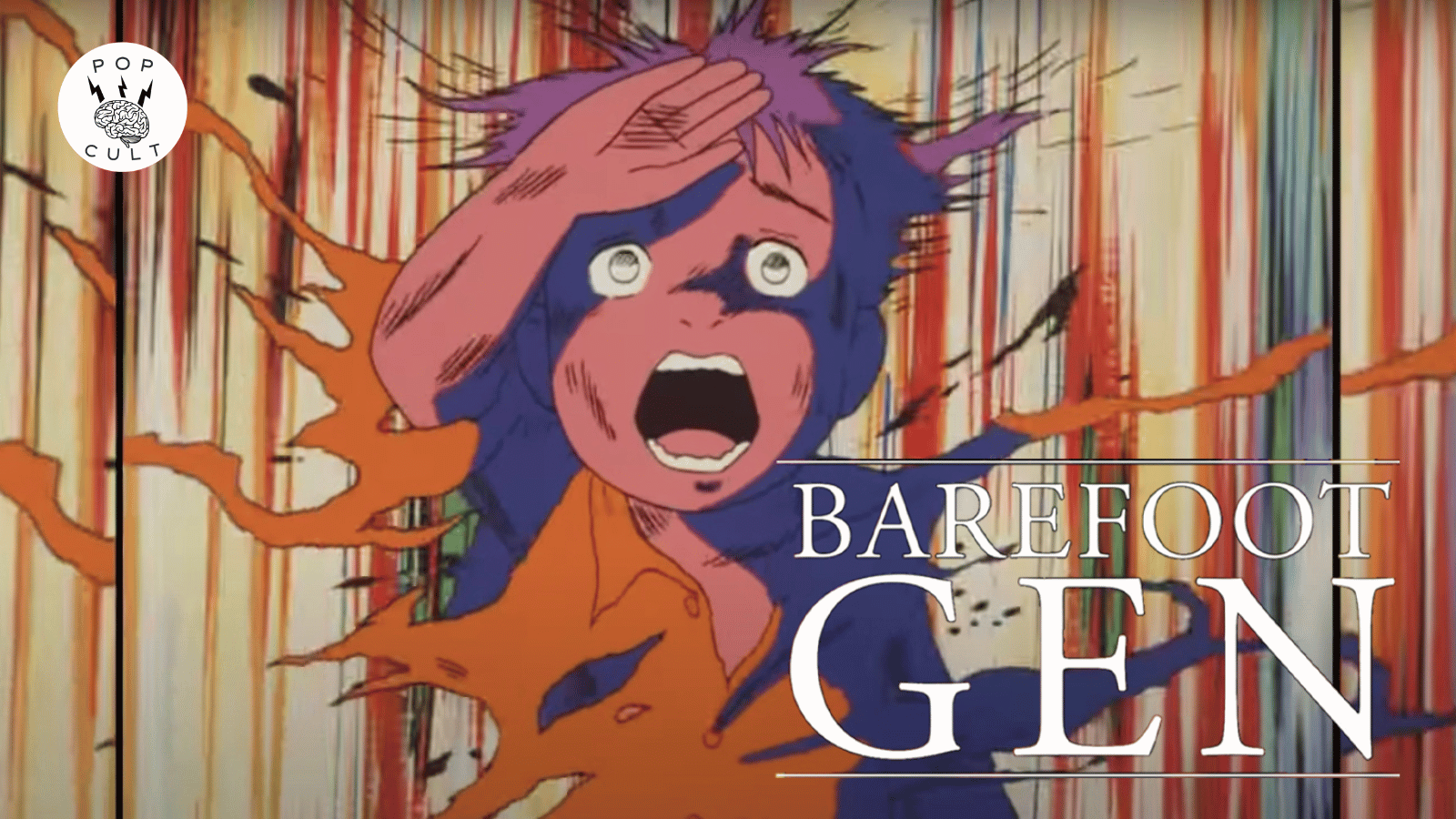
The moment when the bomb drops is one of the most potent sequences and reminds us how effective animation is in talented hands. The color palette changes to reflect the sun’s burst of light from the bomb. Time slows to a crawl. The backgrounds become nothing but multi-colored lines and movement. A little girl stands looking directly at the explosion. Her eyes are erased by the light. Then, the shockwave of heat strikes her fragile form. Skin crumbles away, revealing muscle sinew, and then that melts off to show us the bone beneath. The deconstruction of the human form in a matter of seconds. It seems strange that something full of life could be gone so quickly.
The American media is a brilliant design. Part of its purpose is to casually create barriers between what the average U.S. citizen sees and the world’s reality. We teach that the dropping of the atomic bombs was necessary because it brought the war in the Pacific Theater to a conclusion. That ignores the fact that Japan’s military was on the ropes by this time and had invited the Soviets to discuss ending the conflict. The United States coming in and occupying Japan under the dictatorship of General MacArthur was done to keep the crime covered up, to make the aftermath seem “not so bad.” Today, the U.S. military in Okinawa is a hot spot for rape & murder by U.S. soldiers, nearly 80 years later.
For the next step of the American project, it was necessary to villainize communists. The U.S. had to be the heroes of the story, and they twisted themselves into that. By obscuring the details of what the bomb does to human beings, events were shaped into a heroic victory. The bombs were, in fact, the American answer to “How do you make the Holocaust faster & more efficient?”
There are images in this film that should stay with you for the rest of your life. You should be upset and disturbed seeing this. Film is not simply a medium to escape from personal stresses. It exists like painting, sculpture, music, poetry, and more, so people can express their thoughts through it. The film combines sound & images in a manner that is perfect for both numbing the audience and jolting them awake.
Barefoot Gen is a picture that lulls us into a sense of comfort and then shocks us back into consciousness. This is Hell on Earth as seen through the eyes of a child, which is why its style seems to clash with its themes. Sit with that discomfort when you watch it. The dissonance is the point. How could we allow such horrific things to happen to little kids, to pregnant mothers, to the elderly, to entire families, to a community?

 PopCult Reviews
One thought on “Movie Review – Barefoot Gen”