
Black Rain (1989)
Written by Shōhei Imamura and Toshirō Ishido
Directed by Shōhei Imamura
In a bizarre coincidence, two movies titled Black Rain were released in 1989. They both take place in Japan. They opened in theaters one week apart. The other Black Rain we won’t be reviewing is a Michael Douglas-led action picture about the Yakuza directed by Ridley Scott. No one involved in the writing of that film was Japanese. But they both derive their title from the same phenomenon: the black rain that fell after the atomic bombings of Hiroshima and Nagasaki. This substance was nuclear fallout falling like rain from the massive pyrocumulus cloud left in the bomb’s wake. The U.S. picture uses the black rain as a plot point and doesn’t really provide context or give adequate respect to the victims. As is typical in escapist Western cinema, it’s exploitation from top to bottom. Not so with the Japanese film.
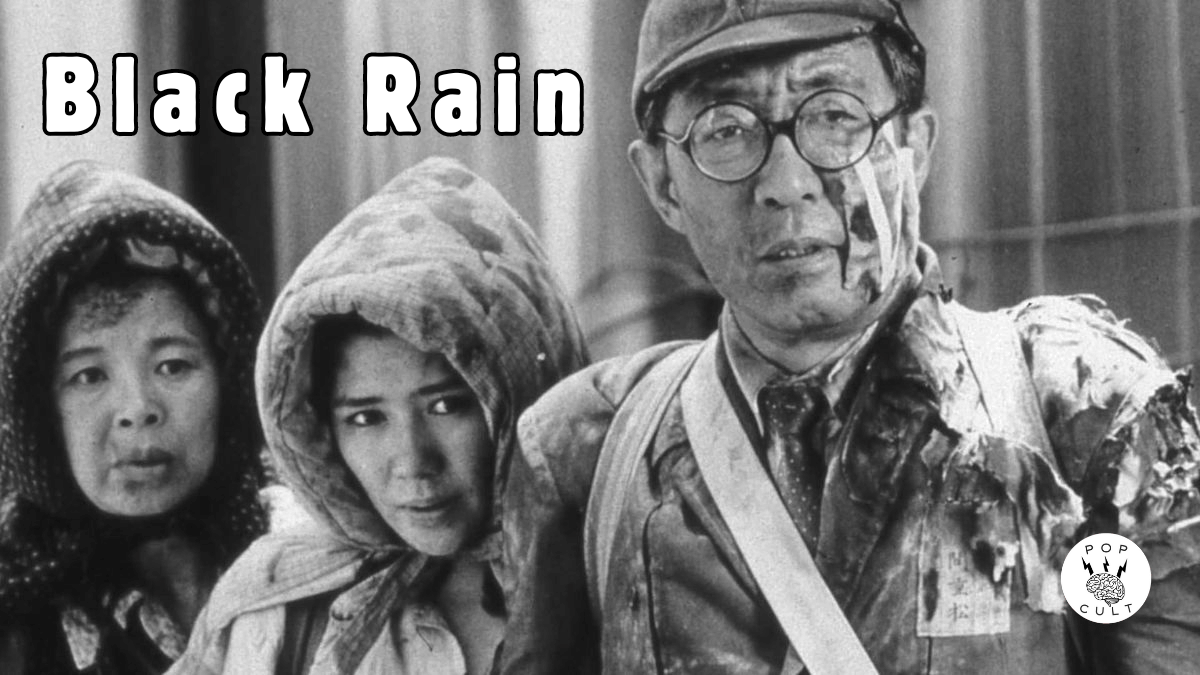
In the Japanese film Black Rain, we follow Yasuko, a teenage half-orphan living with her uncle and aunt in Hiroshima. Yasuko is helping friends with a move when the atomic bomb is dropped. She can get a boat back to the city when the black rain falls, and she’s covered in it. Once reunited with her aunt and uncle, the trio make their way through the town, hoping to get to her uncle’s workplace to escape the fires everywhere. As they travel through the city, they see the aftermath, including human beings left in a state of near death, skin melting off and crying out in pain. Five years pass.
Yasuko still lives with her aunt & uncle and now her uncle’s mother in Fukuyama. She’s a young woman now reaching the age where marriage traditionally happens. Her family searches for a suitor but finds something that causes the men and their families to back out. When they learn she was in Hiroshima during the atomic fallout, they believe she is sick, and this would mean she may not be able to give birth. The family starts to watch as the other refugees from Hiroshima become ill and die in prolonged, painful ways. They worry as Yasuko resigns herself to being an unmarried woman, rejected by her society. Life takes a dark pallor.
We certainly understand the immediate deaths of the atomic bombings in Japan, but I think those of us in the West, especially the U.S., have actively had the ongoing trail of deaths from fallout hidden from us. The media surrounding the event at the time was centered purely on the “end of the war” and the “defeat of Japan.” As I’ve said in other reviews in this series, the Japanese government had already contacted the USSR to begin talks. The U.S. had to ensure they were framed as the victors, not the “filthy commies.” They ran the same propaganda on the European Front by diminishing the sacrifices and victories made by the Soviets against the Germans. This is why you see the war as a significant moment in U.S. history, and the Soviets have effectively been erased from the story.
So, we must understand that the immediate deaths and resulting ones were utterly unnecessary in defeating Japan. The subsequent U.S. invasion and dictatorship put in place by MacArthur helped forcibly shape even the narrative within Japan. It would take Japanese filmmakers like Shōhei Imamura to eventually tell the whole story. He does an excellent job making his film look like something from the period. I kept marveling at how many shots of home life reminded me of Yasujirō Ozu’s domestic films. But there are moments I have never seen in an Ozu picture. Imamura centers his camera on the three family members as they walk through a devastated Hiroshima, letting the horror come in on the edge of the frame, never lingering for too long. The effect is powerful because we are only given brief glimpses.
The filmmaker masterfully balances the historical horror he confronts with a humanist family story. As we see Yaskuo’s marriage prospects fall through one after another due to suspicions of her health, her aunt & uncle become more visibly distraught. This is made worse as her uncle watches some of his closest friends become suddenly ill and fade away before his eyes. If their niece cannot be married, if she cannot bear children, then how is there a future? Family is a major centerpiece of Japanese culture, and the idea of a family line being severed is one of the worst things that could ever happen. Today, the United States provides billions & billions of dollars of weapons to allies like the Israeli occupation, who in turn end the family lines of dozens of Palestinians.
I left a character out of this review because watching the film unfold and meeting this character in real time has a tremendous impact. Seeing how this person’s life intertwines with Yaskuo allows some hope to seep into a fairly grim story. They serve as a reminder that even the most damaged souls can be full of immense love. The atomic bomb tore two massive scars across an already troubled society, but it did not destroy the Japanese. They suffer and continue to suffer, but it is by relying on family that they find a way through it.
The family in Black Rain is the antithesis of the family we experienced in Studio Ghibli’s Grave of the Fireflies. In that film, we encounter an aunt who sees her nephew & niece as a way to get more rations. When she sees them becoming a burden, she causes them to run away, resulting in one of the most depressing endings of all time. Black Rain finds a way to cling to hope, even with a conclusion that also involves tragic death. In Western cinema, we don’t often see such harrowing tragedies paired with messages of hope. Usually, our films seek to soften the darker aspects of the world, but that exchange carries a heavy cost. It can convince a person to see the world from a skewed perspective, one that causes them to adhere to ideals of nationalism, seeing places outside of their society as less than.
Neoliberalism has done an exceptional job of convincing us that history is something in the past that we read about in books. This is a lie. History is unfolding around us constantly. The day an atomic bomb was dropped in Hiroshima was not the only day that the act had an impact. It impacted the next day, the day after that, the following week, six months later, five years later, a decade later, and continues today. That is history. The results of the actions we take, how they ripple out across the ocean of humanity. The choice to drop two atomic bombs on Japan had consequences that we still feel today.
The Japanese government disinvited the Israeli government from 2024’s atomic bombing memorial ceremony because that entity is, at the time of this writing, engaged in an ongoing genocide. The United States responded by refusing to attend. The audacity of that speaks volumes. History is not over; it has barely started. Actions have consequences. A nation’s refusal to genuinely accept responsibility for its actions should have a heavy price. You don’t get to commit mass murder and then behave like you are sainted.

 PopCult Reviews
One thought on “Movie Review – Black Rain”