
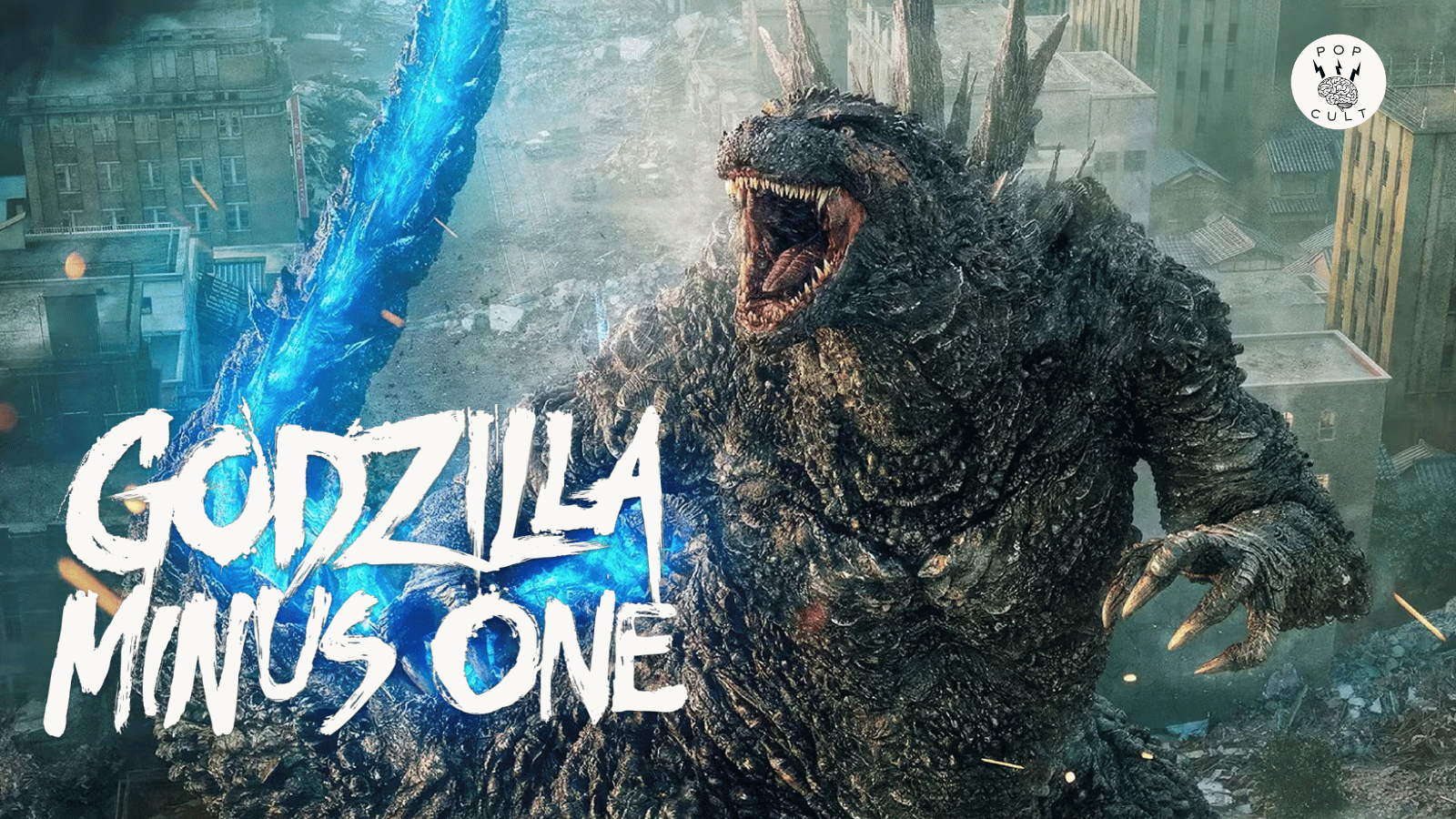
Godzilla Minus One (2023)
Written and directed by Takashi Yamazaki
There is a scene just before the big third-act finale where Godzilla Minus One lays out its core thesis through the words of Kenji, a former Naval weapons officer trying to end the monster’s reign of terror on Japan. He states: “Come to think of it, this country has treated life far too cheaply. Poorly armored tanks. Poor supply chains resulting in half of all deaths from starvation and disease. Fighter planes built without ejection seats, and finally, kamikaze and suicide attacks. That’s why this time I’d take pride in a citizen led effort that sacrifices no lives at all! This next battle is not one waged to the death, but a battle to live for the future.” And that’s the theme of this film, to live in the face of what seems like hopeless obliteration.
Koichi is a Japanese kamikaze pilot who lands at a base on Odo island, citing mechanical failure. It becomes apparent that the pilot became scared as he approached his terminus point and flew away. That night, while hunkering down on the island with the repair crew, Koichi witnesses Godzilla emerge from the ocean and attack and kill all but himself and one other man. The creature is about the size of a dinosaur, terrifying but not the massive city destroyer we know him as. Koichi returns home, where he discovers his parents died in the firebombing of Tokyo. As he rebuilds his life, he also brings Noriko, a young woman whose parents also died in the bombing, and the orphaned baby she has taken into her care. It’s a family made up of those who lost their own families in the attack.
While working as part of a minesweeper crew cleaning up the waters off the coast, Koichi and his shipmates learn Godzilla has transformed as a result of the American’s atomic bombing. He’s larger, with powers, and is destroying naval vessels without a second thought. An encounter with the monster reveals that he is impervious to so many of their weapons and has the ability to fire an atomic blast from within him that incinerates anything in its path. Eventually, the creature makes landfall, and Koichi must unify with the broken & exhausted population to have any chance at stopping Godzilla.
I was not as moved by this film as many others I see leaving reviews & comments online. I certainly didn’t think it was bad. I have not watched many Godzilla movies, they have just never been a genre that appealed to me. Without a doubt, this was the best one I’ve seen because it chose to focus on the human characters and their struggles. Godzilla is very much a force of nature and does not have any personality. That’s the way it should be. The intent of the monster was always to act as a metaphor for the destructive power of the atomic bomb and how it left a scar across Japan. I don’t like how the Western version of the character has repurposed him into a “superhero,” essentially.
Koichi is a very compelling character, and it’s not often that your protagonist is a “failed kamikaze pilot.” I have seen some criticism, which seems valid that this director has made two films with a kamikaze pilot as the main character. In our discussions about the atomic bombing of Japan, we need to remember not to leave out that the Japanese government was not a saint. It was an imperialist, fascist regime, and there were a lot of people that went along with that. That doesn’t mean they deserved the firebombings and atomic bombings, though. As I’ve noted in my review of Grave of the Fireflies, many Japanese artists want to discuss the fascist aspects that crept into everyday life and the way that made these attacks worse. The people were not unified in a way that helped them recover.
Godzilla Minus One shows this through his neighbor Sumkio. She’s played by the fantastic Sakura Ando, whose collaborations with filmmaker Hirokazu Kore-eda (Shoplifters, Monster) have been some of the best films of the last ten years. Sumiko is intensely bitter when she sees Koichi digging through the wreckage of his family’s home. She remembers he was a kamikaze pilot, so why is he alive and in their neighborhood right now? She spits venom at him, claiming that this couldn’t have happened to all of them if he had fulfilled his duty. Like many of the other characters in the picture, she goes through a transformation, a rediscovery of community, and that we must struggle for life against the tide of death & destruction.
The film manages to balance the intimate with the grand so perfectly. I see so many American films where they want an emotional core alongside the bombast, and it feels like the loud noises & explosions always overwhelm any intimacy. Take Gareth Edwards’ Godzilla film from a decade ago. It attempts to have an emotional center with Bryan Cranston and Aaron Taylor-Johnson, and then the latter’s wife, played by Elizabeth Olsen. It never worked for me. That could be because Godzilla is inherently a Japanese story, and slapping American characters into the lead roles feels disconnected from the concept.
Minus One is a film about the need for a community to weather struggles. Those lines I quoted at the start connect to much of what is happening worldwide. I couldn’t help but think about the Palestinian people facing Western-financed genocide and how they provide a perfect example of solidarity in the face of horror. Then I turn to look at my people back in the U.S. and see a nation foaming at the mouth, ready to rip into each other’s throats.
There are some bad-faith actors that deserve that level of scorn, the fascists who feed into division. But every day on social media, I see people with little to no power going at each other like their lives depend on it, ready to explode at the merest perceived slight. Perhaps face-to-face conflicts might turn out differently, but I doubt that. A realistic film about Godzilla attacking the United States wouldn’t see people coming together. They’d blame the monster on the social panic of the day and start turning on each other as his atomic breath leveled their cities.

 PopCult Reviews
One thought on “Movie Review – Godzilla Minus One”