
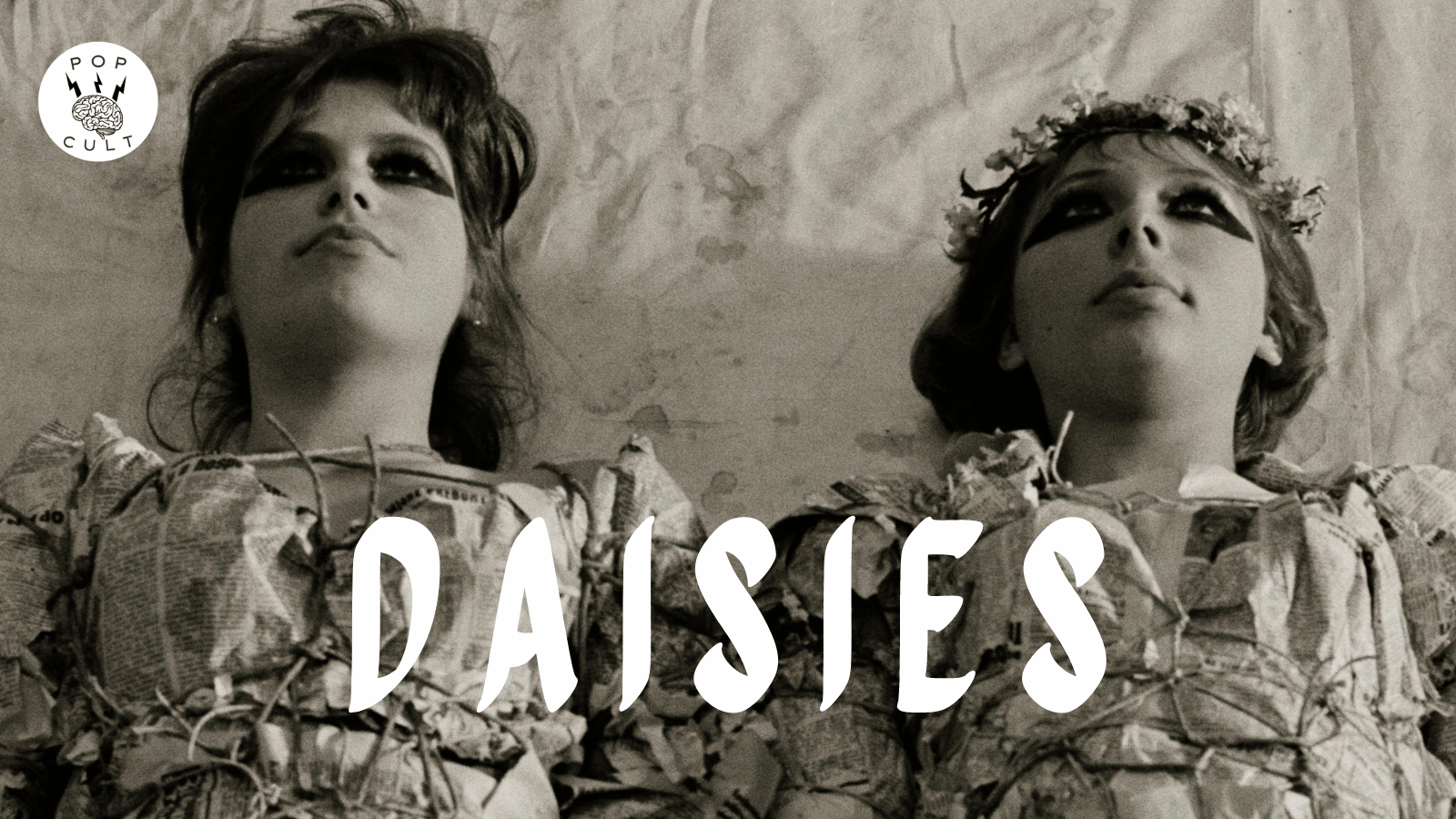
Daisies (1966)
Written by Ester Krumbachová, Pavel Juráček, and Věra Chytilová
Directed by Věra Chytilová
There’s a vibrating chaos at the heart of Daisies, considered the most significant achievement in Czech cinema. It’s a study of patriarchy through the eyes of two cartoon-like women whose behaviors and antics are intentionally exaggerated. There’s no real plot to speak of, rather vignettes in which two girls, both named Marie, interact with people or engage in frantic behavior, giggling and gorging down food. The film conflicts with the conservatism present in Czechoslovakia’s communist government at the time. It is, in my opinion, a needed continued push to the Left that all communist governments are constantly in need of. We humans tend to settle into familiar routines and ruts, but we must also allow our perspectives to be challenged, especially when it comes to increasing our embrace of others outside of systemic power. Daisies is an attempt at that.
Marie I and Marie II sit around. Each time they move, we hear creaking sounds. Their movements and speech are robotic in nature. They talk about the whole world being spoiled and decide they will be spoiled, too. Marie I goes on a date with an older man. Marie II crashes the date, claiming to be the sister. She orders lots of food on the man’s tab, mocks him to his face, and keeps getting in the way as he tries to make moves on Marie I. The girls ditch the man and continue on.
This behavior continues, and the girls trash one social setting after another. They try to kill themselves but sabotage the effort by accident. Men pursue them. They find it amusing but ultimately boring. The Maries eventually end up in a grand dining room with a table filled from end to end with food. And they gorge. The film eventually ends with footage of bombs being dropped and a dedication to “to those who get upset only over a stomped-upon bed of lettuce.”
I won’t blame you if you find Daisies to be incomprehensible chaos. Ariana commented while we were watching that this is what she envisioned foreign films as before she started watching them with me. The Eastern Bloc countries certainly produced intensely surreal cinema during this period. It’s often a rebellious notion as the previous generation of communist leaders had settled into a comfort zone and needed to be shaken. What Daisies is doing is peeling back a veneer of dishonesty that exists in “polite” society to point out ways in which women have their power greatly diminished for the sake of the male ego.
In U.S. politics, we often hear a lot of talk about decorum from the Democratic Party. The Republican Party, on the other hand, likes to cause trouble, but not for any real purpose. Both methods are obstructionist. The former inhibits meaningful material change by forcing faux incrementalism, which is a standstill. The latter creates chaos that serves no purpose, continually punching down and fealty to established hierarchies. While I can’t speak to the details of Czech society when Daisies was made, I can see parallels in the current state of the U.S.
The whole “well-behaved women rarely change history” line was floating around during Trump’s term, which seems to have evaporated in the era of Biden/Harris. I agree with that statement, but not those who were parroting endlessly. The people I saw saying that statement on repeat often benefited tremendously from the status quo. They were the same people who believe Aaron Sorkin’s twisted version of U.S. politics is a reality. I saw them admonishing all forms of authentic resistance, instead opting for well-organized and permitted parades. That is the definition of “well-behaved.” Protests that don’t disturb the flow of commerce and daily life might as well be happening behind closed doors.
A polite society is a falsehood. It veils the truth of our “developed” societies. We are taught in the U.S. that it is the freest country in the world, that everyday things are improving, and that equality is increasing. This is a lie that takes little effort to debunk. All it takes is a glimpse at the history of the United States as written by the people who have lived at the bottom of it their whole lives.
I recently finished “The War Against All Puerto Ricans,” a text that focuses on the Puerto Rican people’s early to mid-20th century experience under the rule of the United States. Among many horrific things related in that book, there is the anecdote of the political prisoner who was brought meat one day as a surprise break from the typical diet his U.S. captors fed him, stale bread. After eating the meat, his jailer asked if he had enjoyed his son. The prisoner didn’t understand. That’s when the severed head of a young boy was produced and shown to the prisoner. He responded by vomiting while the guards laughed and then dying of a heart attack.
This is just one of the many things the “civilized” United States has done. Also shared in the book were details about the decades-long projects exposing citizens both in Puerto Rico and the States to amounts of radiation that are considered over ten times the safe amount. One of those was with mentally disabled students in an institution where they were told they were joining a “science club” and were subsequently fed breakfast cereal with radioactive materials mixed in.
Back to Daisies. The Maries go about a campaign of destruction, culminating in the utter obliteration of a dining room. Food ends up slopped everywhere. Clothes are mismatched and torn. The furniture is shattered. In the end, we are left with nothing but ruins. Beneath the construct of society is the dirty truth about Western civilization, we are the barbarians, we are the savages, we are the beasts who walk like men. Not the indigenous people whose land we’ve conquered and subjugated and systematically raped for centuries. Those people had conflicts for sure, but they were not building world-spanning armadas to scour the globe and take everything they could back home.
In recent years, there have been questions from bad faith actors about “what is a woman?” A woman is a social construct. The main requirement, according to many, seems to be the presence of a uterus. They don’t quite know what to say when said reproductive organs don’t work correctly, as they have boiled a woman down purely to her ability to procreate. They say a woman is a person who wears dresses or stays at home with the kids or anything else they have attributed to “womanhood,” and which are contradicted constantly. Some people identify as men who like to wear dresses. Many fathers stay at home. I was a male elementary school teacher, a job typically seen as feminine.
“Woman” is a performance just as “man” is. Daisies is about two young people who realize they know how to play women well. They are women enough in the given situations to get what they want out of them: mainly food and a good time. Transgender people understand gender performance better than any of us cis people as they were forced to perform as the one they were assigned, likely their whole childhood or longer.
The girls are robots at the movie’s beginning as an acknowledgment of the constructed nature of their identity. However, by the end, they have played the game for so long that it devolves into a disgusting horror show of gluttony. They suddenly feel regret because they have eaten everything and there’s nothing left. There’s something about playing the game for too long and with such intensity that it leaves you hollow. All the pleasures and indulgences wear thin, and reality starts to set in. We see this in the closing montage of bombs dropping. That’s the truth of the social constructs we were born into, cover for an intense savagery that will eventually destroy us.

 PopCult Reviews
One thought on “Movie Review – Daisies”