
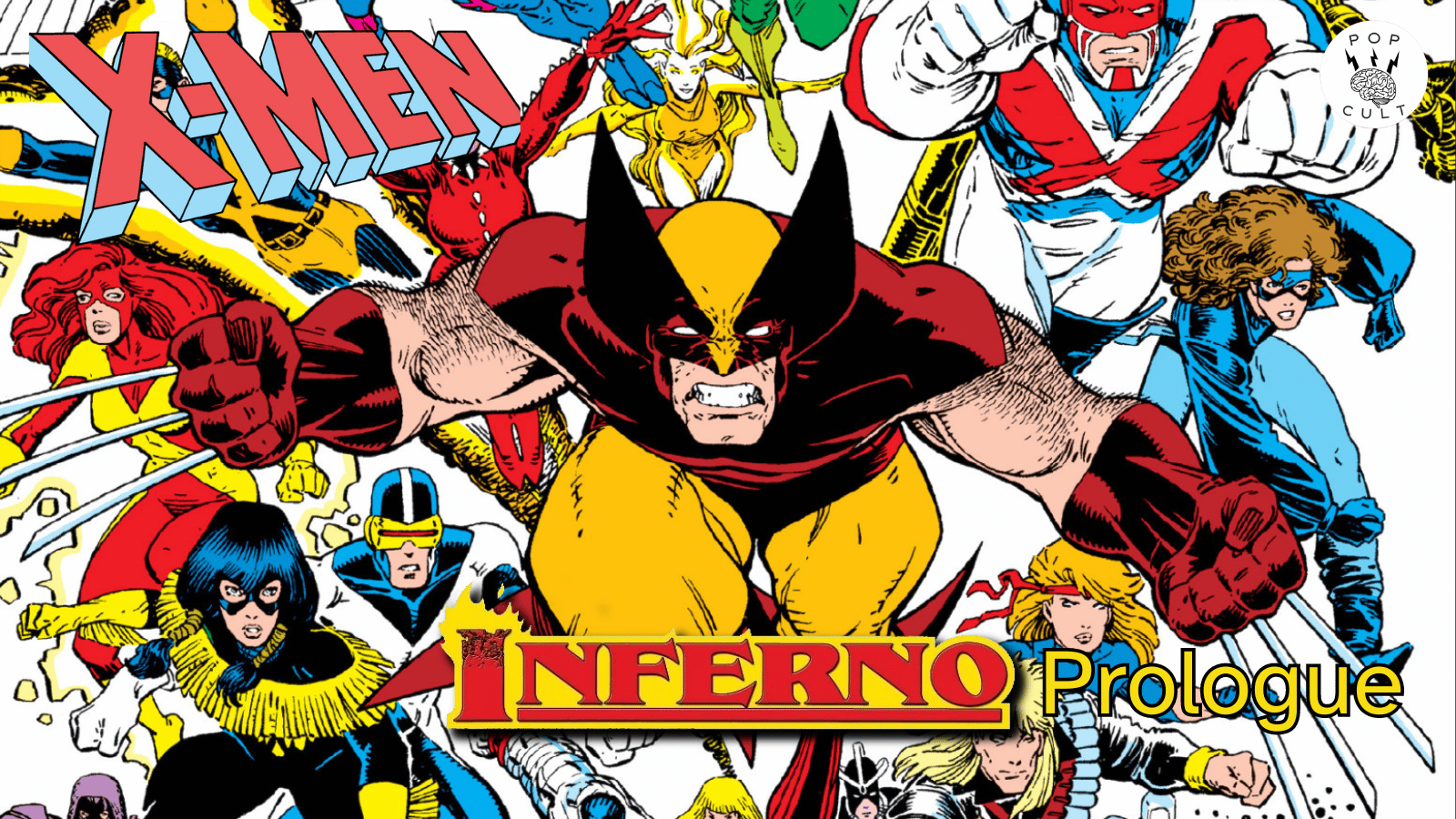
X-Men: Inferno Prologue Omnibus (2021)
Reprints X-Factor #27-32, X-Factor Annual #3, Uncanny X-Men #228-238, X-Men Annual #12, New Mutants #62-70, New Mutants Annual #4, Marvel Age Annual #4, and Marvel Fanfare #40
Written by Chris Claremont, Louise Simonson, Tom DeFalco, Walter Simonson, and Mark Gruenwald
Art by Marc Silvestri, Walter Simonson, Rick Leonardi, Jon J. Muth, Bo Hampton, Bret Blevins, Terry Shoemaker, June Brigman, Arthur Adams, Steve Lightle, Tom Artis, Paris Cullins, Ron Lim, John Buscema, and Craig Hamilton
The X-Men are dead. At least, that’s what the world believes in Chris Claremont’s landmark run. The Fall of the Mutants storyline ended with the team dying and secretly being resurrected by the goddess Roma. These are not the X-Men from the animated series or the films but a roster not referenced in contemporary comics or media adaptations. Wolverine, Storm, Colossus, and Rogue are here – standards that we associate with the team over the decades. But there’s also pre-ninja Psylocke, Cyclops’s brother Havok, pop star Dazzler, and Mojoverse refugee Longshot. Madelyne Pryor, Cyclops’s wife & a dead ringer for Jean Grey, is there too. More on them later, as this collection begins with X-Factor.
X-Factor continued the stories of the original five X-Men and the young mutants they have rescued from the clutches of hatemongers. Their Fall of the Mutants arc led them to push back the threat of Apocalypse for a while and take over Ship, his sentient headquarters. Warren Worthington, formerly Angel, was remade into Archangel and is still reeling over identity issues and the hate he was infused with by Apocalypse. Beast has had his intelligence nerfed as well. In this opening issue, Cyclops sees the “death” of the X-Men on a television broadcast, which informs him that his wife, Madelyne, whom he believes had been killed during the Mutant Massacre by Mister Sinister’s Marauders.
One of the takeaways from my reading of X-Factor, from its embarrassing start under the pen of Bob Layton to its fairly mediocre continuation by Louise Simonson, is that the comic was not very good. So many of the villains are extremely forgettable. Even Apocalypse is written so broadly and kept mysterious to an absurd degree that if other writers hadn’t done the work to develop him, he’d have been tossed on the trash heap like many of these other rogues. For example, these issues introduce Infectia, a mutant who can alter the genetic structure of others, effectively turning them into monsters. She’s in a too-long arc involving Iceman and Beast, but it’s incredibly forgettable. She was one of the first mutants to be killed off by the Legacy virus in the 1990s, which makes sense as getting rid of her was not a loss for the X-mythos.
The collection switches to Uncanny X-Men for a strangely awkward issue that is a flashback to a Dazzler & Wolverine-centric story before they were killed. It’s framed through a letter written by one of her associates and is an odd story to enter the world of the X-Men as it feels so detached from everything else to come. The first issue that really kicks off the “Australian era” is interesting because we don’t see the X-Men until eleven pages into the story. Instead, we’re shown an attack by the Reavers, a band of cybernetic killers who are striking a bank in Singapore. Their trick to jumping in & out of places is the mute Aboriginal mutant Gateway. Gateway doesn’t support them other than through his power, but details about him will never get developed during Claremont’s run.
The Reavers are based out of an abandoned town in the Outback, and when the X-Men show up, they promptly clear the killers out by shunting them into the Siege Perilous. This is a mystical gateway to the Multiverse given to the X-Men by Roma and ends up being used primarily to magically handwave away things later in the run. Rogue is acting strangely and will later learn about Carol Danvers/Ms. Marvel persona she absorbed years earlier is taking over control of her body. Colossus has been trapped in his organic metal form since the Mutant Massacre. This doesn’t feel like the X-Men we know today, but it is fascinating.
There were also some significant changes behind the scenes, such as editorial shifts, of which the average adolescent reader was likely only aware if they paid close attention to the credits in each issue. Ann Nocenti who oversaw the X-books for four years. Bob Harras replaced her, who would eventually become editor-in-chief of Marvel Comics in 1995. He saw the X-Men as having drifted too far from the “original concept,” meaning he wanted Professor X and the mansion back. These regressions would create much tension between him and Claremont, eventually leading to the writer’s departure as the Jim Lee era dominated the books. There will be a years-long tug-of-war between the two, though.
In New Mutants, Louise Simonson continues her effort to undo a lot of the things Claremont set up in that book before he left. One of those is writing Magma out of the title and sending her off to be part of Emma Frost’s Hellions. She’d killed off Doug Ramsey just before this in The Fall of the Mutants, and the team is still mourning their friend’s death. We get a partial sequel to the famous Kitty Pryde fairy tale, this time as a space opera. Like the Dazzler issue I mentioned above, this is a strange flashback filler-style issue that feels unmemorable. Claremont plots the story alongside Simonson’s scripting.
The most important developments in New Mutants are the team’s slow-motion dissolution, Magneto drifting away as their mentor to returning to his villainous roots, and Magik hurtling towards her destiny and losing more of her humanity. They, too, witness the death of the X-Men on TV, and Magik wants revenge for her brother’s death. She clashes with Magneto and Kitty Pryde, both stuck in grief. Magik believes Freedom Force, Mystique’s government-sponsored mutant squad, are the ones who killed the X-Men and want their heads. This leads to a fight with Forge, where Magik further embraces her demonic Darkchilde persona. This crosses into the Uncanny X-Men, where Colossus ends up appearing to Magik, but through some weird convolutions, she believes it’s a dream or something. I really disliked a lot of the first half of this collection because it all feels like this, lacking motivation or direction.
Things get better with a short Brood story arc that finally has the X-Men getting involved in an actual story. I’ve never been a huge fan of the Brood concept, but this is okay. More importantly, Madelyne Pryor starts to be manipulated by demons. She’s shown footage of Cyclops with Jean Grey, which will begin to trigger her transformation into the Goblin Queen, the main villain of Inferno. This leads to a trippy vision sequence where Madelyne appears as an angel and watches Cyclops kiss a faceless mannequin. He takes Madelyn’s face off of her head and places it on the doll, which is transformed into Jean Grey. This is all quite ironic if you know what the reveal of Pryor’s true origins will be in Inferno. Eventually, she meets S’ym, a demon under the thrall of Magik who thinks he can use Pryor to overthrow his mistress.
The story is interrupted by the X-books tie-ins with the Evolutionary War story arc, an event that I couldn’t have given fewer shits about. The only real memorable thing that comes out of this is in a backup feature where Mojo creates the X-Babies, a satire of the “insert popular franchise here” as kids trope. X-Factor continues its Infectia story arc slog.
Claremont delivers one of the best stories of his later period of X-Men, starting in issue 235. Here, he introduces the island nation of Genosha, a futuristic society where mutants have their autonomy removed and serve as tools of the state. From the opening pages, we see a man carrying a baby. He’s being chased by armed soldiers. They kill the man without a second thought and end up in Australia, where Madelyne gets abducted by the Genoshans, allowing a reason for the X-Men to become aware and get involved. It was no coincidence that Claremont was writing this in the late 1980s, as apartheid in South Africa was the focus of a targeted boycott and global action. It’s his last foray into making the X-Men explicitly political and is one of his best stories.
The cover of issue 236 features Rogue and Wolverine as fish, strung up by their feet as two Genoshan soldiers stand on either side posing for a photograph. At one point, Rogue is captured, and it is heavily implied that she is sexually assaulted and tortured by the Genoshans. It’s never played as exploitatively but rather as genuine horror. This incident puts the Danvers persona into the driver’s seat and will be how Rogue is up until the final arc of Claremont’s run. Madelyne also sees her mind snap after being brutalized by the Genoshans, and she appears for the first time in her Goblin Queen form. They acknowledge their systems tell them she’s no mutant, but what she is scares them nevertheless. By the end, the seeds of a romance between Madelyne and Havok are sown, and the X-Men leave Genoshan knowing that the nation hasn’t been stopped yet.
The book closes out with some New Mutants issues involving them teaming up with mutant rockstar Lila Cheney on a space adventure. It’s an extremely forgettable, boring story.
This is such a strange moment in the X-books. I can easily understand why the 1991 reboot would be necessary because things feel stagnant. Yet, Claremont is still delivering brilliant stories despite all the muck. The Genosha arc is truly one of his best, reminding us that he can still give us some great stories over a decade into the run when inspiration strikes. In our next review, Inferno arrives, and the first real X-crossover happens.

 PopCult Reviews
One thought on “Comic Book Review – X-Men: Inferno Prologue Omnibus”