
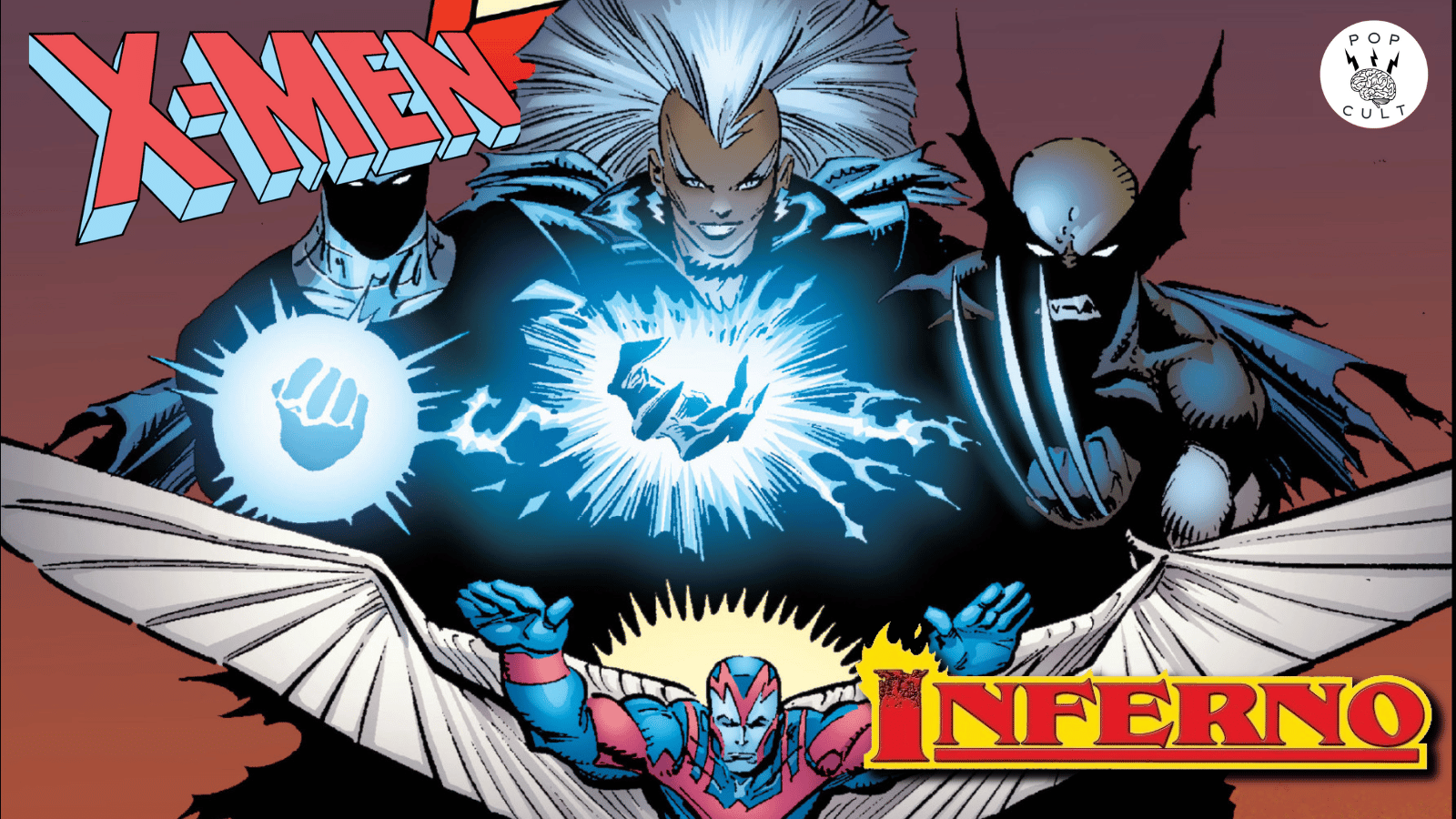
X-Men: Inferno Omnibus (2018)
Reprints X-Factor #33-40, X-Factor Annual #4, X-Terminators #1-4, Uncanny X-Men #239-243 and New Mutants #71-73
Written by Chris Claremont, Louise Simonson, and Mark Gruenwald
Art by Marc Silvestri, Walter Simonson, Jon Bogdanove, Terry Shoemaker, Bret Blevins, Jim Fern, Rob Liefeld, Dan Green, Bob Wiacek, Al Williamson, Al Migrom, Joe Rubenstein, Mike Manley, and Hilary Barta
For five years, Madelyne Pryor had existed as a mystery in the X-Men corner of the Marvel Universe. A few years after losing Jean Grey, Cyclops met her doppelganger, an Alaskan pilot. Their love blossomed, they married, and they even had a baby. But then Jean miraculously returned, and Cyclops abandoned his wife and child so that he could head back to New York City as part of X-Factor. Maddie was attacked by the Marauders, and her baby was stolen. She’d end up with the X-Men in Dallas, where they were killed in front of television cameras only to be resurrected by the goddess Roma and sent off into a new chapter of life in the Australian Outback. Finally, Claremont would reveal the true nature of Maddie in what would serve as the first true X-Men crossover, an event that touched on all the ongoing books and had tie-ins throughout the Marvel Universe.
A sizable number of X-Men fans and even admirers of Claremont’s run see Inferno as the creative low point of the series. With over thirty years of hindsight, I can read this and reflect on how several tropes emerged that have become persistent and overused. The shocking revelations that serve as convenient reminders to deal with pesky story conflicts are among the biggest. For Cyclops to remain with Jean meant he was a deadbeat dad and husband. That’s a hard sell for one of the key characters in a comic book franchise.
Claremont never liked Cyclops all that much and felt he’d sent him off to live happily ever after with the conclusion of the character’s involvement in Uncanny X-Men. Claremont and collaborator John Byrne had not wanted to kill off Jean Grey after the Phoenix Saga, but then editor-in-chief Jim Shooter, a known bully, demanded that’s what happened. Now, to make X-Factor happen, a contrived resurrection had to occur. It should be noted Claremont was not involved in X-Factor at any point based on the writing credits. He was doing his own thing in the pages of Uncanny.
Inferno clearly has two parallel plots going on. The first is Louise Simonson’s New Mutants and the mini-series X-Terminators. It seemed clear that one of the underlying purposes here was to transition the sizable group of teenage mutants X-Factor had rescued from their book into the more appropriate New Mutants. Not many of these characters are remembered by anyone outside of hardcore fans – Rusty, Skids, Boom Boom, Rictor, Leech, Artie Maddocks. The demons N’astirh and S’ym end up in a battle over the souls of Madelyne Pryor and Magik, with the latter being who the New Mutants arc focuses on.
Having read a considerable portion of Louise Simonson’s New Mutants and X-Factor, I am not a massive fan of her writing. There’s a pervasive dullness throughout it all, coming from an adherence to a predictable structure. We remember events from her work, but when you read through the actual stories, I feel very little emotion. Claremont’s work is the opposite, constantly surprising me and searching for a new way of exploring the mutant side of Marvel. Her contributions to Inferno drag on and feel repetitive.
The only moment that really stood out to me was the conclusion where Illyana, aka Magik, must confront the demonic evil that’s been hinted at about her character since she was trapped in Limbo with Belasco. We get her death, which I didn’t even know had ever happened, as she’s walking around alive and well today with a new ongoing series on the horizon. Despite knowing of her inevitable resurrection, I still found her sacrifice one of Simonson’s best stories.
Over in the X-Men/X-Factor side of things, Claremont finally provides a story in which Mister Sinister takes an active part. That’s not to say the character is some complex original creation; he remains a generic but visually interesting addition to the X-Men’s Rogues. He’s presented as a Machiavellian schemer and brilliant geneticist. There’s no real sense of a person, though; more of a walking plot device. He mainly goes about manipulating the X-Men into position so he can wipe them off the board. It’s revealed that the infant Nathan Summers is in his possession, and he has some vague plans to use the child’s DNA to shape the future. I doubt that Claremont knew exactly where Sinister was going, as Inferno will be the sole story arc he uses the character in aside from being a figure in the shadows during Mutant Massacre.
Over in the pages of X-Factor, Simonson pits the team against Nanny, a well-meaning but ultimately delusional mutant who uses her mind manipulation to rescue young mutants from whom she believed was a threat. She correctly assessed Mister Sinister and the anti-mutant group The Right as a danger, but she and her “son”/henchman Orphanmaker have methods that put them at odds with the heroes. Archangel also closes out part of his first arc by confronting his former friend turned foe, Cameron Hodge. It ends with the apparent decapitation of Hodge, but faithful readers know that’s just the start of the villain’s transformation.
Throughout all these issues, the background of New York City is shifting, becoming more sinister, and by the time the Inferno breaks out, it’s clear Hell has come to Earth. Inanimate objects transform into deadly monsters. X-Factor fights a subway train that has become a massive devilish serpent. Maddie brings Havok to New York City as part of her seduction, and we glimpse an elevator that eats people. All the pieces are in place, and things begin to fall apart. It is with Uncanny X-Men #241 that we learn the truth about Madelyne Pryor, why she resembles Jean Grey, and her connection to Mister Sinister.
One of the problems with trying to provide a backstory to Maddie at this point is that Claremont was never interested in developing her into that integral part of the series. She provided Cyclops with an exit so Claremont could move on with the characters he was more interested in, like Storm, Nightcrawler, and Colossus. The answer to Maddie’s past is that she is simply a clone of Jean Grey, created by Sinister. He provided some false memories and dropped her in Cyclops’s path to produce a child. Sinister was far more interested in a new generation of mutants, and now he’s happy to eliminate what he sees as relics of the past. The return of Jean Grey messed up those plans and made Maddie vulnerable to the manipulations of the demons, which also became a problem for Sinister.
In Simonson’s writing, we find someone far more sympathetic to Cyclops. Maddie has Nathan and tosses him aside, with Cyclops coming to his infant son’s rescue. That begs the question of where all this care for his child was when he found out his old flame was alive & well, leading to him abandoning the child in the first place. This makes for very convenient writing under Bob Harras, who insisted that the X-books begin to return to their classic roots – mansion, Xavier, and all. It was Claremont who always had a strong feminist streak in his writing – I would argue Storm has been the central character in X-Men for several years. – that goes along with maligning Maddie so that Cyclops can be redeemed.
You would not be blamed for feeling like much of Maddie’s arc in Inferno feels like Jean during her Dark Phoenix era. This moment also leads to the first meeting of the X-Men and X-Factor, providing a genuine clash between the groups. Since Claremont started on the book, a fight between the original X-Men and the new members had been teased but always revealed to be robots or an illusion. Here, we get the real deal, and I have to admit it feels appropriately epic. The tension between Archangel and Wolverine carries over from the former’s short time on Claremont’s team. It makes me wonder if Angel’s disapproval of Wolverine’s tactics and his own transformation into a cold-blooded killer was ever explored further between the two characters. I don’t quite remember any tension like that from Rick Remender’s Uncanny X-Force, which would have been a great place to explore it. Perhaps it’s somewhere in the Nicezia/Lobdell era?
Eventually, Inferno becomes a series of “shocking reveals” on double-sided issues. It’s a lot of fun but not necessarily Claremont’s high point as a writer on the series. Eventually, Maddie dies, but her soul is merged with Jean’s, so they can say she’s the mother of Nathan and try to sweep the unpleasantness of Maddie’s character assassination under the rug. This leads to Inferno’s conclusion, which is a direct confrontation with Mister Sinister, who uses the hollowed ruins of X-Mansion as his base of operations. There’s a rematch between Sabretooth and Psylocke, harkening back to their first confrontation during Mutant Massacre. The biggest reveal is that Sinister has been manipulating Cyclops and Havok’s lives since they were children. The villain is seemingly killed with plenty of questions remaining, but he will return in time, albeit after Claremont exits the title.
The omnibus concludes with a couple issues of X-Factor that serve as housekeeping, an epilogue of sorts. The teenage characters from the book are now officially part of the New Mutants, and Nathan Summers is the child of Jean and Scott. Nanny and Orphanmaker surface again, but without much impact. We’re also “treated” to some early work by Rob Liefeld, whose tenure on New Mutants was coming soon. He does an alright job of matching the direction in which Marvel’s art was trending.
Inferno was a fun read, but a complicated one, too. This is the beginning of the end for Claremont on the X-Men. With Madelyn Pryor gone, Bob Harras is going to shutter his Australian experiment fairly quickly. This will begin one of the strangest eras of Uncanny X-Men, an over-one-year-long arc that would see the team completely disbanded and the narrative hopping around the world almost like an anthology title. More on that in our next review.

 PopCult Reviews
2 thoughts on “Comic Book Review – X-Men: Inferno Omnibus”