
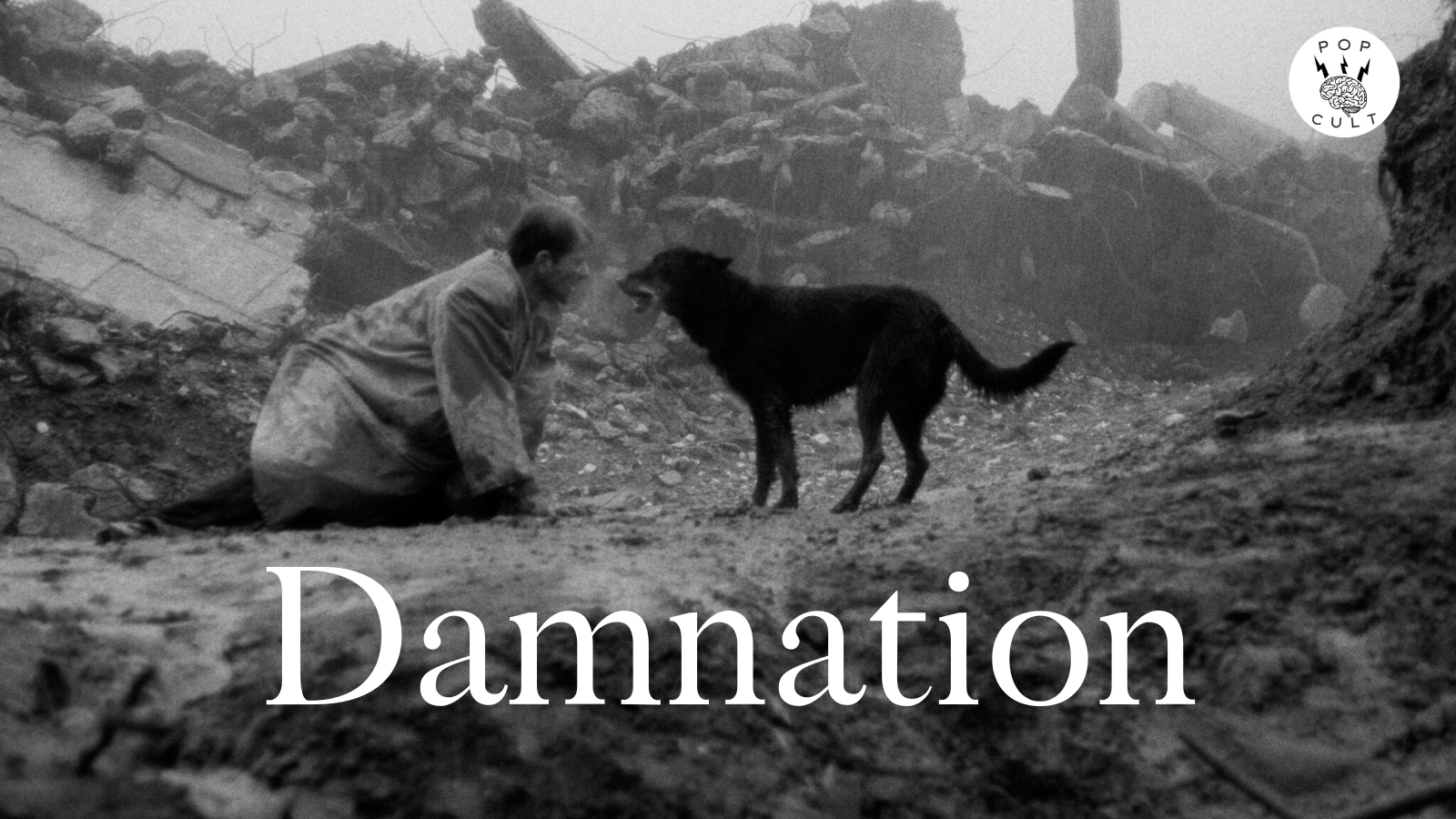
Damnation (1988)
Written by Béla Tarr and László Krasznahorkai
Directed by Béla Tarr
You must remove any of your expectations when you sit down to watch a Béla Tarr film. He’s a filmmaker I’d heard of for years and even seen films influenced indirectly & directly by him. The Chinese film An Elephant Sitting Still by his late protege Hu Bo was one of them. But I’d never seen anything by Tarr himself. I decided to watch his four highest-rated movies, made during the second period of his career, where he changed his style and produced work that is considered some of the finest films ever made. These are definitive slow cinema stories in no hurry and use their plodding nature to emphasize some cruel truths about being human.
Tarr is a Hungarian filmmaker who has been directing since 1979. He calls this opening nine years his “social cinema” period. These films told stories about everyday people and were shot in a cinema vérité style. By 1988, his style had transformed entirely, and his attitude toward humanity was markedly bleak. That was fueled by the ongoing collapse of communism in Eastern Europe, which worried the respective societies about what came next. There had been promises for a better life, but those who lived on the fringes of this industrial world found misery to be the only constant.
Damnation was the first film of this second period. Karrer (Miklós B. Székely) is in love with a torch singer (Vali Kerekes) at the local bar, Titanik. She is married and breaks off her affair with Karrer because the singer believes she can be famous one day, but this small town is holding her back. Karrer ends up deeply depressed, and in this malaise, he’s offered a smuggling job by Willarsky (Gyula Pauer), a shady bartender. Our protagonist hatches a cruel plot; he convinces the singer’s husband to take the job, which gets his rival out of town for a bit. But of course, things don’t work out as planned, leading to a nasty betrayal and Karrer’s resignation to the wretchedness of his life.
The landscape of Tarr’s work, beginning with Damnation, is of a world in the wake of the apocalypse. George Miller’s post-apocalyptic Australia is a frenetic, speed-fueled horror show, while Tarr’s Hungary matches the languid, ennui-filled mood you might expect. Instead of marauders driving around in death machines, Tarr’s survivors sit helpless against the tide of decay. People walk everywhere, long, draining marches from place to place that look identical, save for a few special places.
The setting is completely cut off from any greater society except for the image we see at the beginning. An elevated mining conveyor slices through the community, hauling large dumpster-sized containers of raw ore. The belt’s clanking and clattering are one of the first things we hear when the film opens. It’s a reminder that this place had probably once been more alive, but now it’s just a place to extract resources from, taking to them a nicer society that these people don’t get to be a part of. That same opening image slowly pulls back to reveal Karrer sitting alone in front of the window as the loads of mined resources float past. The despair we see echoes into eternity.
One of Tarr’s core themes is the spiritual disintegration of humanity in the late 20th century. It’s done through an astounding mix of beauty and ugliness. The former emerges from his gorgeous cinematography, particularly the camera movement. The first scene in Titanik is a perfect example of this, using mirror reflections and the geography of the setting to move around corners and play with our perceptions before finally coming to a stop on Karrer as he listens to his obsession sing. Before we get to him, the camera moves through the club; her song can be heard, and we pause for a second or two on the other patrons. Each face informs us of a whole life and story we won’t hear in this movie, but we can feel them there under the surface.
There’s a chilling confession from Karrer midway through the film. He talks about the most frightening thing to him being little children with cute faces and bright eyes. He says they convince humanity to keep going with the lie of civilization, thus condemning us and future generations to the Hell of existence. Yet Karrer is one of those helping to make existence so squalid. He confesses to his lover that he drove his late wife to suicide by telling her he never loved her. His excuse is that this experiment was to see “if it made sense to speak at all.” He was not sure if it was the truth, so he thought saying it aloud to her would let him know. Karrer never explains what conclusion he came to from this incident.
What is so fascinating about Damnation is its lack of a complex plot. The story here is barebones: a man wants someone else’s woman, tricks her husband, and tries to take the woman, but he fails. It’s a narrative that’s been playing out since David & Bathsheba and probably long before that. What it’s about are some of the primal emotions we experience being alive in a cruel world. We often want what others have, especially those things it’s made clear to us that we cannot have. In our nasty clawing away at the world and each other to get them, we lose whole chunks of our humanity, ending up disconnected from others and mired in self-pity and resentment. It’s the ultimate fate of an individualist society.
Tarr’s world is akin to David Lynch’s – filthy, ugly, industrial, the constant buzz of some ambient noise in the background. I would argue Tarr’s work is more visually complex than Lynch’s when we talk about lighting and movement. , The camerawork feels simple, but you’ll suddenly witness it turn or begin to move, and the scene opens up into something you didn’t see before. Because the director lingers beyond the rhythm we expect from Western cinema, we feel pulled into these worlds. In a later review, I’ll discuss my trance-like experience with this element. I didn’t feel it as much with Damnation, but other films truly made me feel disconnected from my material surroundings, something I consider immense praise for a piece of cinema.
Tarr sees the world as petrified in horror about itself. That will be the continuing theme through our other three films, all of which push that idea further and improve upon one another. Next up is Tarr’s most ambitious project, the over seven-hour-long Satantango.

 PopCult Reviews
2 thoughts on “Movie Review – Damnation”