
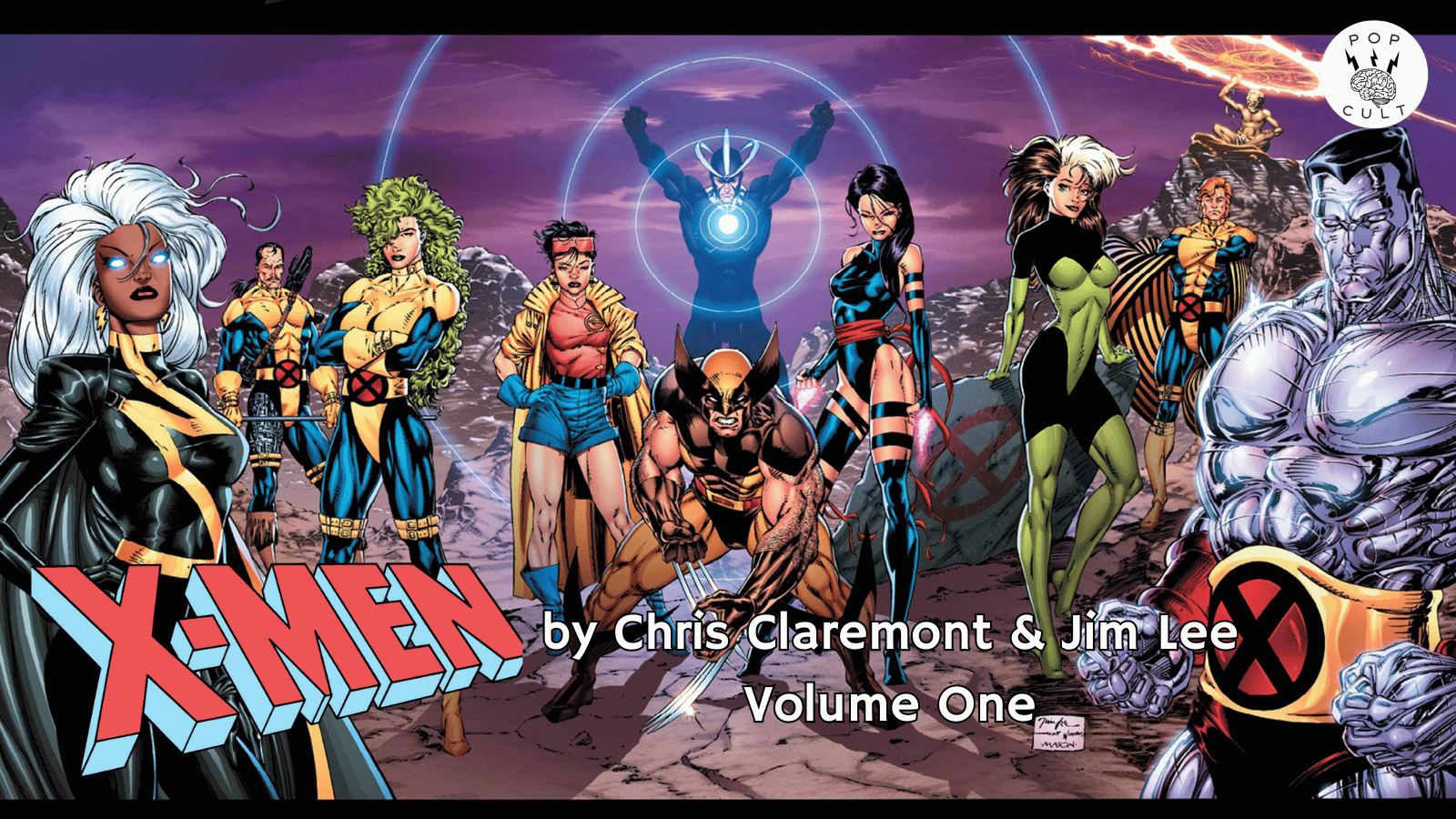
X-Men by Chris Claremont & Jim Lee Omnibus Volume One (2021)
Reprints Uncanny X-Men #244-269, X-Men Annual #13, and Classic X-Men #39
Written by Chris Claremont and Ann Nocenti
Art by Jim Lee, Marc Silvestri, Rob Liefeld, Rick Leonardi, Kieron Dwyer, Bill Jaaska, Whilce Portacio, Mike Collins, Dan Green, Steve Leialoha, Kent Williams, Scott Williams, Josef Rubenstein, and Art Thibert
Following the conclusion of Inferno, Claremont’s Uncanny X-Men entered a strange period. He would wrap up the Australia-era team only to disband the X-Men. Yet the comic would continue. Instead of team-centered stories, the book became a rotating anthology about mutants who had been or were associated with the X-Men. There wasn’t a team officially bearing that name for nearly a year, but the stories continued. What was happening was a showdown between Claremont and new line editor Bob Harras.
Harras thought “classic” X-Men stories were what the book needed. That meant a return of the mansions, Professor Xavier, and that classic line-up from the start of Claremont’s run. Claremont wasn’t a stranger to editorial bullying. Penciller John Byrne and then-editor Roger Stern often double-teamed Claremont into taking stories in a more traditional direction than the writer would have liked. Claremont held fast in most instances and endured, so he still wrote the book in 1989. However, trends were shifting, and a group of young artists whose work appears in this volume.
A few more stories are to come out of the Australian era. One was a cute two-parter where the “girls” on the team have a night while the “boys” do the same. The most significant outcome of this story is the introduction of Jubilee, who would rise to prominence in the Lee X-Men run. I have never been a Jubilee fan, seeing her as Claremont’s attempt to recapture the magic of Kitty Pryde. He does go an unexpected route by having her piggyback on one of Gateway’s teleportations and goes on to hide out in the X-Men’s outback base until she has to reveal herself.
Claremont was infamous for setting up plots and then forgetting them as he tried to keep all the narrative plates spinning. However, he delivered a satisfying conclusion that tied together several elements of the story of Days of Future Past. Nimrod, the future Sentinel living in disguise in NYC, encounters a believed destroyed Mastermold, and the two merge into a new, deadlier form of the mutant-hunting robots. This corresponds with a meeting between Senator Robert Kelly and Sebastian Shaw, the latter agreeing to a lucrative government contract. Kelly’s wife is killed during the battle between the X-Men and the Nimrod/Mastermold hybrid, which leads him to sign off on the legislation that would create the future glimpsed in that classic X-story.
This story arc also begins wrapping up the Australian era by fracturing the team. In this story, Rogue leaves the team as the Carol Danvers part of her consciousness entirely takes over the body. Storm “died,” and the team grieved in the next issue. Of course, she is not deceased; she is one of Claremont’s favorite characters. She will return as part of his new sprawling epic, ushering in one of the most beloved new additions to the team.
Polaris is brought back into the narrative with a side story, returning the team to the Savage Land. She’s managed to shake her possession by Malice but is now in conflict with a woman named Zaladane, who claims to be Polaris’s sister. It’s a decent story, but I’ve never felt much of a draw to the Savage Land stories in X-Men. It takes the team away from their base in the Outback as the Reavers escape the Siege Perilous and go on a hunt. Psylocke will be forced to “betray” her team and send them scattered to the winds with fragmented memories of who they once were.
Wolverine had been off in his solo book and returned in time to be taken down by the Reavers, who now count Lady Deathstrike among their ranks. This leads to the classic Silvestri cover of Logan crucified on a wooden X. Jubilee is forced to come out of hiding and helps Wolverine as the pair escape the Reavers on their hunt. And with Uncanny #251, the X-Men as we know it are done. There are no promises of a new team, only that the story will continue.
Due to its sprawling narrative, critics have referred to Uncanny X-Men #253 through 279 as “The Russian Novel” era. We learn that Storm has been reverted to a child with no memory of her time with the X-Men. She’s discovered just outside of New Orleans. Wolverine & Jubilee stay a few steps ahead of the Reavers, and Gateway sends them somewhere better. The Reavers follow a trail to Muir Island, where readers are reunited with Moira MacTaggert and Banshee, who have been training refugee Morlocks and other mutants. They end up clashing with the Reavers, but instead of defeating them soundly, there are casualties. Freedom Force shows up, and while they drive the Reavers back, it is not without a cost; Mystique loses her beloved Destiny in the fight.
Claremont was incredibly ambitious in attempting this new type of storytelling. The Muir Island mutants are wearing costumes resembling the original school uniforms, a nod to Harras’s demand for a return to the classic stories. We get a glimpse of David Haller, the troubled son of Charles Xavier, who is mentally unwell and allows his powers to harm both foes and friends. This opening story also teams up Forge and Banshee, a pair who will continue their globetrotting adventures over the next year of comics.
The book ties in with Acts of Vengeance for three issues. This was a conceptual Marvel event in which another hero or team’s villain plagued someone new for a couple of months. For the X-Men, we get Iron Man’s The Mandarin, who teams up with The Hand (from Daredevil) to forge the ultimate assassin. That will come out of Psylocke, who has her consciousness transferred into a Japanese body.
This did not sit well with some then and grew more problematic over time as the “yellow face” aspect was seen as inappropriate. Psylocke, as an Asian assassin, became how she was known strangely enough so that even young me was shocked to learn she used to be a white British lady with purple hair once upon a time. The story has her battling Wolverine under The Mandarin’s control, only to shake it off and join her former teammate and Jubilee. This story was also Jim Lee’s longest run on X-Men to date and firmly establishes him as a one to watch.
Claremont had wanted to provide some of his characters with happy endings, only to have them denied. The most prominent of these was Colossus. In Uncanny #259-260, we get what would have ostensibly been the farewell to the armored hero. The result of his journey through the Siege Perilous was to believe he was a Manhattan-based painter named Peter Nicholas. He briefly encounters Callisto, who is transformed into the most beautiful woman in the world as punishment by Masque. They both cross paths with young Genoshans from their country’s Press Gang. This was supposed to be a happy ending for Peter, but Uncanny #279 will force Claremont to bring him back. It would be an editorial decision that upset the writer so much that he walked off the book halfway through scripting.
Claremont tells a parallel story with Dazzler, who comes to Los Angeles. He makes deep-cut references to the one-shot graphic novel Dazzler: The Movie, which features a mentally unstable stalker. Dazzler was always a character that was more important to Jim Shooter during his tenure as editor-in-chief than Claremont. However, the X-writer included her in his radical transformation and even gave her a partner in Longshot, who vanished just before the Reavers returned. I can’t say I have much love for Dazzler and wasn’t too disappointed that she gets lost in the shuffle here.
There’s a three-issue streak of relatively subpar and confused stories. There’s a lot of pointless stuff in Madripoor featuring Wolverine, Psylocke, and Jubilee that doesn’t amount to much. Forge and Banshee search the ruins of X-Mansion only to find some of Masque’s grotesque creations. They team up with Jean Grey, who stops by while she’s still working through the chaos with Madelyne Pryor. Issue #264 is extremely confusing as it reads like an issue of X-Factor spotlighting Jean and Beast as they get involved in the Genoshan troubles.
Claremont devotes several issues to following kid Storm as she learns her former mentor, The Shadow King, has taken possession of a New Orleans police officer. She flees the hospital where she’s been observed, and Shadow King sends people transformed into his Hounds after her. The Hound thing is a recurring trope in Claremont’s run, with Rachel Summers discussing serving as a mutant-hunting hound in her possible future. We’ll see more about that in our next review, but Apocalypse also made Caliban into a Hound on the pages of X-Factor. It never really felt like the lore on Hounds was firmly established.
This story also introduced the world of Gambit, the smooth-talking & mysterious Cajun mutant. He was Claremont’s last major contribution to the mythos and fits the style of the time. I think Gambit was originally presented as creepier than he became in the new X-Men title launched in 1991. One of the most important takeaways from reading these monumental runs is that you discover how much certain characters changed from introduction to popular conception. Gambit is much less a Casanova-like figure and more like a creep who keeps to the shadows.
Uncanny #268 has one of Lee’s most iconic covers from the era – Wolverine posed with Captain America and Black Widow. This was around when other creators wanted to explore Wolverine’s back history, so Claremont decided to chip in as well. Here, we learn that Logan was a full-grown man during World War II, and we jump back and forth between his time in Madripoor then and now. The common thread is the Struckers, Baron Von in 1941, and his twins Fenris in the present. I always felt like Claremont intended bigger things with Fenris, the weird incestuous Nazi mutant twins.
Rogue escapes the Siege Perilous only to discover her team is gone. She can absorb enough of Gateway’s power to teleport herself to Muir Island. She also learns that Mystique has been murdered in a news report. The readers would have seen this a few issues earlier and knew it was the Shadow King behind it all. She and Carol split up after the King took over this homunculus, Danvers. Rogue finds herself ported to the Savage Land, where Magneto has also returned, and the two begin a short romance that would run until Claremont’s last arc on the book.
With all that set up, there’s a divergence for a crossover between the three X-books. But we’ll get more into that in the next review.

 PopCult Reviews
One thought on “Comic Book Review – X-Men by Chris Claremont and Jim Lee Omnibus Volume One”