
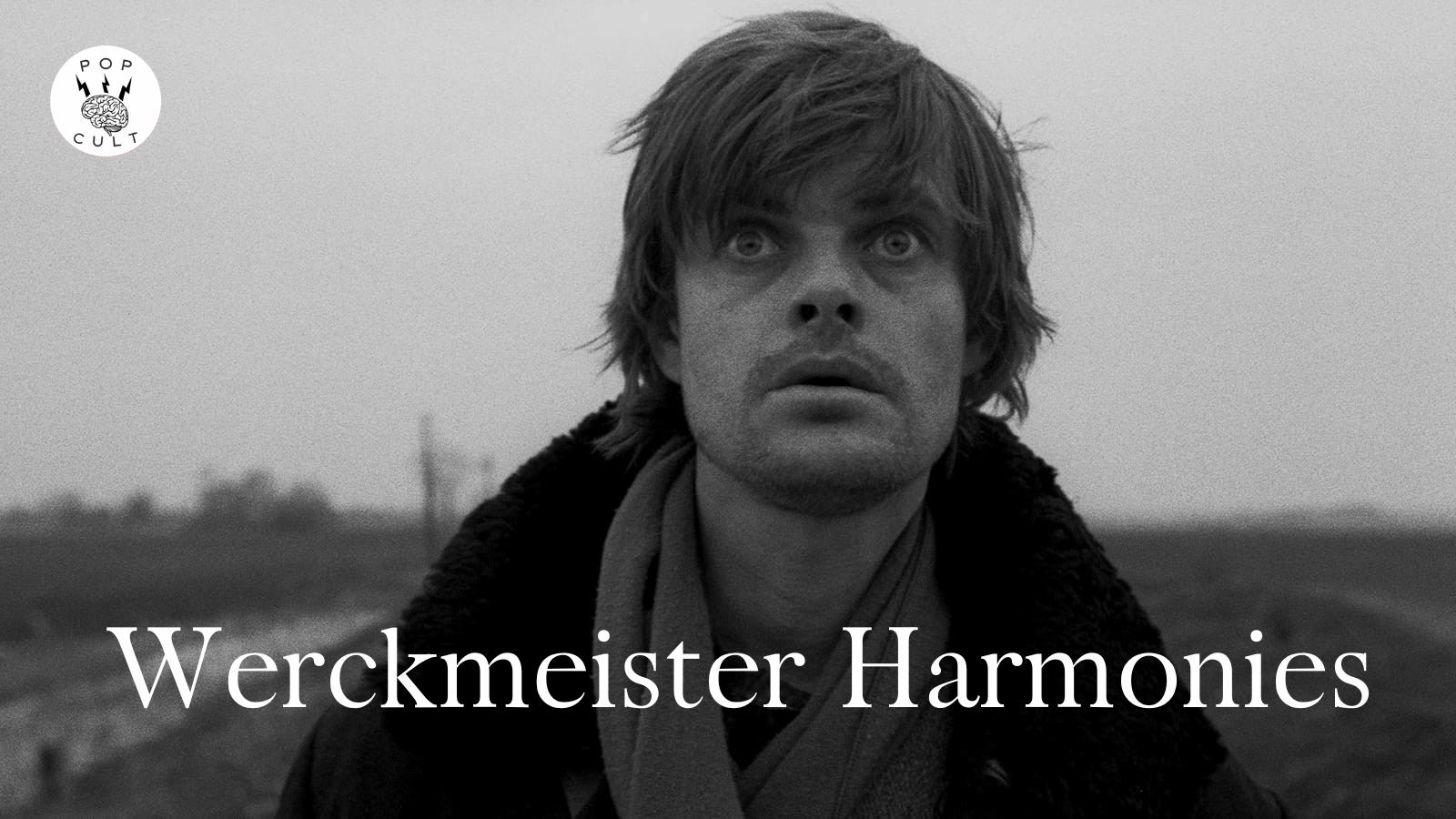
Werckmeister Harmonies (2000)
Written by László Krasznahorkai and Béla Tarr
Directed by Béla Tarr and Ágnes Hranitzky
Janos, a philosophical young man in a small isolated European town, arranges the patrons of a tavern one night in a simulation of the Sun, the Moon, and the Earth. He uses this to tell a story about a total eclipse of the Sun. When the orbiting bodies achieve this conjunction, he tells a brief fable:
The sky darkens, and then all goes dark. The dogs howl, rabbits hunch down, the deer run in panic, run, stampede in fright. And in this awful incomprehensible dusk, even the birds, the birds are too confused and go to roost. And then… Complete silence. Everything that lives is still. Are the hills going to march off? Will heaven fall upon us? Will the Earth open under us? We don’t know. For a total eclipse has come upon us…. But… No need to fear it is not over. For across the Sun’s glooming sphere, slowly, the Moon swims away… And the Sun once again bursts forth, and to the Earth there slowly comes again light, and warmth again floods the Earth. Deep emotion pierces everyone. They have escaped the weight of darkness.
With that, he walks out of the tavern, and the rest of the film unfolds as a realization of this story.
Director Béla Tarr has no problems presenting us with casts of “unlikeable” characters. Part of this is because so much of popular cinema is centered around propaganda disguised as “aspirational,” inspired by the well-meaning but far too simplistic rumination of Joseph Campbell and his Hero’s Journey. Not every fable is about a hero defeating the dragon. Some stories are about the monstrous nature of humans, a reminder that as much as we would like to believe we are above them, we are simply another of the Earth’s animals. This story that Janos and his friends act out reminds us of our place in a vast, unceasing cosmos. This is a reality where things occur, and we do not always have an explanation for them. We’ve certainly developed our understanding of the world far better than our distant ancestors, but humanity’s time on this planet is microscopic compared to the eons that came before us.
The title is derived from the work of composer Andreas Werckmeister, who is a subject of intense interest for György, Janos’s uncle. Werckmeister is responsible for the construction of the twelve half-steps of the octave. This is still the standard used in Western music, which is why when a European ear hears music from Asian or African cultures, it can sound strange to us.
György points out that our ears no longer hear the natural sound of music; instead, an artificial system is imposed on top of it. He explains contradictions that are beyond my personal musical knowledge but are based on science. This, in turn, is what happens in Janos’s community. The people believe they can overcome whatever they are faced with, yet they are attempting to compete with nature’s fundamental laws, which will always destroy them sooner or later. We persevere by changing, adapting, and learning new harmonies, requiring us to attune our hearts and minds.
Change is coming to this small town, signaled by the arrival of a strange, sinister circus and a dark cloud that hangs over the community. Janos discovers that the main attraction of the circus is a stuffed, odorous whale carcass kept in a wagon. There is also “The Prince,” a figure hyped up by the villagers and the ringmaster whom we never see, though we hear his voice from offscreen. Janos’s encounter with the whale leads him to ruminate on God and the purpose of nature.
A problem is roiling up in the background. György’s estranged wife, Tünde, holds great political and social status because of her husband. She leverages this to recruit people for her “Clean Up The Town” movement. The local police chief backs her up, but she needs more support. She threatens to move back in with György unless he speaks to people on a list she’s composed and gets them to join. The Prince ends up stirring up a crowd agitated by this propaganda, and a riot ensues. A mob wreaks havoc through the town only stopping when, during their destruction of the hospital, they come across a frail skin & bones naked old man who suddenly reminds them of their own mortality. But the damage is done.
Janos witnesses the horror at a distance but then learns the mob was after him before they calmed. However, it’s only a matter of time until something else stirs them up again, and they rage. Before leaving, he comes across the diary of a rioter who recounts the mob’s hate-filled assault and rape of two young women working at the post office.
On his way home, Janos sees Tünde and the police chief meeting, with the military ready to swarm into town. The riots have been used as an excuse to impose martial law. Janos’s story only gets more bleak from there. The film’s final image of the whale carcass sitting in the ruins of its destroyed cage, slowly submerged in growing fog, resonates with us, evidence of what happened being swallowed up by minds eager to pretend it never happened.
Tarr will never be accused of being an optimist. He has been a far Lefist with anarchist leanings since his youth. It should come as no surprise that he is also an atheist. Of all the evils in the world that anger him the most, nationalism and all its thoughtlessness are at the forefront. Like many of us Leftists, he has an intense love of humanity but doesn’t pretend his species is some sort of marvel. He acknowledges how deeply fucked up we are. Despite all the knowledge we have accrued, it does us no good unless it is partnered with radical empathy.
The ascension of the fascist Viktor Orbán has been something Tarr unashamedly rails against any chance he gets. He wishes the Hungarian people would choose better, but in the end, it doesn’t matter whether Hungary continues to exist or France, Germany, or the United States. These are artificial constructs imposed onto us, illusions that distort our own self-identity. I am not from the U.S. I am a person born by chance in that country and am not truly free because of it. This is also why Tarr has been quite vocal over the last year and longer regarding the Israeli genocide of Palestinians.
Tarr is speaking to the celestial harmony that governs our reality and how we have gotten so out of sync that our species is becoming further lost in the darkness of unceasing cruelty. The term “revolution” has multiple meanings that we rarely regard. That was the purpose of Janos’s little play in the tavern. Revolutions bring about alignments, and those moments can feel terrifying and overwhelming. But they are opportunities. Whoever seizes them is of vital importance to us all. Tarr regularly uses a slowly rotating camera in his films, reminding us how we often return to where we started. The universe moves in cycles. With each iteration, we have the potential for change for the better or worse. The last section of Sátántangó is titled “The Circle Closes.”
The sequence where Janos gazes at the whale is done in rotation. The camera follows behind the young man and then circles the creature with him. It’s always at Tarr’s intentionally plodding pace. The scene breathes; it comes alive. We feel the awe that Janos is feeling.
I would say 99% of the audience just can’t engage fully in this level of maturity in filmmaking. There are multiple moments in Tarr’s cinema where my eyelids get heavy, and my mind drifts. That is not because he’s a poor filmmaker; instead, I have been conditioned by popular media to demand hits of dopamine far more often. Thus, it is my responsibility to discover the rhythm of his work and attempt to match myself with it. In the moments that I am able, it takes on what I can only describe as the type of religious awe that I would guess the believers must feel. In that way, Tarr’s work could be seen as a gospel for humanism.
We could sit and attempt to interpret Tarr’s work all day – and I have one more film to go, so I will continue this – but at the end of the day, the director is very explicit that he doesn’t like deep “readings” of his work. My English major/Lit Crit brain has a hard time disconnecting from that, and I can see how a film like Werckmeister can only be fully comprehended as a visceral experience. It is hard to shut off the intellect and look only at another person’s humanity.
It has been made near impossible for some to stop seeing themselves as the Sun but simply another orbiting body moving at the whims of a universe that defies our total comprehension. You, I, and everyone else are just floating here, and the moment we think we are the masters of reality or the sole voice of reason, then we cease to be connected with humanity. That is a profoundly difficult thing for my Western brain to work through, but whatever part of me might be referred to as a soul knows this. I must try to listen to that, to find that harmony, the natural rhythm of life. If we cannot do that, everything we know is doomed.

 PopCult Reviews
2 thoughts on “Movie Review – Werckmeister Harmonies”