
X-Men: Days of Future Present (1989)
Reprints Fantastic Four Annual #23, The New Mutants Annual #6, X-Factor Annual #5, and Uncanny X-Men Annual #14
Written by Walt Simonson, Louise Simonson, and Chris Claremont
Art by Jackson Guice, Geof Isherwood, Terry Shoemaker, Chris Wozniak, Scott Williams, Allen Milgrom, Art Thibert, Harry Candelario, Jon Bogdanove, Arthur Adams, Dan Green, Steve Moncuse, Art Thibert, and Bob Wiacek
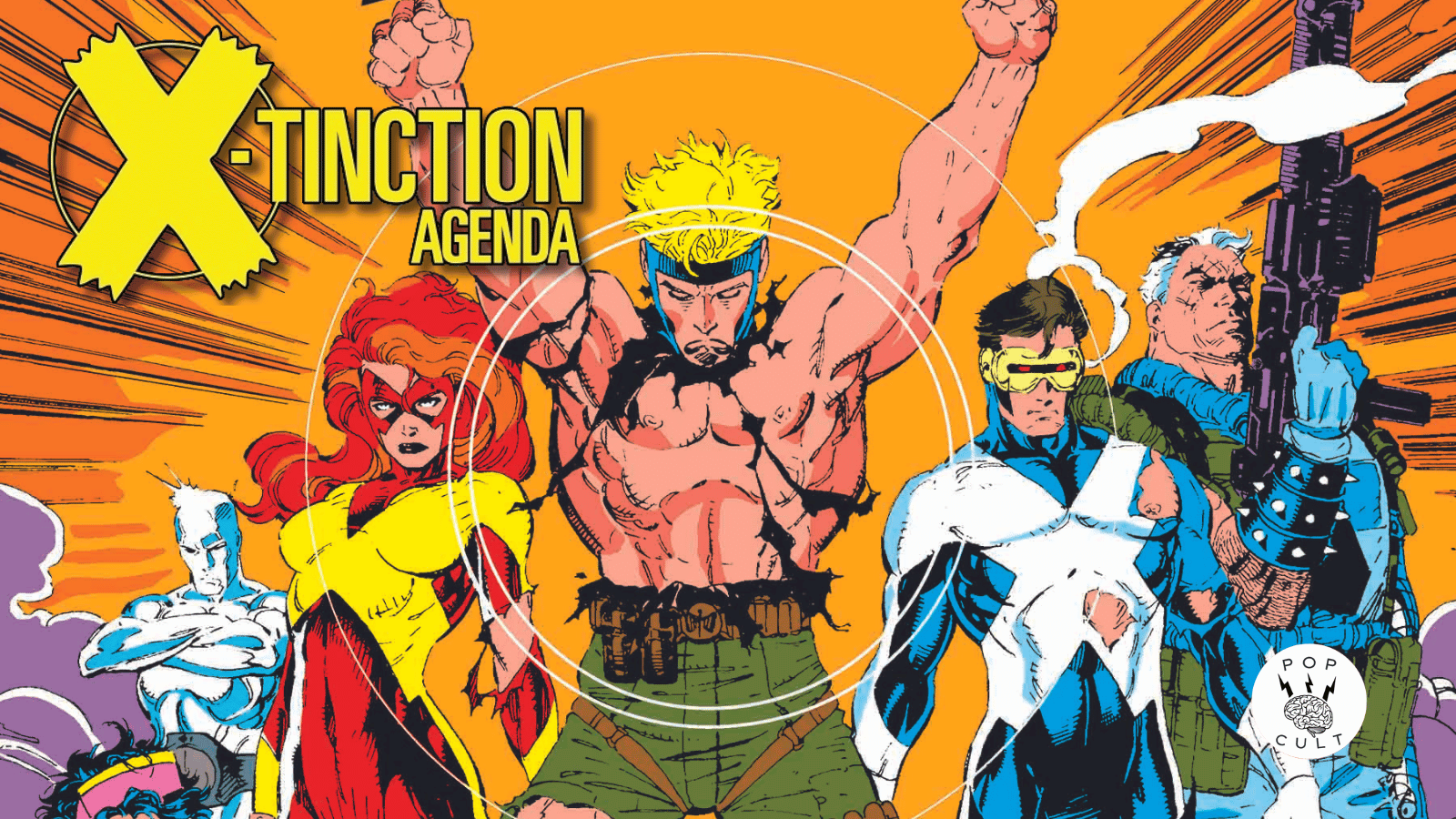
X-Men: The X-Tinction Agenda (1992)
Reprints Uncanny X-Men #270-272, New Mutants #95-97, and X-Factor #60-62
Written by Chris Claremont and Louise Simonson
Art by Jim Lee, Art Thibert, Scott Williams, Rob Liefeld, Joe Rubinstein, Jon Bogdanove, John Caponigro, Al Milgrom, and Guang Yap
Two of Chris Claremont’s stories dominated his run and every subsequent run to follow – “The Dark Phoenix Saga” and “Days of Future Past.” That latter story inspires “Days of Future Present,” a kind of sequel focusing on the adult Franklin Richards introduced in the old story. Over in the pages of Louise Simonson’s Power Pack, she had included Franklin, the son of Mr. Fantastic, and the Invisible Woman showcases his burgeoning mutant powers. The adult version of Franklin is essentially a god who can reshape reality. He’s searching for his lost love, Rachel Summers.
Regular readers of Uncanny X-Men would know that Rachel had ended up stuck in the past and was a member of the X-Men during the mid-1980s. By the time Future Present was published, Rachel was a member of Excalibur, a UK-based team following the presumed death of the X-Men. In classic Claremont fashion, he and co-writer Louise Simonson provide a retcon that has her being hunted by the mutant Ahab and his Hounds. Ahab is a loyalist to the Sentinels and happily turns on his own species. It became evident that James Cameron’s The Terminator profoundly affected Claremont’s writing as many narrative elements from that film were repurposed in the X-Men.
Days of Future Present is a pretty excruciatingly long story with little payoff. Claremont’s only direct contribution is in the final chapter of Uncanny X-Men, which is the best part. After lots of the Fantastic Four, New Mutants, and X-Factor running around alongside Forge & Banshee fighting Hounds and seeing some of their own get temporarily converted by Ahab, we get the chapter that pays off Rachel’s introduction. When she arrived, her mother, Jean Grey, had been dead, and she had kept her identity secret from Cyclops, who had left the X-Men by that time. Here, we see Rachel reveal who she is to her parents even though the moment they would have had her had passed. How does Rachel continue to exist despite the changed timeline? Claremont won’t get around to explaining it here. Instead, Jean and Scott are raising baby Nathan Summers, whom Rachel readily accepts as her brother.
It feels painfully obvious that Rob Liefeld’s darling creation of Cable, serving as the leader of the New Mutants at this time, was not originally intended to be the future son of Jean & Scott. In fact, the baby’s transfer to the future (which we will cover in our next Claremont/X-Men review) was an editorial decision that served to resituate the X-Men in a way that pleased Bob Harras and Jim Lee. If I remember my timeline correctly, it had already been revealed in the pages of New Mutants that Cable and Stryfe were the same person, but I don’t believe Liefeld or Simonson had it in mind that this was the son of two original X-Men.
That’s what makes this such a strange crossover. Claremont is about to have one foot out the door, and late developments like this in long-running storylines will get ignored. Compared to “Future Past,” this is pretty boring. That story is my favorite of the entire Claremont run. It is a perfectly paced story that feels epic despite only a few issues long. There are far more pages devoted to this sequel, and it never comes close to matching its predecessor. I am interested to see the next time Jean and Rachel cross paths because Claremont makes this the emotional core of his chapter, and it’s the best part of the whole thing.
Over in the pages of the monthly titles, Claremont & Simonson revisited Genosha for the X-Tinction Agenda. Where Claremont’s initial exploration of this metaphor for apartheid-era South Africa is thoughtful & nuanced, this follow-up is everything wrong with the Lee/Liefeld era of X-Men. Gone is the political commentary, replaced by a resurrected Cameron Hodge as a cybernetic nightmare. I’ve always thought the concept of Hodge had potential, but the execution completely sucks. Instead of further developing the world of Genosha, we just get lots of characters running around in generic hallways and alleys while Hodge drones on and on like a mustache-twirling villain.
One purpose of the X-Tinction Agenda is to begin forming an official X-Men team again. Storm has shown up at the ruins of the Mansion with Gambit in tow, linking up with Forge and Banshee. During this period, Cable and the New Mutants were using the sub-basements of the Mansion as their base, so there was a little tension between groups but not much. Once on Genosha, the Wolverine/Psylocke/Jubilee contingent arrives, and we’re already starting to see what a post-Claremont X-team will look like. Jubilee gets some cute moments with the New Mutants. Gambit and Wolverine have their first interactions. A lot of groundwork is being laid. Archangel gets a rematch with Hodge. Lots of things are checked off of a list.
The story’s emotional core once again returns to the tragic Summers family. This time, Alex Summers, aka Havok, has ended up on Genosha following his passage through the Siege Perilous. Like the others from the Outback era, he has lost his memories of who he is. He serves the Magistrate, hunting down mutants and brainwashing them. Cyclops desperately tries to save his brother, and by the end, he achieves this. However, Claremont and Simonson allow Alex to choose to remain in Genosha to try and reform it. He’s joined by the New Mutants’ Wolfsbane, which continues a trend of Louise Simonson jettisoning Claremont’s original team members.
One of the most jarring experiences of reading this crossover is the wild variance in art styles. Uncanny is featuring Jim Lee’s art full-time at this point, and while he’s not my favorite artist, I would never deny that he is very good. Compare that to Jon Bogdanove’s cartoonish style in X-Factor, and it definitely affects the flow of the story. Then there’s Rob Liefeld drawing a couple of New Mutants issues. It’s genuinely dreadful stuff and makes me question why this guy became such a dominant force in the industry when his art is so terrible.
The final pieces are in place. Claremont isn’t going to give up—well, not yet. He will keep playing along, helping Harras and Lee rearrange his creations and reset a lot of his work. At one point, it will become too much, and he will step aside. That will be what we talk about in our next review.

 PopCult Reviews
2 thoughts on “Comic Book Review – X-Men: Days of Future Present and The X-Tinction Agenda”