
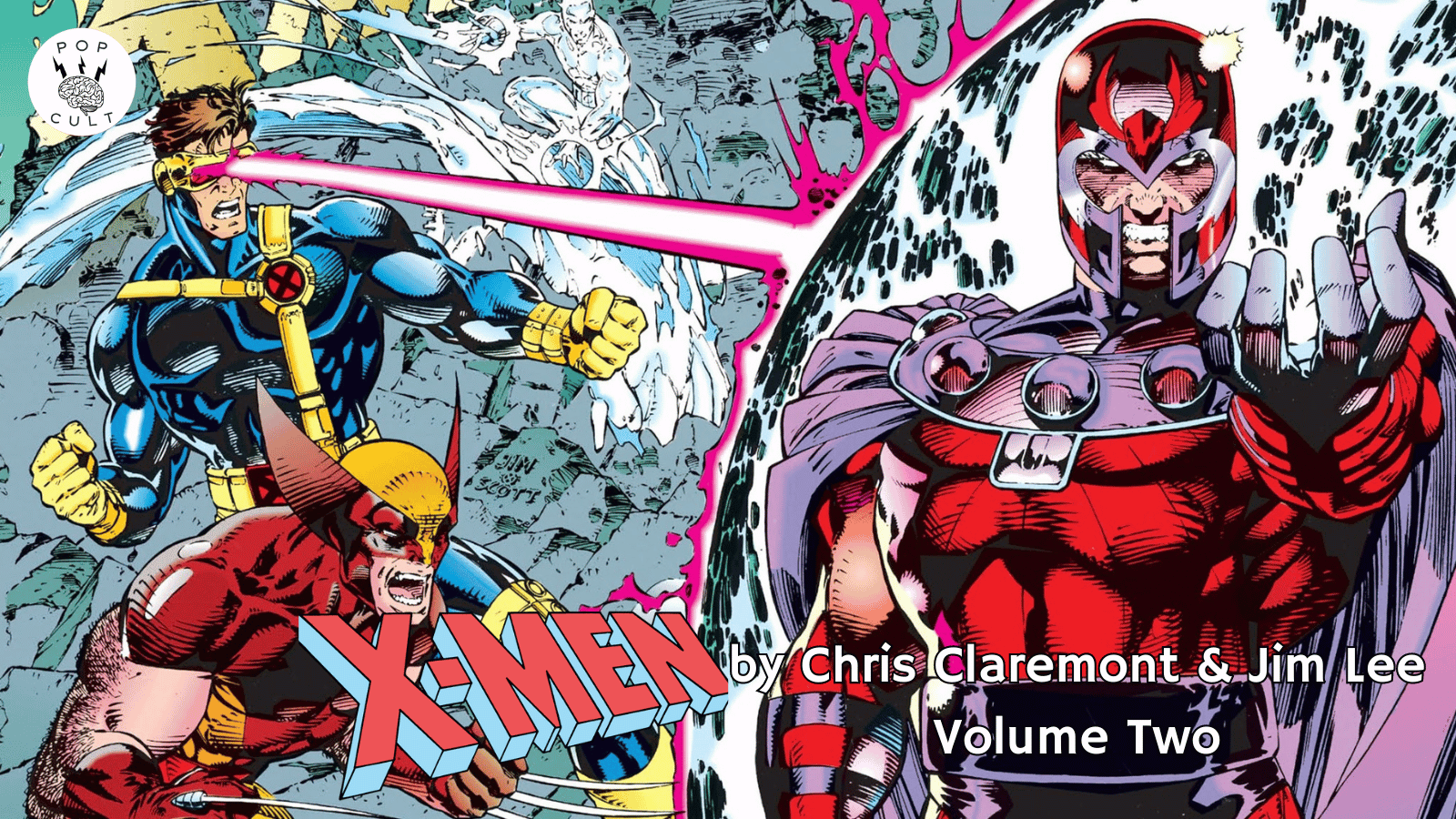
X-Men by Chris Claremont and Jim Lee Omnibus Volume Two (2022)
Reprints X-Factor #63-70, Uncanny X-Men #273-280, X-Men #1-11, and Ghost Rider #26-27
Written by Chris Claremont, Louise Simonson, Whilce Portacio, Jim Lee, Fabian Nicieza, Peter David, John Byrne, Scott Lobdell, and Howard Mackie
Art by Jim Lee, Whilce Portacio, Klaus Janson, Marc Silvestri, Rick Leonardi, Michael Golden, Larry Stroman, Paul Smith, Andy Kubert, Steven Butler, Kirk Jarvinen, Ron Wagner, Art Thibert, Scott Williams, Hilary Barta, Josef Rubenstein, Michael Bair, Mike Witherby, Karl Alstaetter, and Dan Panosian
The first X-Men comic I ever read in full was Chris Claremont’s final issue. I didn’t know it at the time. It was Christmas 1991. For the last couple of years, I had desperately wanted one of 22 issue comic book grab bags sold in the Sears Wishbook. Having grown up watching Challenge of the Superfriends, Spider-Man and His Amazing Friends, and other animated series, my interest had been piqued. Occasionally, I’d convince my mother to buy me a comic book at the grocery store, or I’d spend some birthday money to pick up a couple. That same year, I purchased some Superman books and a Wolverine comic. But this Christmas gift was the one that changed everything. This was the year I became a comic book collector, not for money, but because I was enamored with these complex worlds and their colorful characters.
At the time, I didn’t notice the double-billing on writers – Claremont & Fabian Nicieza. I was just interested in who this Colossus guy was and why the X-Men appeared to be fighting each other on an island off the coast of Scotland. Also included in this pack of comics was X-Factor #69, the next part in the Muir Island Saga, which ended on a massive cliffhanger. I didn’t know that halfway through writing Uncanny #279, Claremont just gave up. He was being asked by line editor Bob Harras to bring back Colossus, a character who Claremont had let go of into the sunset. With no memories of his sister Illyana’s death, Colossus’s mind had been wiped clean by the Siege Perilous. He would be Peter Nicholas, a talented painter living in the Village. But Harras and Lee were adamant on a full roster of “classic” X-Men for the big reboot. Claremont got them halfway there and let Uncanny’s new writer, Fabian Nicieza, do the dirty work.
Louise Simonson delivered a couple more issues of X-Factor. Both that and New Mutants were undergoing significant overhauls. In the case of New Mutants, Rob Liefeld was now in the captain’s chair. Simonson would find herself at DC Comics, penning a new monthly book, Superman: Man of Steel, with artist Jon Bogdanove. She writes one more two-parter here that wraps up a subplot involving Iceman and a girlfriend with ties to the Yakuza, and then she’s gone.
Over in Uncanny, Claremont has the three teams back at Xavier’s Mansion following the X-Tinction Agenda. In #273, we get a celebration of artists from throughout the years as this over-sized group of mutants gets their new directions established. Cable clashes with Cyclops, Jean, and Storm, further pushing his New Mutants towards their role as the off-the-grid X-Force. We get interactions with various members from across teams to see how personalities clash. It’s a fun issue, one of those rest stops between story arcs that allows for a breather. Jean becomes aware of the Shadow King’s presence, but before anything can be done about that, the X-Men are teleported by Lila Cheney into Shi’ar territory.
Rogue continues her story arc with Magneto in the Savage Land. They team up with Ka-Zar and Nick Fury as part of a mission to take out Zaladane and her mutates. Claremont returns to the narrative he established with Magneto early on as a Holocaust survivor whose trauma informs his fight for mutant liberation. One of the strike team’s allies is a Russian commando whose son was one of those killed by Magneto back in Uncanny #150. This vendetta becomes vital to the narrative and re-establishes Magneto as a villain. This is another change that Claremont would not have made if given the choice. He had worked for years to turn Magneto into a gray-area character. It made sense and gave the character a more complex and exciting direction. Harras wanted the villain back.
The X-Men end up uncovering a royal conspiracy with the Shi’ar Empire. Xavier is helping Lilandra conquer more swaths of their interstellar region. Of course, we get fights with the Imperial Guard, which ends up being this new X-team’s first real mission. Gambit fights with Psylocke, Jubilee, Storm, and Wolverine. Banshee and Forge, no longer a globe-trotting duo, are fully with the group. While far better than peers like Liefeld, Lee’s artwork still turns every woman into a Barbie doll and every man into a He-Man with ridiculous proportions. It’s art that would look fine as a poster hanging on the wall but doesn’t lend itself to a narrative flow. Lots of starts and stops just to have a cool pose. Eventually, those shapeshifting troublemakers, the Skrulls, are behind this. Xavier senses trouble with the Shadow King just in time for the X-Men to teleport back to Earth.
Meanwhile, Claremont was highly amenable on X-Factor despite his ideas being overridden. Lee and Whilce Portacio plotted out Endgame, an arc to ready the members of X-Factor to rejoin the X-Men. Claremont agreed to script for them. He delivers a bombastic but ultimately poignant conclusion to the story of Nathan Summers. Nathan was raised by Scott and Jean; the former saw him as her own son despite his being born to her clone, Madelyne Pryor.
Apocalypse dispatches a group of killers who look like sketches from the artists’ archives. They bear names like Foxbat, Gauntlet, Tusk, Barrage, and Psynapse – forgettable space fillers. A mysterious woman named Askani shows up doing everything she can to protect the infant. The battle eventually finds its way to the Blue Area of the moon. At the time, the Inhumans had relocated their home to the place and made an appearance. More importantly, Claremont brings us back to where Jean once sacrificed her life to stop the Phoenix. It’s time for another sacrifice.
With Apocalypse pushed back for now, it’s revealed Nathan is infected with a technovirus. Askani reveals she’s from the future and Nathan will become a very important person for mutants. But she has to take him to the cure, and he won’t be able to return immediately. Scott and Jean are forced to say goodbye to their child, the tragedy of the Summers family having no end in sight, it seems. Claremont had also intended for Gambit to be revealed as the third hereto unknown Summers’ brother, but that was one arc never to be.
And then it’s The Muir Island Saga, a quaint name for a crossover that clocks in around five parts. These days, we’d have X-Men: The Muir Island Saga Alpha and Omega issues, along with four or five tie-in mini-series focusing on specific characters. This is actually a very quick story. Paul Smith stops in as guest penciller for #278 as the X-Men arrive at Muir Island and find Moira has turned it into a savage place under the control of the Shadow King. Shadow King uses Legion, Xavier’s son, and Polaris as his two central conduits, using their volatile mutant powers to make himself nearly invulnerable.
Xavier is forced to take control of Colossus’s mind when his former student attacks while under the King’s control. The returned leader of the X-Men goes to the U.S. government, where he’s reunited with his original students in X-Factor. They mount a rescue attempt to Muir Island, where Mystique reveals she survived her assassination attempt just in time to take out Shadow King’s human host. The art in #279 is done by Adam Kubert, and despite the emotional turmoil it caused Claremont to write, the art is gorgeous. I think Kubert’s work has always outshone Lee and Liefeld; weirdly, they got so much more acclaim than him. It has many of the hallmarks of what was popular then, but Kubert’s form and perspective are so much more pleasing to my eye.
There’s a big final battle with the Shadow King as he controls Legion, which leads to a rebuilding issue in X-Factor. We begin to see Peter David’s iteration of that team taking shape while Xavier chooses to build a more sprawling version of the X-Men spread across two teams and two books. Claremont is not present for any of these issues as he is working on fulfilling one last promise. He will write the first three issues of the new X-Men book, a story that is a battle with every page between Claremont’s devotion to the X-Men as people first and Lee’s obsession with the costumes and bombast.
X-Men #1-3 is Claremont’s goodbye, and it reads like an epilogue, not a new beginning. Magneto rebuilt his orbital Asteroid M base, which raised the hackles of the Russians as they floated above their nation. Magneto is also approached by Fabian Cortez and his Acolytes, mutants who believe in the Master of Magnetism’s militant past more than his recent heroic turn. This turns into Jim Lee drawing a bunch of splash pages reintroducing the X-Men as they stand posed in the Danger Room. Just so you understand how packed to the gills this roster was, these are the members of the X-Men in #1:
Cyclops, Jean Grey, Wolverine, Rogue, Banshee, Iceman, Archangel, Colossus, Beast, Storm, Forge, Psylocke, Gambit, Jubilee, and Professor Xavier
There’s an aside where Xavier, holding a framed photograph of the New Mutants, laments that the family he thought he’d been building is “at each other’s throats now more than ever.” X-Force #1 was published shortly before this comic and overtook Todd McFarlane’s Spider-Man #1 as the best-selling comic of all time. Claremont & Lee’s X-Men #1 would overshadow X-Force months later to take the title it holds today. Claremont can see where things are going, and it’s a place he’s uncomfortable being. It was a good sixteen years, now it’s time for something new.
The story closes out with the apparent death of Magneto as his Asteroid M explodes. Xavier shares with his team that his former friend opened his thoughts to the telepath. Xavier says Magneto is still the same man who was his friend all those years prior. His final words to the leader of the X-Men are:
“I save you, X-Men because that is my task in life: To safeguard my people – Homo Sapiens Superior – Mutantkind – from those who would do us harm. And those forces are legion. In that, and I suspect nothing else, Charles, we are much alike. I have survived one holocaust, I could not tolerate another. Nor any who – by accident, by intent – act to bring it about. I bore no animus to you, old friend, or your students until you chose to oppose me. Then, I had no choice but to count you among my enemies. Have no illusions on that score. Perhaps it’s best it ends this way, Charles. Best for my dream to end in flames and glory, here far above the Earth. For if we were ever to meet again, I would have shown you no mercy. I give you your dream, Charles. But I fear, in time, your heart will break as you realize it has ever been a fool’s hope. Farewell, my friend.”
And so, Chris Claremont stepped away from the X-Men.
Jim Lee would write the title for the next nine months. John Byrne was brought in at one point to try and keep the book from devolving into a garish mess of art without a plot. We’d be introduced to Omega Red as Wolverine, and his past took more of a spotlight than it ever had during Claremont’s tenure. Storm, who was once the star of the book at Claremont’s heights, is pushed further into the background. A regal Black woman having her star replaced by a white man who exudes toxic masculinity. Lee would try to create drama that fell flat, the most embarrassing of which is trying to build relationship conflict by having Jean flirt with Gambit and Psylocke put the moves on Scott. There’s a story that attempts to bring closure for Dazzler and Longshot, which is just okay.
Eventually, Scott Lobdell will come along and, with Fabian Nicieza, give the X-Men some direction. Your satisfaction may vary on whether or not you feel it brought the X-Men back to the same level they had been under Claremont. But this would not be the last time Claremont would get a chance to write the team. After a decade away, trying out some other projects like a brand-new superhero team for DC Comics, Claremont returned to Marvel. One of those X-Men projects will be in our spotlight in December. Claremont wrote X-Men Forever, an alternate reality book with him taking us down an alternate path where X-Men #4 keeps his ideas going, and we get to see what could have been.

 PopCult Reviews
2 thoughts on “Comic Book Review – X-Men by Chris Claremont and Jim Lee Omnibus Volume Two”