
Northern Exposure Season Four (1992-93)
Written by Robin Green, Michael Katleman, Diane Frolov, Andrew Schneider, Jeff Vlaming, Mark B. Perry, Sy Rosen, Christian Williams, Mitchell Burgess, David Assael, Jeff Melvoin, Denise Dobbs, and Geoffrey Neigher
Directed by Dean Parisot, Michael Katleman, Nick Marck, Charles Braverman, Rob Thompson, Joan Tewkesbury, Randall Miller, Michael Fresco, Daniel Attias, Win Phelps, Joe Napolitano, Bill D’Elia, Adam Arkin, Michael Lange, Jim Charleston, and Frank Prinzi
Northern Exposure was coming off season three, for which it won several Emmys. Season Four was to be the largest season order for the series, with twenty-five episodes. These days, most shows we get on the variety of streaming services come in around 8-10 episodes per season. Thirteen episodes feel like an indulgence. One of the downsides of having such large season orders was that quantity did not equate to quality. There are some utterly fantastic parts of season four. Then, some episodes are cringingly wrong and outdated. Even so, I’d rather watch this season again than watch much contemporary television, especially the fare that leans into cynicism.
Season Four marked a greater focus on Maggie (Janine Turner), giving her character more development and a genuine arc. While the series may have started with the hook of Joel (Rob Morrow) being a fish out of water, it became clear this season that the show was an ensemble piece and the good doctor was just one of many important players in the story. The first episode of the season, Northwest Passage, devotes its main plot to Maggie’s 30th birthday, which causes her to reflect on her past, especially her many dead ex-boyfriends.
Ed (Darren E. Burrows) convinces her to follow a Native tradition and spend the day alone. Joel realizes Maggie is sick with the severe flu, but she’s already out of contact range. As she falls into a hallucination where her dead exes voice their grievances, Joel and Ed attempt to go downriver and rescue their friend. This kicks off a season-long exploration of Maggie’s character, allowing her to gain a new romantic partner that contrasts heavily with Joel, take us to her home in Grosse Pointe, and enable her to go through heartbreak. While Turner has become a somewhat unhinged conservative reactionary post-NE, I have to say she gives a committed performance here that is wonderful.
That romance will come from Mike Monroe (Anthony Edwards), a lawyer who claims to have a litany of environmental allergies. He’s come to Cicely, Alaska, and lives inside a sealed & sterilized geodesic dome, only venturing outside with the help of Maurice’s spacesuit from his Mercury Program days. Mike’s expertise as a lawyer will be used in multiple instances to keep bringing him into the plot. It seems that Edwards was set up to become a series regular in season five. Behind the scenes, Edwards would become part of the cast of NBC’s new medical drama ER, leading to him being written out of Northern Exposure.
Edwards finds a way to play Mike that grounds him in the reality of Cicely. It helps that this is such a magically realistic world, so someone like Mike doesn’t feel out of place. The character is earnest in his devotion to environmental activism, which shapes some of the plots of a few episodes. At one point, Ed becomes convinced that he has to use his passion for filmmaking to educate people about how their actions affect the world. One of the most endearing things about this show is that it gave a lot of space to discuss subjects that today’s television feels insecure addressing. Now we’re met with snark and cynical characters, whereas Northern Exposure was so, for lack of a better word, pure.
That doesn’t mean they are all winners. A late-season episode has Maurice’s estranged Korean son come to visit due to a cultural custom of getting his father’s permission to marry. It turns out the bride is the daughter of a deceased North Korean general who was notorious for torturing and executing U.S. soldiers during the Korean War. Maurice learns this from one member of the gay couple who runs the local Bed & Breakfast and shares being a Marine with Maurice. It’s such a weird, anticommunist, jingoistic turn for the show. I kept thinking they would explicitly talk about this woman not being the same as her father. I knew they wouldn’t point out the fact that it was the United States that invaded Korea; therefore, their soldiers’ lives were being put on the line. Instead, we get a very ambivalent, annoying conclusion.
Holling and Shelly are not becoming more endearing as the series progresses. The age difference is something even the writers know they can’t move past, so many of their stories use that as the jumping-off point for the jokes. By the end of this season, Shelly is pregnant and has developed an exceptionally cringy condition – she sings everything she says. This might not be so bad if actress Cynthia Geary was a strong singer. She is not. John Cullum, a Broadway veteran, gets a scene where he sings with her, and all that serves to highlight how rough her singing is. Apparently, this continues into season five, and dear god, let it be one scene and then done.
Some episode highlights from this season include:
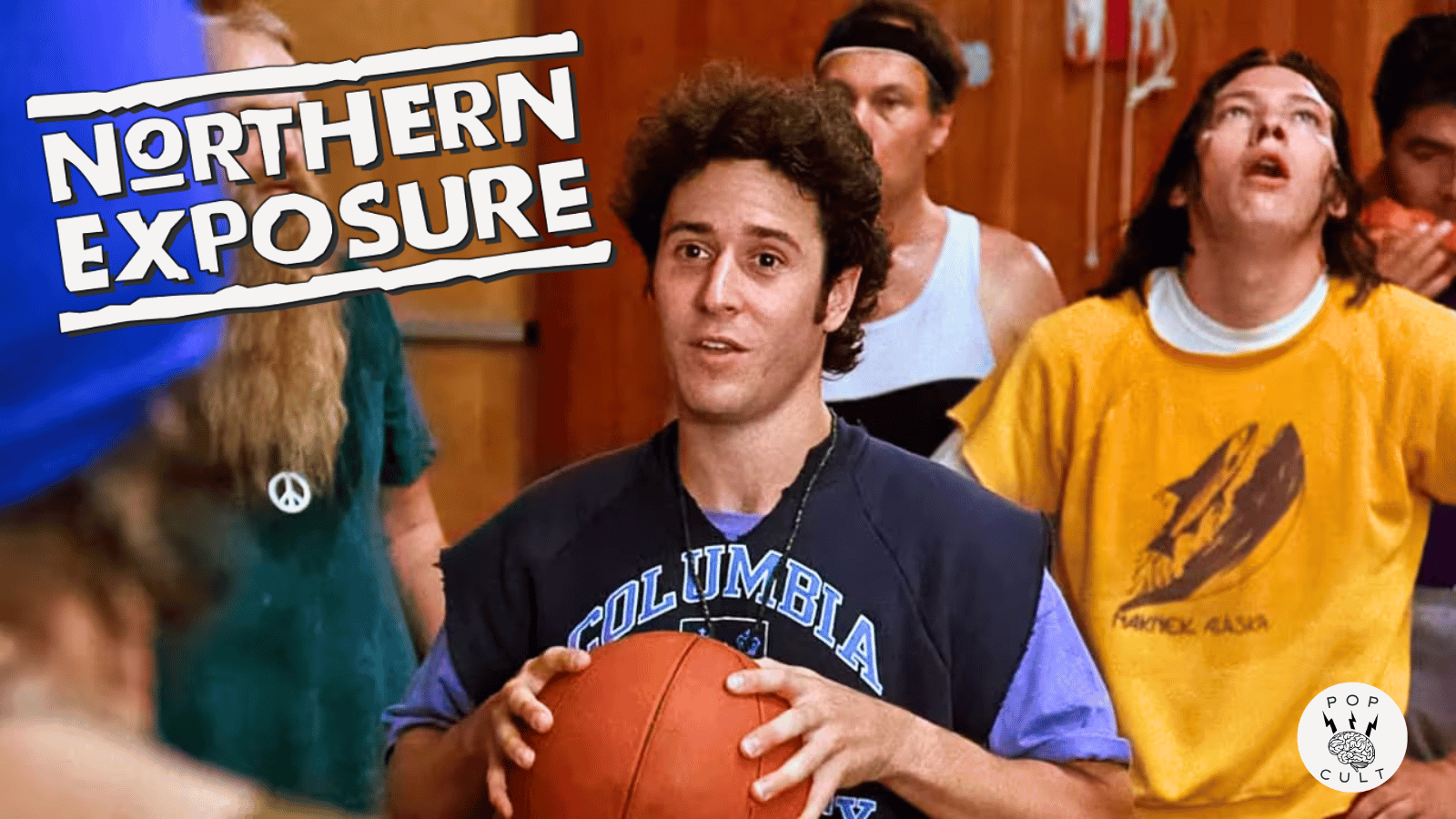
Midnight Sun (Episode 2) – Joel has to deal with the midnight sun of Alaska’s summers, resulting in him becoming what the locals call a “light loony.” Then Maurice decides to make Joel the coach of the Cicely Quarks for their annual basketball game against Sleetmute. This is one of the episodes where Rob Morrow gets to do more than whine as Joel usually does, and it’s all the better for it.
Thanksgiving (Episode 8) – Joel is introduced to the local Natives’ method of celebrating Thanksgiving by throwing produce at white people. Most white people take it in stride, understanding the reason behind it. Joel becomes apoplectic, which results in him being the butt of the joke. At one point, he tries to argue that Ashkenazi Jews aren’t white people. Marilyn responds to this with the appropriate blank stare.
Learning Curve (Episode 15) – This stands out as the best for a single scene of all of Holling’s episodes. The senior bartender returns to school and gets the diploma that has been so elusive for most of his life. Most of the episode plays out as you’d expect. The twist comes when Holling is asked to read a personal narrative he wrote to the whole class – a one-room schoolhouse with students of all ages – so he read about a bloody incident at his bar decades ago. The juxtaposition of his story and the kids’ faces had me genuinely laughing my ass off.
Homesick (E20)—One of the plots in this episode involves Maurice transporting his childhood home from Oklahoma to Cicely. This brings up a lot of emotions he has regarding his little brother, who died long ago. As a child, Maurice became jealous of his brother’s magnet fishing game and hid the fish under a stair in the house. Chris helps Maurice work through his guilt and all the unresolved emotions that come with it. I found this to be a nice, moving story.
The Big Feast (E21) – This is the best episode of the season. Maurice hosts a grand dinner party at his house. He’s spared no expense, and the townsfolk talk about past parties and how lavish they’ve been. The problem is that Joel seems to be the only person not to receive an invitation, which causes him to get more annoyed the closer the big day gets. This episode also sees the return of Adam and Eve, the strange couple whose lives feel like fantasy.
In my opinion, season four was as good as the third. Things are going to change, though, as the two showrunners will depart. Replacing them is David Chase, the future creator and showrunner of The Sopranos. Chase’s tenure on Northern Exposure will see the show degrade in quality, leading to its sixth season cancellation.

 PopCult Reviews
2 thoughts on “TV Review – Northern Exposure Season Four”