
House (1977)
Written by Chigumi Obayashi and Chiho Katsura
Directed by Nobuhiko Obayashi
Following the phenomenal success of Jaws at the box office, Japanese film studio Toho went to Nobuhiko Obayashi and proposed he develop a similar script. Obayashi was an odd choice. His filmmaking career focused on personal, avant-garde experimental movies and TV ads, not big commercial hits. The director discussed the script with Chigumi, his preteen daughter, positing that telling everything from an adult perspective is limiting for films. From young Chigumi, he got several of the set pieces that would end up in House, including a mirror attacking the audience and a house eating a girl. The final product doesn’t have much in common with Jaws, but it is a film you won’t forget after watching it.
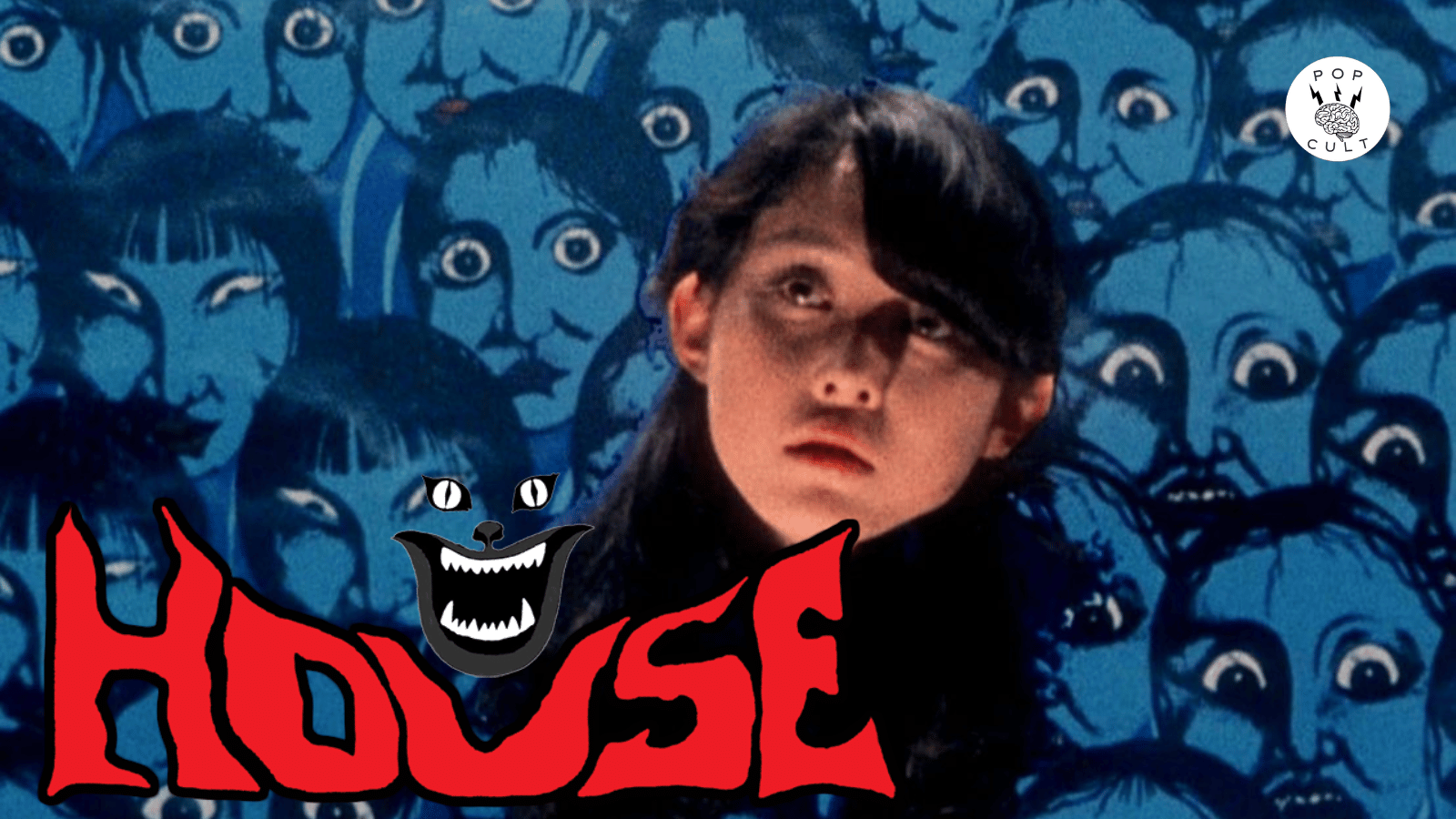
Gorgeous returns home from a day at school, and her father announces that he’s remarried. This upsets the teenage girl’s plans for the summer, and she writes to her aunt asking if she can come visit her instead. Her aunt agrees, and Gorgeous invites her friend group, Prof, Melody, Kung Fu, Mac, Sweet, and Fantasy, along with her. Upon arriving at the large country house, they present Gorgeous’s aunt with a watermelon. However, when Mac fails to return after retrieving the watermelon from a well where it was placed to keep it cold, Fantasy investigates. Mac’s disembodied head flies out of the well and bites Fantasy on the ass. This becomes the first of several wild, unhinged supernatural encounters that have the girls realizing the place is haunted.
If you have seen House, I expect you have images stuck in your head that you likely don’t even understand why they happened. That’s one of the appeals of this strange movie. Before the haunting begins, it is evident that it was made by someone with a unique filmmaking style. Simple scenes of characters talking to each other are so hyper-edited that I was reminded of more contemporary fare like Tim & Eric and associated media. It was easy to see why 1977 audiences might not have enjoyed this picture, but it would have been a smash hit if it had come out in the 2010s. It’s a live-action anime about a group of school girls going to a haunted house.
Part of this comes from Obayashi’s willingness to listen to children. He was a citizen of Hiroshima as a child and has explained how most of his childhood friends didn’t survive the atomic bombing by the United States. As a result, he has always treasured a child’s perspective. His original idea regarding a Jaws knockoff was to replace the shark with a bear. However, when he started listening to his daughter’s ideas, he was met with a plethora of subconscious fears & phobias that sounded more visually interesting than his initial concept.
Watching House will disorient you, which means you either give yourself to the film or spend its runtime in tension with it. The way scenes are framed immediately creates dissonance. Camera angles, zooms, fades, and blocking completely break the rules even by Japanese standards. Kurosawa was known for his precision, storyboarding out everything, so his shots came off with perfect precision. Ozu created a gentle, calm atmosphere. Camera movement in his films was a delicate matter. House takes these standards and tosses them out the window. Obayashi doesn’t hide the DIY nature of his work, which lends it a quaintness. The horror always remains in the realm of fairy tales.
Having recently watched four of Bela Tarr’s best films, I have been surrounded by slow cinema. To move from those to something as hyperkinetic as House. The Turin Horse is a film comprising 30 shots, while this picture consists of thousands of fragmented ones. Where Tarr and Obayashi intersect is how they present a stylized world that suits their tastes. Through their work, we get to understand how they see the world; in Obayashi’s case, the childlike perspective is far more interesting. House is also a Japanese remix of Italian giallo tropes and techniques through a comedic lens.
What cannot be denied is how much Obayashi loves cinema. He’s playing with the form, pushing it to do things we might not expect. There’s a scene where one of the girls is slowly drowning in cat blood, and the effect of her body disintegrating is done by the actress being suspended by a rope and being slowly covered in blue paint that would be chroma-keyed out. The way this scene is edited and shot is such a clever feat of filmmaking. All of the wild & strange effects are the same. He also loves using matte paintings, a part of the film I genuinely miss, as such pieces have been replaced with green-screened computer-generated backgrounds.
House is like opening dozens of presents. Each scene presents something new and unexpected. I can’t confidently say that I understand what was happening at a certain point. The movie’s ending is completely bonkers, and the film is the closest it comes to, strangely resembling Jaws. But watching this was such an enjoyable experience. I can easily see why this has become a regular at midnight movie showings. I don’t typically like crowded theaters when I see movies, but while watching House, I kept thinking back to my theater experience with Tommy Wiseau’s The Room and how much fun it was. I would guess House presents something quite similar. If you are searching for something completely off the wall for the Halloween season, this picture offers quite a lot.

 PopCult Reviews
One thought on “Movie Review – House”