
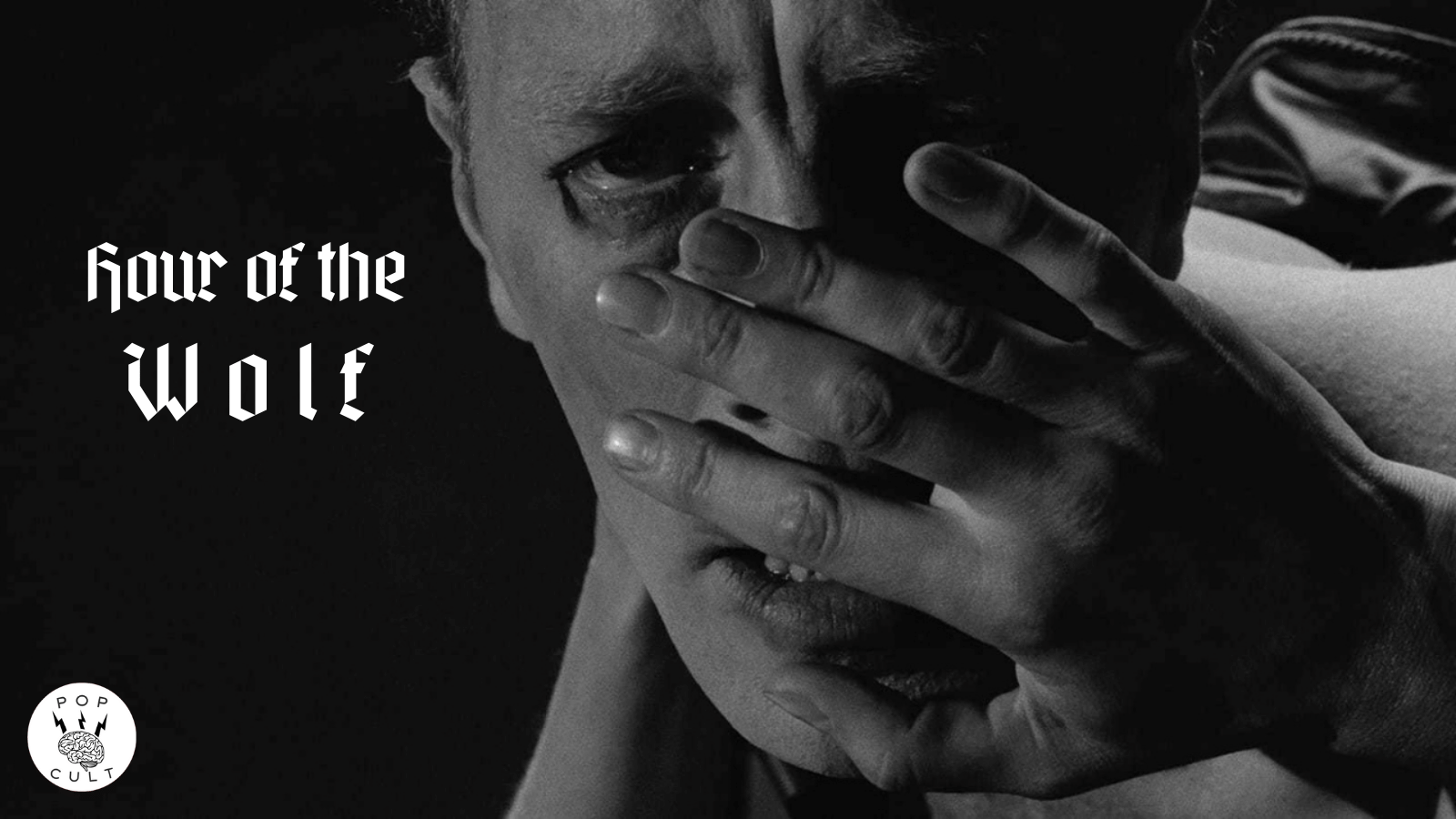
Hour of the Wolf (1968)
Written and directed by Ingmar Bergman
I can’t say I’ve fallen in love with the work of Ingmar Bergman. I’ve seen four of his works – Persona, Scenes from a Marriage (television version), Fanny and Alexander (film version), and now this movie. Of the four, Fanny and Alexander is my favorite because it feels like a mature take on the Christmas movie. Otherwise, I find Bergman’s work to come from an emotional place that isn’t culturally the same as mine. It makes sense. Sweden is very different from the United States. Even more so, Ingmar Bergman is very different from me, especially in how he treated his wives and consistently cheated on them with actresses he worked with. I feel at odds with Bergman, but I am still open to watching his films to try and understand what he is saying through his work.
Told through found writings, which are dramatized, we learn about Johan Borg (Max von Sydow), a painter who lives with his pregnant wife Alma (Liv Ullman) on the Frisian Island of Baltrum. Johan has started having intense visions of strange creatures. They’ve caused him to develop insomnia, which causes Alma to worry about him. While Johan is away one day, a strange old woman stops in and tells Alma to read her husband’s journal. She does and discovers Johan is obsessed with a former lover as well as being invited to the nearby castle of Baron von Merkens. Alma attends a dinner with Johan at the castle, where a portrait of Johan’s lover hangs on the wall. Not long after that, Johan has a particularly rough night sleeping and reveals some dark truths about himself to his wife, including being attacked by a feral child while fishing and subsequently murdering the boy. He talks about the “Hour of the Wolf,” a portion of the night where most births and deaths occur. It all unsettles Alma, who believes her husband is losing his grip on reality.
Hour of the Wolf came out of Bergman’s own nightmares. He had recurring ones, like a woman removing her face and an entity walking across the ceiling. Johan shares a story about being punished by his parents by being shoved into a closet where he was told a little person lived. That was based on Bergman’s own childhood. The stories of ETA Hoffmann, a gothic horror writer who penned The Nutcracker and The Mouse King and inspired a fantastical Powell & Pressburger film, also inspired Bergman. Hour of the Wolf went into pre-production while Bergman was working on Persona, which signals that this was a particularly dark period for the filmmaker.
It’s widely accepted that Johan is a stand-in for Bergman. The director had impregnated Ullman, so her state during filming was what she was actually going through at the time. Bergman was going through a collapse of his Ego, leading to big questions surrounding his identity. Johan experiences the same and reveals a perverse inner world with thoughts of masochism and necrophilia. Transvestism is touched upon, which reveals the dated cultural views as if cross-dressing is some moral sin.
The castle’s denizens are the most fascinating aspect, a possible play on the vampire idea. Johan takes on animal-like traits near the film’s end, which reminded me of the werewolf image in popular culture. On top of that, there are allusions to cannibalism, particularly the fear of being devoured and Little Red Riding Hood. These horror and fantasy tropes are often interlinked with concerns about sexual awakening. These fantasies representing the internal horrors of the psyche bring us back to the story of the little person in the closet and Johan being attacked by a feral child.
It can be argued that Johan never killed anyone and that his conflict with this “imp of the Id” was a psychological battle. There are many similarities in this regard to Robert Eggers’s The Lighthouse, where what we see is clearly not literally happening to the character. Themes of remoteness from civilization and the thoughts that creep in feel like something many of us can relate to. I’ve never felt uneasy with my own thoughts but met several people who can’t seem to handle silence or solitude. They have a profound desire to have external stimuli and voices around them; if they don’t, they might have to come face-to-face with themselves and process those emotions. The Hour of the Wolf is when they are forced to confront the Ego and reckon with it.
Even beyond Bergman, the film explores the tension inside an artist. You cannot produce work that emotionally moves audiences without it seriously affecting your mind. It makes sense that an artist would eventually turn their focus inward to learn where specific images come from. What is a muse? Is it a blessing or a curse? The horror that emerges is social, the fear of being judged by society. The things that inspire Johan are the same things that plague his mind at night and keep him from sleep. The horror is that of the artist, always attempting to connect with a society that will never actually understand what he is saying, only able to make rough approximations.
To make great art is to be dangerously vulnerable. You risk something when you share your art with others. Their rejection is not just of the piece but of your mind and soul. For people seeking out gory, plot-driven horror, Hour of the Wolf will not likely suit your tastes. If you enjoy psychological horror stories, it’s more your speed. The filmmaking is experimental, so I would pair this with something like Skinamarink or Come True, which is horror that feels as if it has been captured from a dream.

 PopCult Reviews
2 thoughts on “Movie Review – Hour of the Wolf”