
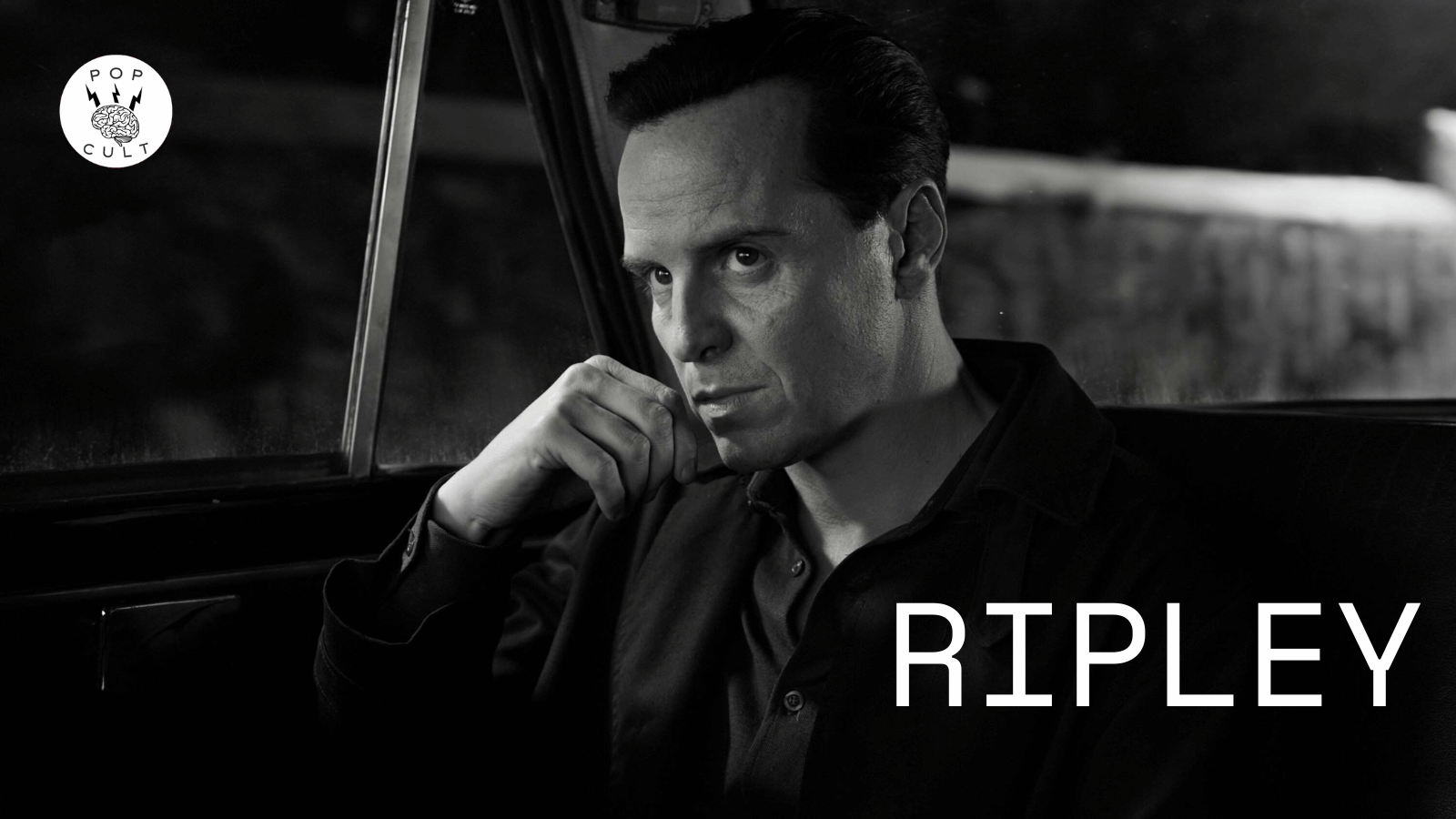
Ripley (2024)
Written and directed by Steven Zaillian
There are few protagonists in modern literature as challenging as Tom Ripley. He’s a captivating figure because he’s pretty pathetic yet so cunning. In many ways, Ripley is the shadow underdog, a guy who, by all evidence, should lose, yet he manages to commit multiple murders and steal millions while evading capture. Despite coming from a poor/working-class background, Ripley has evolved refined tastes mainly because he believes he deserves to live the best life possible. Other people are inconveniences most of the time, hindrances to him enjoying the luxury offered to the wealthiest among us. If ever there was a character to highlight the negative aspects of sociopathy, an actual condition that isn’t as one-dimensional as much media would like you to think. Ripley can’t seem to care about anyone other than himself; it troubles him, but it is not enough to stop his pursuit of comfort.
Tom Ripley (Andrew Scott) is down on his luck, running an insurance scam out of a PO Box in New York City. He is contacted by a private investigator working for Mr. Greenleaf, the father of a very brief acquaintance Tom once had. The patriarch wants to send Tom to Italy to find his son, Richard (Johnny Flynn), and convince him to return to the States. With the insurance scam being discovered, Tom decides that a journey abroad might be the thing he needs. Upon arriving, he finds Richard living a life of leisure, devoting his time to painting – and very badly. Richard is in a relationship with Marge (Dakota Fanning), an aspiring photojournalist whose talent for that is as good as her boyfriend’s when it comes to painting. Tom realizes he’s wearing out his welcome and that Richard will soon kick him to the curb. But our protagonist isn’t going to let that happen and begins a descent into murder and fraud that threatens to destroy him if he’s caught.
Andrew Scott delivers a stunning performance of Ripley. Because the main character is doing such horrible things and cannot see the humanity in others, it presents a challenge for an actor. How do you find empathy for such a person? Scott does it; he presents Ripley not as a clockwork-brained genius but as a person who sees himself outside the world he lives in. He’s an observer of people and can see them better than they can see themselves. Ripley recognizes Richard’s mediocrity, that he’s someone coasting off other people’s labor. Richard doesn’t live in Italy because he worked hard for it; Daddy just gave him money.
That doesn’t mean Ripley is a Robin Hood figure. He’s a shadow of that archetype. He steals from the rich to make himself rich. The idea of charity would never cross Ripley’s mind. Through bits of backstory, we learn his parents drowned to death when Ripley was five, and he was raised by his cruel Aunt Dottie. This is likely why he’s such a quiet, introverted, observant person and why his emotions never developed in a way that would lead to a healthy life. As far as Ripley can see, the world is where people crush one another to get what they want. Most of the time, people like Ripley live passively reticent lives. He refuses that and believes if he is willing to do horrible things, to take human life, then he deserves the spoils that come with it.
While Ripley’s exploits in the novels of Patricia Highsmith always took place in Europe, he is very much an American character. Despite the mythologizing we are fed during our formative years in the U.S., it is a country built on guile and murder. From the genocide & displacement of the Native people all the way up to our present multitude of horrors, the United States has been a place that has justified violence to take what it wants. As individualism dominates the structure through which the average American sees themselves, I expect more people like Tom Ripley to be produced. Therefore, he’s incapable of seeing community as a possibility and is left with nothing more than killing whoever stands in the way of his spoils.
While Anthony Minghella’s 1999 adaptation The Talented Mr. Ripley has a more glamorous take on the material, this mini-series explores the depth of sadness in its characters. Shot in black & white, the series evokes the imagery of Italian film icons like Federico Fellini and Michelangelo Antonini. Much like Antonini’s work, there’s a sense of ennui throughout each episode. Richard and Marge live comfortably, but there’s a sense that they are aware of their mediocrity. Marge keeps hammering away at her book on the coastal town of Atrani, but she seems to know it’s not great. Richard understands that he lives on his father’s work, who in turn exploits workers to generate his wealth, and that he hasn’t earned anything he has. At the same time, they like living comfortably, and whether they deserve it or not, they will keep it that way. Ripley just wants a slice, and when it becomes clear they are pushing him to leave, he decides he’ll take even more than that.
Each episode contains so much here, but not in the way of dialogue. Series director-writer Steven Zaillian lets scenes breathe and understands exposition doesn’t have to come from characters speaking. The camera can deliver all the information you need to know. It’s an idea that filmmakers like Hitchcock played with, juxtaposing two images to create an affect. A camera lingering on a heavy glass ashtray in one scene takes on a different meaning after that object is used in a crime. It becomes an ominous totem of evil left out in plain sight. We hold our breath when a visiting Roman detective flicks off his ashes in it. Ripley dances so close to the edge.
The show chooses not to make Ripley’s sexuality as clearly defined as the 1999 film does, which is a good thing. Apparently, Highsmith decided to play it with more nuance in the text, so here we have a Ripley who is attracted to men but maybe also women. Perhaps he’s not attracted to them at all, but studying them, envying what they have, calculating what use they could be to him. Ripley also isn’t some master of disguise or deceit. He tries things out, and they work most of the time. He poses as Richard for a long chunk of the show, but most people don’t care or notice. Several hotel desk clerks reveal that they can lie about almost anything for the right amount of coin in their palm.
Ripley comes to represent the con artist, a uniquely American figure. He’s the power of positive thinking taken to a dark, craven core. Anything Ripley sets his mind on, he can do, including murdering several people and disposing of their bodies. The crudeness of Ripley’s acts stands out the most, with an entire episode being taken up mainly by the protagonist getting rid of a body and running into trouble because of a broken elevator. His murders are never committed with much pre-meditation, either. Ripley grabs an object and beats someone over the head with it, revealing the impulsivity of his desires.
This was an absolutely remarkable series to watch, and it made me curious about picking up Highsmith’s novel and reading it sometime. Andrew Scott is one of the best actors working today and delivers such a rich, layered performance that sometimes feels like a magic trick. The supporting players all do fantastically, with the standout being Maurizio Lombardi as Inspector Ravini. He shows up in the last four episodes of the series, but I loved every second he was on camera. You may think Ripley has met his match, but that would be the expected direction the story would take. Instead, this show has more complex ideas in mind.

 PopCult Reviews
2 thoughts on “TV Review – Ripley”