
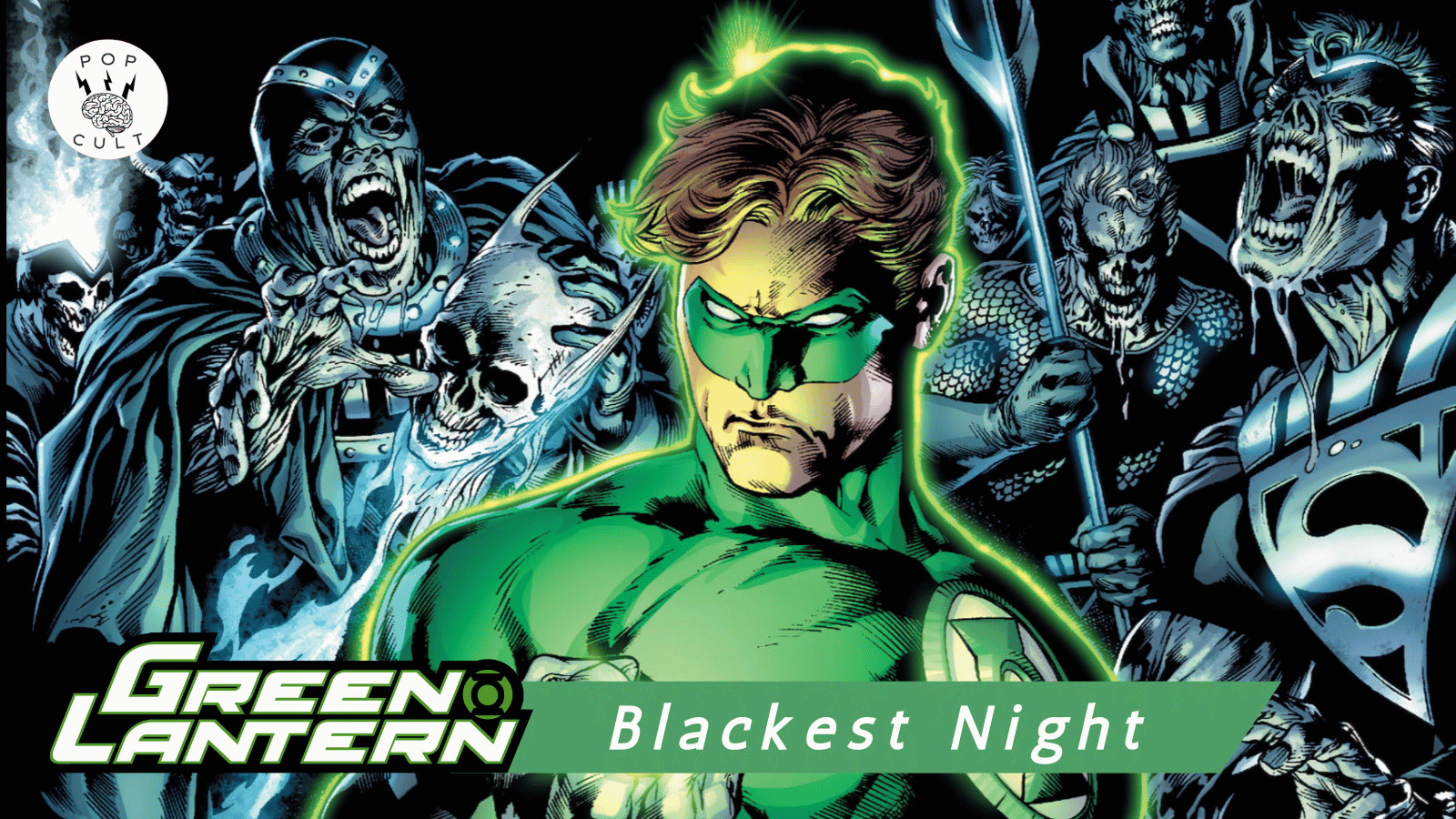
Blackest Night (2010)
Reprints Blackest Night #0-8
Written by Geoff Johns
Art by Ivan Reis
Green Lantern: Blackest Night (2010)
Reprints Green Lantern #43-52
Written by Geoff Johns
Art by Doug Mahnke, Ed Benes, and Marcos Marz
Geoff Johns’s run on Green Lantern was intensely inspired by Alan Moore’s work on the title during the 1980s. The short story “Tygers” was most influential, which mentions the rise of the Guardians of the Universe’s greatest threats in the form of Ranx the Sentient City and the Children of the White Lobe, both of whom had shown up as enemies early in Johns’ run. In these Green Lantern Corps short tales penned by Moore, he introduced the prophecies of a Blackest Night. The details of this weren’t fully developed, but Nekron, a cosmic god of the dead, was involved. As Johns loves repurposing bits of DC Universe history, he devoted a large chunk of this run to the build-up of Blackest Night.
Black Hand, a Green Lantern villain from the 1960s, is at the center of Blackest Night. Hand died and was resurrected by the power of Nekron in a Johns retcon and uses Bruce Wayne’s skull (Batman had “died” in Final Crisis that year) to unleash hordes of Black Lantern rings. These devices find the heroes who have stayed permanently dead and resurrect them as zombies filled with nothing but nihilistic hate. The more intimate encounters of this event take place in spin-off mini-series, like Wonder Woman’s re-match with Maxwell Lord. The rings even affect characters who have died and returned, like Hawkman and Hawkgirl.
The most central heroes to the main mini-series are Hal Jordan, the newly reborn Barry Allen (The Flash), The Atom, Mera, and Firestorm. About halfway through, the focus shifts to the multi-colored Lantern coalition, which shares its powers with some heroes to turn the tide. Wonder Woman ends up with a Violet ring from the sapphires, The Flash wears a Blue ring for Hope, and The Atom dons his short-lived tribal wear once again to wield the Indigo staff which stands for Compassion. Lex Luthor being given an orange ring (Avarice) does lead to some amusing back and forth between him and Larfleeze. Many things happen in Blackest Night, but repeatedly, I slogged through the noise and visuals to get some meaningful story.
There’s a remarkable cruelty to some of the plot beats in Blackest Night. The Hawks are turned into evil zombies when Elongated Man and his wife Sue show up controlled by the rings. It had been just a few years prior that Sue was murdered in the pages of Identity Crisis, an event book that has garnered a lot of hate for that very reason. Ralph Dibny, the Elongated Man, himself was killed by Felix Faust in the year-long 52 series. The idea was that now the lovers were reunited in death; it was as happily ever after as they would get. Johns brings them back to serve as part of his horrific zombie army, and I just felt it was in poor taste, though I get that it made sense based on the conceit of the comic.
Another horrible sequence involves Jason Rusch, aka Firestorm, witnessing his girlfriend Ghenna, whose consciousness merges with his own to become a superhero, be murdered by the shambling corpse of Ronnie Raymond, the original Firestorm. For such a traumatizing moment that doesn’t get covered in depth in a spin-off mini, I would have liked Johns to let that moment have resonance. Instead, she’s killed off a plot contrivance. Firestorm has become a character like that in several of John’s stories. I recall his inclusion in the woefully bad & incoherently meaningless Doomsday Clock as a punching bag to have his life ruined.
The tide turns when it’s revealed that the Earth contains the White Light Entity, the antithesis of Nekron and the Black Lanterns. This leads to another retcon – Earth is the center of the universe, not the Guardians’ world of Oa; they knew this and have lied about it for millennia. A white lantern and ring are generated, with Sinestro wielding them first and being handily beaten by Nekron. Deadman is able to help out via possession of Guy Gardner and lets Jordan know Nekron is tethered to the world through Black Hand. Jordan gets the white ring and helps to save the day. Along the way, Johns crams the Anti-Monitor back into the story fairly pointlessly.
Johns really thinks the Anti-Monitor has legs beyond the Crisis on Infinite Earths storyline and put him in the Sinestro Corps War, this mini-series, and his final Justice League arc, “The Darkseid War.” There’s really not much interesting about the Anti-Monitor; he’s a force of nature, more than a character, and a means to facilitate DC editorial’s reboot of the line in 1985. When Johns brings him back, I just can’t help but think of the image of a five-year-old smashing his action figures together. Also, Johns is bad at naming events and frequently uses the word “War” – Sinestro Corps War, The War of Light, War of the Green Lanterns, The Darkseid War, Rogue War, Trinity War – everything is a war with this guy.
Blackest Night came after so many endless events with DC trotting out a new one every six months to a quarter from Identity Crisis onwards. It’s a story so steeped in established continuity that it does a terrible job of bringing in new readers. I think big events should walk that fine line between fan service and introducing people to the pillars of the universe. It’s a great chance for readers to sample characters they may not read otherwise, piquing their interest in picking up that hero’s ongoing title. I cannot imagine someone unfamiliar with the Flash picking up his comic after this because I doubt they would understand what the fuck was going on.
The resolution to Blackest Night was very boring to me. The fixation on the emotional spectrum sometimes makes Green Lantern feel like Power Rangers. You may have enjoyed Power Rangers as a kid, but I can guarantee that the storytelling quality does not get better with age. When you get to the last couple of issues, the plot is tossed aside in favor of a dull slugfest between characters. I think DC saw Marvel Zombies and wanted to do something similar, Johns was up for it as he wanted to bring back Moore’s Nekron and the Blackest Night prophecy, and it served as an opportunity to reboot a half dozen or so characters. It also came just as DC dramatically pivoted to its line-wide New 52 reboot. Johns’s Green Lantern was left alone for the most part, but I would challenge anyone to explain what Blackest Night looked like in the New 52 Universe with as many changes as that poorly thought-out move made.
Blackest Night has regular tie-ins with the ongoing Green Lantern book, and those are slightly better mainly because they are just part of Geoff Johns’s run, and if you had read what came before, they keep going in that same direction. In this collection, we get a spotlight issue on Black Hand that takes us through his entire retconned origin, which now connects him to Nekron. Doug Mahnke is the perfect artist for this type of thing. Something about the grotesque nature of his art can take on makes the necrophilic nature of Black Hand even more disturbing and icky.
In these pages, we also witness the resurrection of Martian Manhunter, who, like Batman, was killed off in Final Crisis. I found the idea of a Black Lantern J’onn J’onzz fairly terrifying because he has a Superman-level of power and can shapeshift and become intangible. Johns plays around with that, but because so much else is happening, the Manhunter gets lost in the shuffle of characters and “shocking” cameos.
There are many asides with Carol Ferris, Sinestro, Atrocitus, and Larfleeze along the way, leading them down a path to show up in the main Blackest Night book. The sequence in which Sinestro is confronted by former members of his Corps who died in battle is effective. We also have John Stewart being confronted with the return of Xanshi, the planet he failed to protect in the criminally underrated Cosmic Odyssey. The entire population is back as Black Lanterns and wants Stewart’s blood.
The saving grace here is Mahnke’s art. He is very good at filling in the pages with an avalanche of detail. So many of the Lanterns of the spectrum are non-humanoid or barely humanoid aliens, and the artist has tremendous skill in making them so interesting to look at. If something is gross and body horror, he nails it. If we need a regal trumpet-blaring superhero moment, Mahnke nails it, too. Johns had several artistic collaborators during his run, and I think Mahnke was one of the best. There’s some rushing through the plot, which makes the art resemble splash pages sometimes, but it is relatively entertaining. In my opinion, Mahnke feels like he would nail a Larfleeze/Bizarro/Solomon Grundy mini-series.
As Johns moves closer to the (temporary) collapse of this era of DC continuity, he’s undoubtedly delivering big, loud stories. It’s funny to think about how much writing he delivered monthly and then contemplate that it took him two years to get out twelve issues of the recent Justice Society mini-series. How the mighty have fallen.

 PopCult Reviews
One thought on “Comic Book Review – Blackest Night/Green Lantern: Blackest Night”