
The Face of Another (1966)
Written by Kōbō Abe
Directed by Hiroshi Teshigahara
Hiroshi Teshigahara found his cinematic muse in the writing of Kōbō Abe. He directed an adaptation of Abe’s novel Woman in the Dunes two years prior. He returned to the author’s work for his next film, The Face of Another. Teshigahara’s relationship with filmmaking was very tempestuous, though, making a film in 1972 and abandoning the medium for nearly a decade. He pursued other interests like calligraphy, ceramics, and ikebana (the art of flower arranging, of which his father was seen as the master). While he returned to film, Teshigahara never recaptured the height of this period when he and the work were perfect. Western critics dismissed his work at the time of release, but a new appreciation has grown in the following decades.
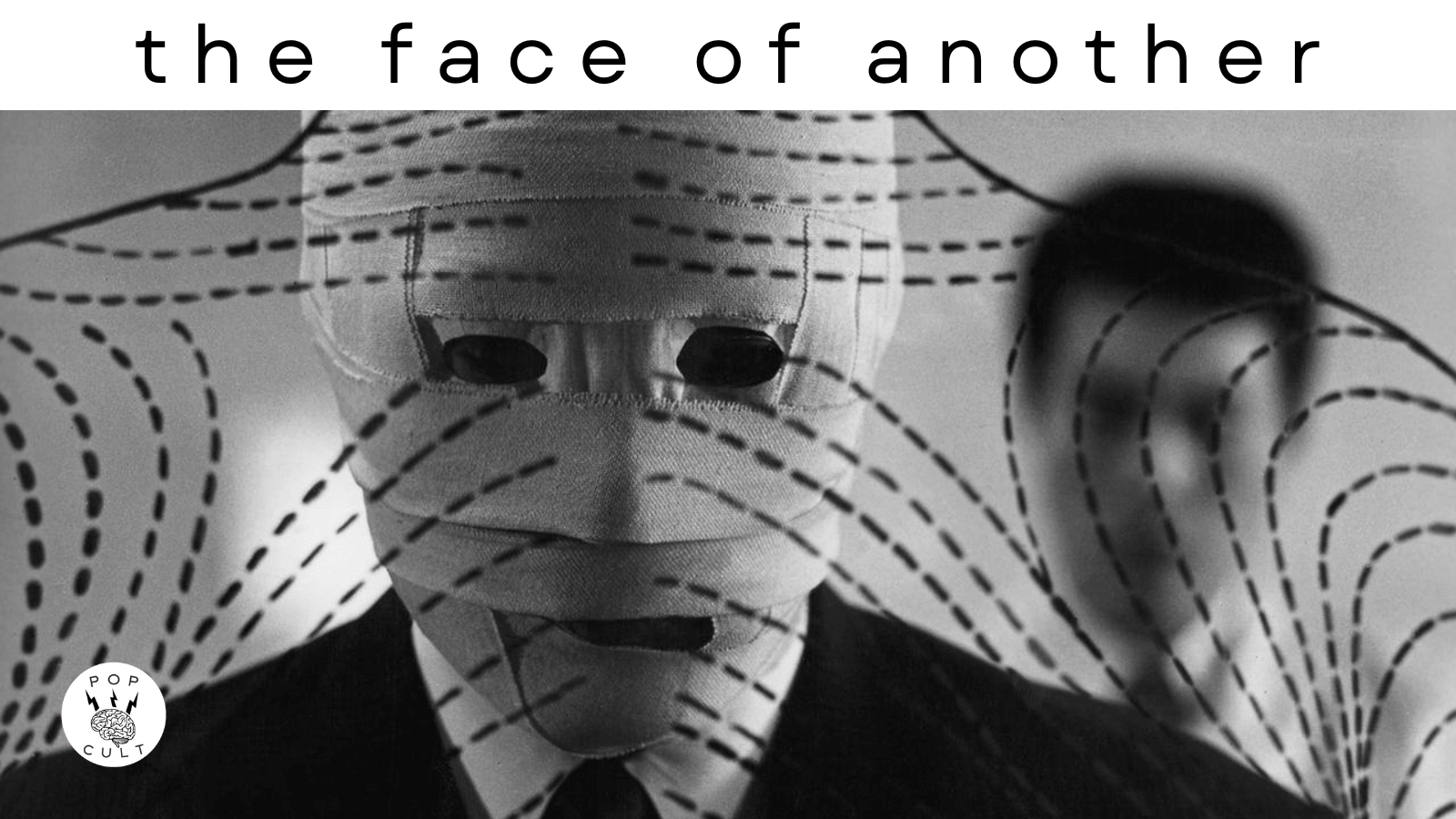
The Face of Another follows Mr. Okuyama, an engineer whose face was disfigured in an industrial accident. His face is covered in bandages that protect what remains of his face. This has led to a sense of isolation, and he has become increasingly moody. Okuyama’s psychiatrist wants to create a prosthetic mask in the hopes that his client will be able to re-enter society and become more emotionally balanced. To have a foundation for the mask, Okuyama and his doctor pay a man 10k yen to let his face be used as a mold.
Okuyama tells no one when the mask arrives and uses this new face to create a parallel life. He tells his wife he’s traveling for business while posing as a new person. The only person who seems to recognize him is the apartment superintendent’s mentally challenged daughter. Okuyama’s psychiatrist begins to imagine mass production of such masks leading to the elimination of all social morality. His client wants to take that idea further, and soon, things spiral out of control.
Throughout the whole film is a parallel story which never intersects with the main story. In Abe’s novel, this story is a film that Okuyama goes to see at the theater. There is a young woman who hides a facial disfigurement with her hair. She works with several WWII veterans in the psychiatric ward of a hospital and lives with her older brother. There’s a mention of them being from Nagasaki, which implies the burns may have been a result of the atomic bombing or perhaps some further consequence of that event. The Woman worries about another war breaking out and is just as isolated from the world as Okuyama. Her story remains its own but serves as a commentary on Okuyama’s.
The work of Teshigahara has thematic parallels with contemporaries like Antonioni or Bergman. They are less concerned with a narrative’s reality than the characters’ psychological burdens. This makes the piece work as much as horror as a straightforward drama. Teshigahara seems aware of this fact and leans into the horror drama with visual & thematic references to classic horror stories about identity – Dr. Jekyll and Mr. Hyde & The Invisible Man. Okuyama’s bandaged face and suit is a nod to that latter horror film about a man driven to madness as a result of his face being erased.
The strange, intense atmosphere is established from the opening credits. A warbly and sinister electronic score plays a variation on a waltz. The piece reminded me of the movie theme for The Addams Family, which surprised me. It’s a very spooky-sounding score that puts us in the mind of Okuyama. He does not see the world accurately; the music reflects that warped nature. Early on, we can hear audio from Hitler’s speeches, reminding us that the specter of WWII is still very potent. The film becomes an examination of trauma allowed to fester and twist so that it becomes something so rank with evil that there’s just nothing that can be done about it.
The way the film is shot adds to this disorientation. Images are flashed before our eyes at a remarkable rate at times. X-rays are shown. Sudden close-ups cause us to lose track of who we are looking at: jump cuts and sudden zooms. Intentionally stuttered editing makes us feel unsettled. Teshigahara also shoots in the 4:3 ratio, a throwback to a form that had fallen out of popularity with the sweeping vistas of formats like Cinemascope. It’s a mix of past and future forms, resulting in something that feels profoundly surreal.
Several sets are composed of glass walls with anatomical diagrams etched onto them. At once, this creates a sense of openness – we can see through everything and see everyone. Yet it is also disorienting. There’s no warmth to these spaces, only the cold, clinical sterility we associate with medical facilities, the aspect of those places that inspires so many to develop anxiety when contemplating having to go to the doctor or the emergency room. There’s a reflectivity that also adds to the layering of identity. Okuyama enters a room with dozens of him as a mirrored surface reflects another mirror.
It is this idea of doubles that leads to the tragic conclusion. Okuyama is empowered by having a new face and interacting with people who know him, preying on their lack of knowledge that he’s someone they know, work with, or are married to. The film I would pair this one with on a double feature would be John Frankenheimer’s Seconds. Beyond coming out the same year, they both deal with the ramifications of pushing aside the protagonist’s identity, replacing their face with new ones. It would seem a way to get away from past irreparable mistakes. However, when the protagonists face the reality of a new visage, it overwhelms them; their sense of self is fractured, and they fall into madness. The Face of Another is a gorgeous & thoughtfully made piece of psychological horror that should get more praise than it currently does.

 PopCult Reviews
One thought on “Movie Review – The Face of Another”