
Accattone (1961)
Written and directed by Pier Paolo Pasolini
Pier Paolo Pasolini was born in Bologna, Italy, in 1925. His mother was a primary school teacher, and his father was a lieutenant in the Royal Italian Army. A year later, Pasolini’s father was arrested for gambling debts, and his mother moved in with her family. In time, Pasolini’s father would embrace Italian fascism.
Meanwhile, his son began writing poetry at seven and divided deep into literature, enjoying Rimbaud, Shakespeare, Dostoyevsky, Coleridge, etc. The young man grew distant from his Catholic upbringing, eventually taking the label of atheist. In 1939, he enrolled at the University of Bologna and studied poetry & literature even more in-depth. He also began frequenting the cinema during these years. World War II arrived, and Pasolini was drafted into the Italian Army. After Italy’s surrender, he evaded capture from the Germans. He believed he was a fascist, influenced by his father and the society around him. But soon, after intense study and observation of the world around him. Pasolini came to realize communism was the way to liberate humanity.
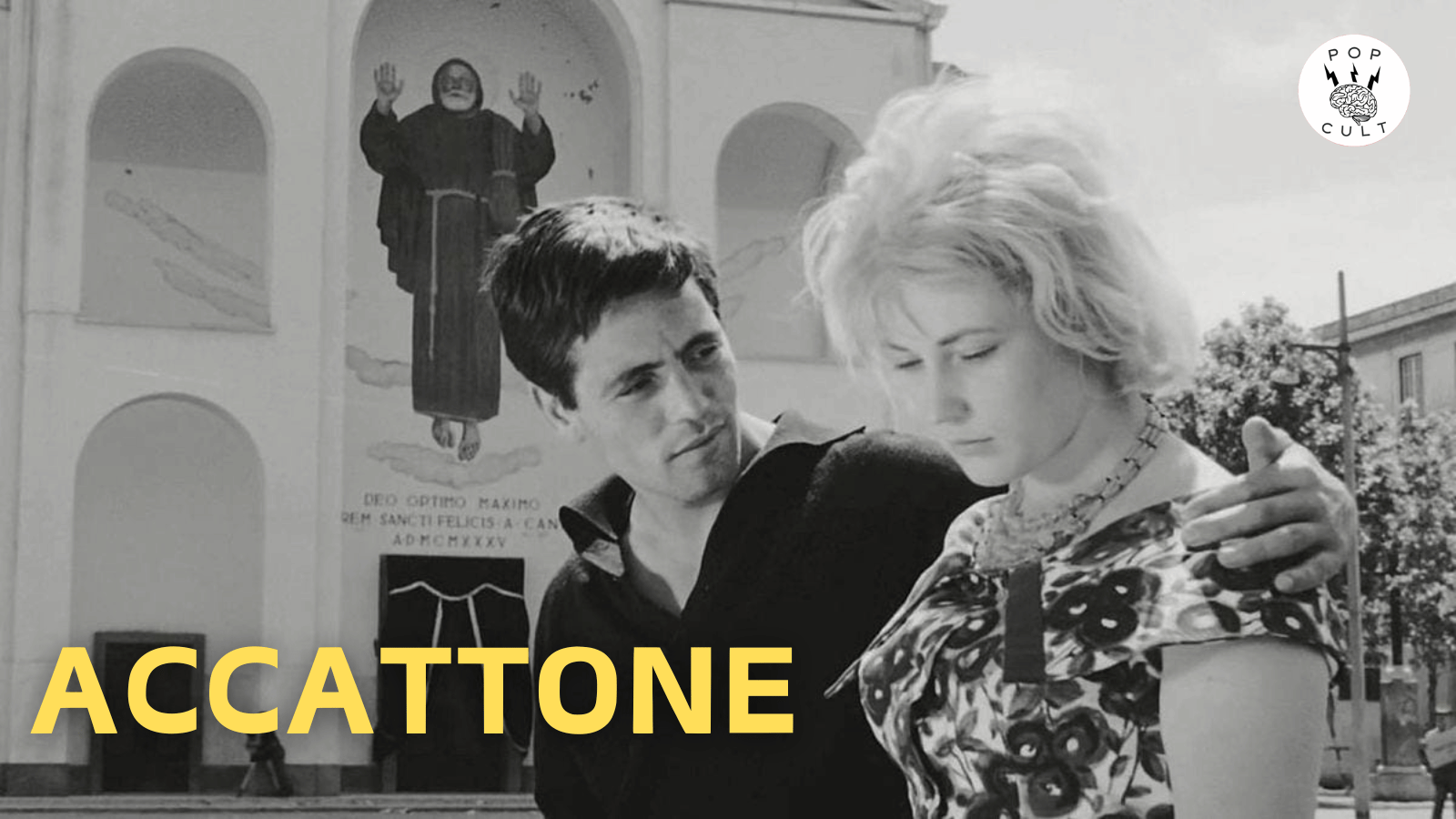
Vittorio (Franco Citti), nicknamed Accattone, is a pimp living on the outskirts of post-war Rome. His prostitute, Madelena (Silvana Corsini), is injured by a gang running their own sex work operation. She ends up in prison after it’s claimed she gave false testimony, leaving Accattone adrift without income. He tries to make good with the mother of his child, but she’s seen this song and dance before. No dice. Then, he meets Stella, a working-class young woman, and starts to coerce her into going into sex work. It doesn’t go well; a client mistreats her, and Accattone kicks her out of his car. He works for one day in an iron foundry. He begins having vivid dreams of his own death and falls into a theft as a way to make ends meet. It’s a life that won’t end well, a tragedy in a sea of them.
This was Pasolini’s debut feature after helping write Nights of Cabiria and La Dolce Vita with Federico Felllini. The director was almost forty, having spent most of his life writing poetry and painting. These skills become immediately evident in his cinematic work. You can see the pressure of neo-realism coming through; Accattone was one of Pasolini’s least fantastical features. The popular thing at the time was to tell stories of the working class, with Vittorio De Sica’s Bicycle Thieves being the movie that started it all. Pasolini pointed out at the time that so many prominent filmmakers in Italy were bourgeois Christian Democrats, which led them to have a weird parent-like view of the poor and working class. Pasolini did not see those forced to live on the bottom rungs of society in that way.
Pasolini desires to portray a more accurate view of Rome early in the picture. Accattone and his unemployed friends sit around tables at a cafe. The surroundings are a slum, not the grand architecture of the Roman Empire, but dingy little buildings and dirt roads. This feels removed from the Rome seen on cinema screens at the time. This is not Fellini’s nocturnal fantasia from La Dolce Vita. Pasolini knew what it was like there because he lived there among the post-war unemployed. He observed day-to-day life in these rundown neighborhoods quite closely. His actors were non-professionals, people from the neighborhood who knew the roles. The director chose to often shoot his actors in medium close-ups; he found immense inspiration in faces. Sometimes, all we can see of them are their eyes.
Pasolini would talk about “im-signes”, a cinematic counterpart to Roland Barthes’s “lin-signes.” This meant that images we see in movies, no matter how “realistic” we judge them to be, are symbolic. What we call “neo-realism” is more unreal than it appears. It’s a condensation of ideas and concepts into images. Pasolini insisted that real objects are transformed by the camera, which means you didn’t require massive budgets for special effects to get the intent across. You simply had to understand the language of images, and you could evoke any sensation you wanted. It’s through this that he transforms the story of Accattone, a street hustler, into one of a religious saint.
Pasolini was an atheist, yet he accepted the imagery and ideas of Catholicism. He saw them as embedded in the cultural makeup of Rome. In this way, they lost their power as a driving force of morality in his life; they were ways to understand the people around him. He was a homosexual, and that gave him a perspective that was quite different from the straight male Italian directors. Homoeroticism was embraced in his work and often paired with religious images. He claimed to have a religious sense of life, which is something to unpack as we work through his films.
What happens to Accattone is a religious martyrdom, a transformation, through death, into a saint. He keeps trying to reinvent himself but proves unsuccessful at every turn. Working-class and poor people engage in this dance every day. We try to figure out an identity, often through our labor, that will provide a shorthand for others to understand who we are. In Accattone’s dream, we get a very slight peek at what we could become, but we are not permitted to see it when the end credits roll. Pasolini says that we can transform into something glorious, yet it can’t happen in life, only death. The underclass is unable to escape their plight until they die, making them a mass of saints. This is all accomplished with Pasolini’s trademark silence, very little dialogue, and an emphasis on the images, yet we can hear them speak.
If the film’s message escapes the audience, Pasolini has ensured it will get through with music associated with the Church. Bach’s works are all over the picture. Accattone’s dream involves music, a church bell ringing, a crash, and heavy breathing. All of these return in the film’s conclusion, providing context. The fact that our protagonist experiences these sounds before they actually happen lifts the film away from strict realism and into the realm of something else. Each woman with whom Accattone spends time comes to represent aspects of life and his wrong choices, but it’s too late to change them. Characters often speak like prophets, adding to the religious nature of the picture.
Accattone is about lifting religious iconography away from association only with the Church and as representative of the human experience. This will not be Pasolini’s only foray into this territory; in a couple of reviews, we’ll be taking a look at his Catholic Church-endorsed The Gospel According to St. Matthew, where Jesus is reimagined as a peasant revolutionary, and Pasolini draws connections between his teachings and communism. Through these movies, a new gospel of sorts is being fashioned, a testament to the post-war world of those who have spent generations struggling at the bottom of life being shown as glorious and worthy of epic stories.

 PopCult Reviews
2 thoughts on “Movie Review – Accattone”